How Pune Educational Institutes Can Increase Admissions Through SEO
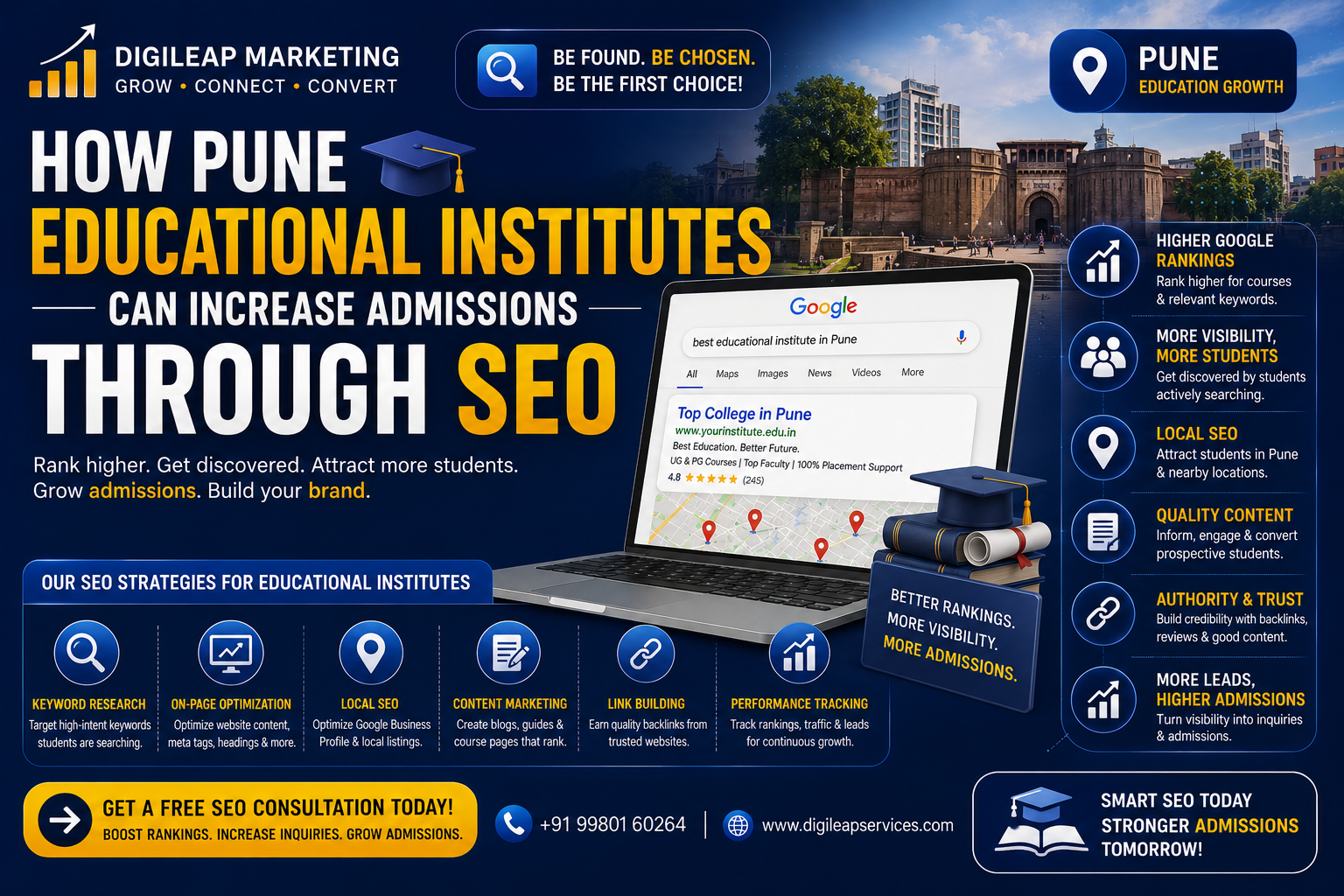
Educational institutes in Pune operate in a highly competitive environment. Students and parents now spend considerable time researching courses, colleges, coaching centres, schools, fees, faculty, placements, reviews, and facilities before making an admission decision. Therefore, being visible when these searches happen can directly influence enquiries and applications. A well-planned Education SEO Pune strategy helps institutes appear in front of students who are already looking for relevant educational opportunities. Instead of depending only on traditional advertising, institutes can use search visibility to attract qualified prospects, build trust, and create a steady flow of admission enquiries.
Why SEO Matters for Pune Educational Institutes
The admission journey rarely starts with a phone call. Instead, it often begins with a Google search. A student may search for “best MBA colleges in Pune,” while a parent may look for “CBSE schools in Pune” or “best coaching classes near me.” Similarly, students can search for course-specific information such as fees, eligibility, placements, entrance exams, and career opportunities.
This behaviour makes search engines an important part of the decision-making process. In fact, a 2025 report based on 23 million student leads found that digital channels accounted for 71.78% of student leads and 61.55% of total enrolments in India. This statistic shows why educational institutes cannot afford to treat their online visibility as an afterthought.
With Education SEO Pune, institutes can target searches that match their courses, location, audience, and admission goals. Moreover, organic search can continue attracting potential students after the initial optimization work, unlike a paid campaign that stops delivering traffic when its budget ends.
Target High-Intent Education Keywords
The first step is understanding what prospective students actually search for. Instead of targeting only broad terms such as “college” or “education,” institutes should identify keywords connected to specific admission needs.
For example, a Pune institute could target phrases related to courses, locations, fees, eligibility, placements, entrance examinations, and admissions. Searches such as “BBA colleges in Pune,” “engineering college admission Pune,” “best coaching institute in Pune,” or “MBA course fees Pune” reveal stronger intent than generic searches.
Keyword research should also consider different stages of the student journey. Informational searches may include questions about course options, while commercial searches may compare institutions. Finally, transactional searches often involve admission forms, application deadlines, fees, or campus visits.
Therefore, an effective Education SEO Pune campaign should create content for every stage rather than focusing on one keyword category. This approach helps an institute attract students early, educate them during their research, and guide them towards an enquiry or application.
Build Dedicated Pages for Courses and Admissions
A common SEO problem among educational websites is putting too much information on one page. A student searching for an MBA programme should not have to navigate through several unrelated pages before finding the course details.
Instead, every major programme should have a dedicated, optimized landing page. The page should clearly explain the course structure, eligibility criteria, duration, fees, faculty, career opportunities, placement information, admission process, and important dates.
Furthermore, the page should answer the questions students commonly ask before applying. Clear headings, short paragraphs, relevant images, internal links, FAQs, and strong calls to action can make the page easier to understand.
The admission page should also provide a straightforward next step. Whether the goal is to submit an application, download a prospectus, book counselling, request a callback, or visit the campus, the action should be easy to find.
Strengthen Local SEO in Pune
Location is extremely important for educational institutes because students often prefer institutions that are accessible from their homes. Consequently, local search optimization should be an important part of the strategy.
Institutes should maintain an accurate Google Business Profile with the correct name, address, phone number, website, category, operating hours, photographs, and other relevant information. Regularly adding genuine updates and responding to reviews can also strengthen the institute’s local presence.
Website content should naturally mention relevant Pune locations where appropriate. For example, an institute may create useful pages covering areas around its campus, transportation options, nearby facilities, or student accommodation. However, keyword stuffing should be avoided because repetitive location phrases can make content difficult to read.
Local SEO also helps institutes compete for searches that include phrases such as “near me” or specific Pune neighbourhoods. As a result, students who are already looking for nearby educational options can discover the institute more easily.
Create Content Around Student Questions
Educational SEO should not be limited to course pages. Students have hundreds of questions before they make a decision, and useful content can bring those searches to an institute’s website.
A Pune college could publish articles explaining how to choose a course, what students should consider before applying, how entrance examinations work, what career opportunities different programmes offer, and how to prepare for admission interviews. Similarly, coaching centres can create study guides, examination preparation resources, subject explanations, and career-focused content.
This content serves two purposes. First, it can attract organic traffic from people searching for answers. Second, it positions the institute as a helpful and knowledgeable source.
For instance, a student searching for “how to choose an MBA specialization” may not be ready to apply immediately. However, after reading a useful guide, that student may explore the institute’s MBA programmes, faculty profiles, placement information, and admission process. In this way, informative content can gradually move users towards conversion.
Showcase Results, Faculty and Student Experiences
Students and parents want evidence before trusting an educational institution. Therefore, SEO content should support credibility rather than simply focus on keywords.
Institutes can showcase faculty expertise, student achievements, examination results, placement outcomes, awards, campus activities, research projects, internships, and alumni experiences. Real photographs and authentic student stories can make this information more convincing.
At the same time, institutes should avoid unsupported claims. If an institution promotes placement statistics or academic results, it should clearly explain the relevant year, methodology, and source. Transparency builds stronger trust and can also support the credibility of the website.
This is especially important because students often compare multiple institutions before applying. A website that clearly demonstrates its strengths can make the decision easier.
Improve Website Speed and Mobile Experience
SEO is not only about keywords and content. Website experience also matters. Students frequently research courses using smartphones, so an educational website must work smoothly on smaller screens.
Pages should load quickly, menus should be easy to use, and important information should not be hidden behind unnecessary pop-ups. Admission forms should also be simple. If a prospective student struggles to complete a form on mobile, the institute may lose an otherwise valuable enquiry.
The same principle applies to navigation. Course pages, admission details, fees, contact information, and enquiry options should be easy to locate. Moreover, broken links, outdated pages, duplicate content, and technical errors should be fixed regularly.
A strong Education SEO Pune strategy therefore combines search optimization with a user-friendly website. Ranking well is valuable, but the website must also convince visitors to stay, explore, and take action.
Use FAQs to Capture Long-Tail Searches
Students often search using complete questions rather than short keywords. Therefore, FAQ sections can help educational institutes address specific search intent.
An institute can answer questions about eligibility, application deadlines, fees, scholarships, entrance examinations, hostel facilities, placements, course duration, documents required, and admission procedures. These answers should be written naturally and should provide genuinely useful information.
For example, instead of simply stating “MBA admission Pune,” an institute could answer a question such as “What documents are required for MBA admission in Pune?” This creates a more useful resource while also targeting a long-tail search.
FAQ content can also reduce uncertainty. When students find clear answers on the official website, they may be more likely to submit an enquiry rather than leave the website to search elsewhere.
Build Authority Through Quality Links
Search visibility can also improve when reputable and relevant websites reference an educational institute. However, institutes should focus on quality rather than collecting large numbers of low-value links.
For example, universities, educational publications, local organizations, alumni networks, event websites, industry associations, and reputable education platforms may provide legitimate opportunities for relevant mentions.
Institutes can also earn links by publishing original research, student achievement stories, useful educational resources, scholarship guides, or reports about local education trends. Additionally, participating in legitimate academic events and community initiatives can create opportunities for online coverage.
The objective should not simply be to obtain backlinks. Instead, the institute should create something useful enough that other relevant websites have a reason to reference it.
Connect SEO With Admissions Tracking
SEO becomes much more valuable when institutes measure what happens after a visitor arrives. Website traffic alone does not guarantee more admissions.
Institutes should monitor organic traffic, course-page visits, enquiry form submissions, phone calls, brochure downloads, counselling requests, and completed applications. These metrics can reveal which pages and keywords attract high-quality prospects.
For example, if a particular course page receives significant organic traffic but very few enquiries, the problem may not be visibility. The page may need clearer information, stronger calls to action, better trust signals, or a simpler enquiry process.
Similarly, if a blog receives many visitors but generates no relevant leads, the institute can examine whether the content matches its admission goals. Over time, this data allows the SEO strategy to become more focused and efficient.
Use SEO Alongside Other Digital Channels
SEO should not operate in isolation. Educational institutes can combine organic search with Google Ads, social media, email marketing, video content, remarketing, and online events.
For example, SEO may attract a student searching for a specific course. That visitor could then see a webinar invitation, watch a faculty video, download a prospectus, or receive a follow-up message after submitting an enquiry.
This integrated approach creates multiple opportunities for engagement. Furthermore, content created for SEO can often be reused across social media, email newsletters, videos, and admission campaigns.
Institutes looking to build a broader digital strategy can also explore Digileap India’s digital marketing resources for educational institutes, which covers website optimization, SEO, paid advertising, email marketing, webinars, and analytics.
Keep Admission Information Fresh
Education websites often contain outdated information. Old admission dates, previous-year fees, expired scholarship announcements, and incorrect course details can damage trust.
Therefore, institutes should review important pages before every admission cycle. Course fees, eligibility criteria, application deadlines, entrance requirements, faculty information, placement data, and contact details should be checked and updated.
Fresh content also gives search engines and users a reason to return. For example, an institute can update its annual admission guide with new dates, current requirements, recent achievements, and updated FAQs.
This matters particularly in Pune, where students have many institutions to compare. Accurate and current information can help an institute stand apart from competitors whose websites appear neglected.
Build a Long-Term SEO Strategy
SEO rarely produces its strongest results overnight. Educational institutes should therefore treat it as a long-term admissions asset rather than a short campaign.
The strategy should begin with technical improvements and keyword research. Next, institutes can build course pages, local landing pages, useful blogs, FAQs, and credibility content. After that, they can strengthen authority through relevant mentions and continuously improve pages based on performance data.
Consistency is important. Search behaviour changes, new courses launch, admission requirements evolve, and competitors publish new content. Consequently, an institute must review its strategy regularly.
The goal of Education SEO Pune is not simply to achieve a higher ranking for one keyword. It is to build strong visibility across hundreds of searches that prospective students use throughout their decision-making journey.
Conclusion
Pune’s educational market is competitive, but institutes can create a stronger admissions pipeline by becoming easier to find online. A focused SEO strategy can help attract students, answer their questions, build trust, and turn relevant website visitors into enquiries.
By combining local SEO, course-focused pages, useful content, technical optimization, credibility signals, and conversion tracking, educational institutes can build sustainable search visibility. Most importantly, they can reach prospective students at the exact moment they are actively researching their next educational opportunity.
TL;DR
Educational institutes in Pune can increase admissions by optimizing their websites for high-intent searches, creating dedicated course pages, strengthening local SEO, publishing useful student-focused content, showcasing genuine results, improving mobile performance, answering FAQs, earning quality links, and tracking enquiries and applications. A consistent Education SEO Pune strategy can turn search visibility into a reliable source of qualified admission opportunities.