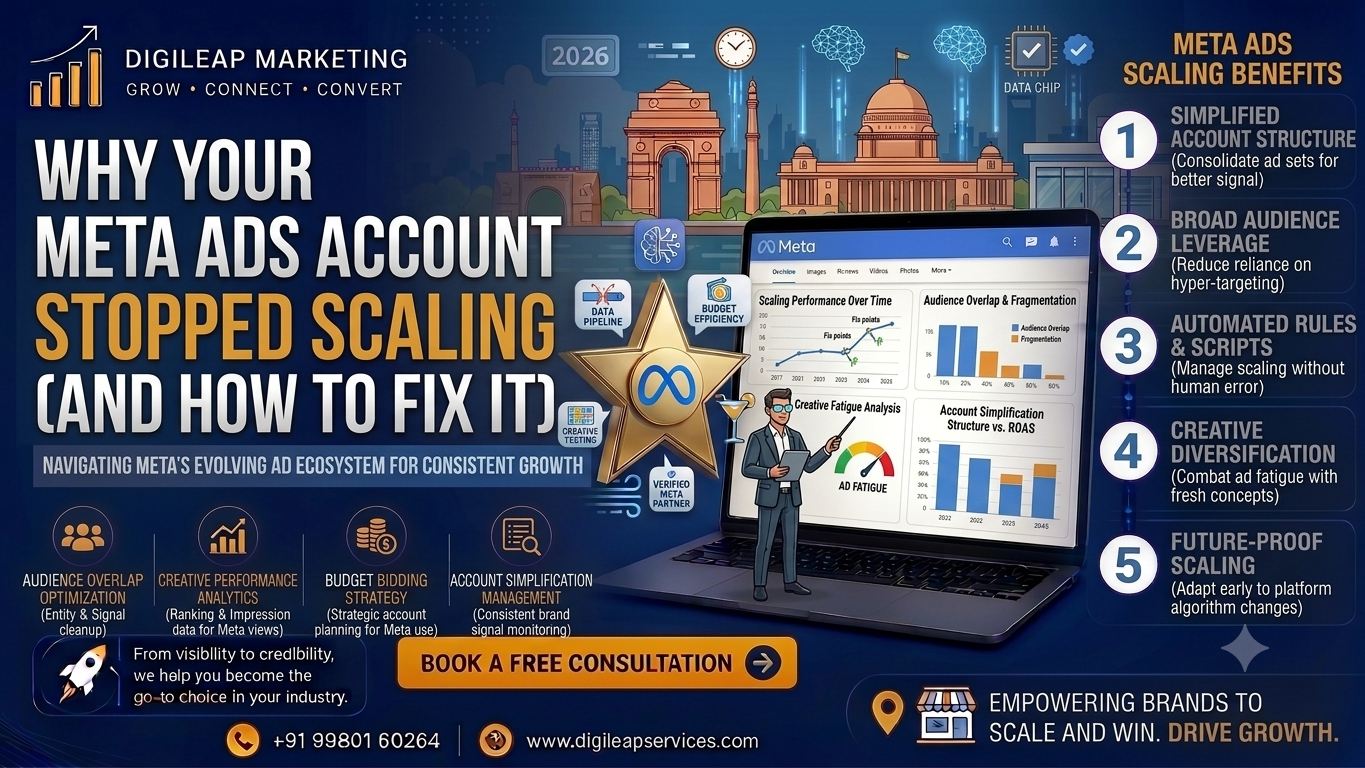
Why Your Meta Ads Account Stopped Scaling (And How to Fix It)
Scaling a Meta Ads campaign sounds simple: increase the budget, reach more people, generate more conversions, and grow revenue. However, many advertisers discover that performance starts dropping as soon as they try to spend more. Costs rise, conversions slow down, and the once-profitable campaign suddenly feels difficult to control. These are common Facebook ad scaling issues, especially when a campaign depends too heavily on one audience, one creative, or one winning ad.
The good news is that a stalled Meta Ads account does not always mean the campaign has failed. Often, the campaign has simply reached a point where its existing structure cannot support additional spending. Meta’s advertising ecosystem is enormous. In the second quarter of 2026, Meta reported an average of 3.60 billion daily active people across its family of apps, while ad impressions increased 14% year over year. That creates a huge opportunity, but it also means advertisers need a smarter approach to scaling.
Understanding what causes Facebook ad scaling issues is therefore essential. Instead of repeatedly increasing budgets and hoping for better results, advertisers need to identify the bottleneck, protect campaign stability, improve creative variety, and give Meta enough quality signals to find additional customers.
Your Campaign May Have Reached Its Audience Limit
One of the most common reasons an account stops growing is audience saturation. A campaign can perform extremely well when it first launches because Meta has plenty of potential customers who have not yet seen the ads. As spending increases, however, the platform may show ads to the same people more frequently.
This can gradually reduce engagement. People who previously clicked may stop responding. Existing customers may see acquisition ads repeatedly. Your frequency can rise while click-through rates fall. Consequently, your cost per result starts increasing.
This is particularly common when advertisers use very narrow interests, small geographic areas, or highly restricted custom audiences. A small audience can work well at a lower budget, but the same audience may not support significantly higher spending.
Before increasing your budget again, look at frequency, CPM, CTR, conversion rate, and audience size together. If frequency is rising while CTR and conversion rates are declining, audience saturation could be one of the biggest Facebook ad scaling issues affecting your account.
The solution is not always to abandon the campaign. Instead, consider expanding your audience, testing broader targeting, introducing new creative angles, and allowing Meta more room to find people who resemble your existing converters.
Increasing the Budget Too Quickly Can Hurt Performance
Another major reason campaigns stop scaling is aggressive budget increases. When an advertiser finds a campaign producing consistent results, the natural reaction is to increase the daily budget significantly.
However, doubling or tripling the budget overnight can change how the system spends money and where it finds impressions. A campaign that performs well at one spending level may not maintain the same efficiency at a much higher level.
For example, imagine a campaign spending ₹5,000 per day and generating profitable leads. Increasing it immediately to ₹20,000 per day does not guarantee four times the number of leads at the same cost. The campaign now needs to spend much more money to access additional opportunities.
Instead, scale gradually when performance is stable. Monitor your cost per result, conversion volume, CPM, CTR, and return on ad spend after each meaningful adjustment. This gives you a clearer understanding of whether the campaign can absorb additional budget.
The goal is not simply to spend more. The goal is to spend more efficiently.
Your Creative Has Probably Become Tired
Creative fatigue is another major factor behind Facebook ad scaling issues. An ad can be excellent when you launch it and ineffective several weeks later.
Why? Your audience has already seen the message.
Even if Meta continues finding impressions, people may become less interested in the same hook, image, video, offer, or headline. As a result, engagement can decline while costs increase.
Creative fatigue does not necessarily mean your product or offer is weak. Sometimes, you simply need to present the same value proposition from a different perspective.
For example, instead of repeatedly saying, “Get 30% off today,” you could create a customer testimonial, demonstrate the product, explain a common problem, answer an objection, show the product in use, or compare the product with an alternative.
Meta itself encourages advertisers to explore creative options and notes that Advantage+ creative can help optimise Reels ads. Therefore, creative diversification should become an ongoing part of your scaling strategy rather than something you do only after performance declines.
Your Winning Ad Cannot Carry the Entire Account
Finding one winning ad feels great. The problem starts when you expect that one ad to generate all your future growth.
A winning creative can eventually become a limitation. If your entire campaign depends on one video or one image, performance becomes vulnerable to fatigue. When that creative weakens, the entire campaign can suffer.
Instead, build a creative system around your winner.
Take the core idea that works and create several variations. Change the opening hook, visual structure, offer presentation, testimonial, CTA, length, or problem statement. You do not need to completely reinvent your message every time.
For instance, if a product demonstration performs well, create another version focused on the problem it solves. Then create a customer-story version. After that, create a short-form version designed for Reels. This gives Meta more creative opportunities while allowing you to preserve the core message that already works.
Meta’s own advertising resources highlight creative testing as a way to understand which design choices perform better.
Your Audience Strategy May Be Too Narrow
Many advertisers believe better targeting means targeting fewer people. That approach can work in some situations, but excessive restrictions can prevent Meta from finding new customers.
If you specify too many interests, behaviours, exclusions, locations, age ranges, and other limitations, you may create an audience that looks perfect on paper but becomes difficult to scale in practice.
This is especially important when your campaign already has strong conversion data. Meta can use those signals to identify people who are more likely to complete your desired action.
Instead of constantly adding more targeting restrictions, test broader audiences. Give the algorithm room to explore. Compare broader targeting with your existing setup and evaluate performance based on actual conversions rather than assumptions about who should buy.
Of course, broader targeting does not mean abandoning strategy. Your creative, offer, landing page, and conversion event still need to communicate clearly with the right customer.
Your Landing Page Could Be the Real Problem
Sometimes advertisers blame Meta when the real problem happens after the click.
Imagine your campaign has a strong CTR, reasonable CPC, and plenty of traffic. Yet conversions remain low. In that situation, increasing the ad budget will only send more people to a page that fails to convert.
Your landing page should match the promise made in your advertisement. If your ad promotes a specific offer but the visitor lands on a generic homepage, confusion can immediately reduce conversions.
Page speed, mobile usability, trust signals, pricing clarity, product information, testimonials, forms, and checkout experience can all influence conversion performance.
Therefore, when diagnosing Facebook ad scaling issues, look beyond Ads Manager. Compare your ad clicks with landing-page views, engagement, leads, purchases, and actual revenue. The weakest step in the customer journey may be somewhere outside Meta.
Your Conversion Tracking Needs Attention
Scaling decisions depend on reliable data. If Meta receives incomplete, delayed, duplicated, or inaccurate conversion signals, optimization can become more difficult.
Check whether your Pixel and Conversions API are configured correctly. Review your events and make sure the primary conversion event reflects the business outcome you actually want.
For an e-commerce brand, that may mean purchases rather than add-to-cart events. For a service business, it could mean qualified leads rather than simple form submissions.
Also compare Meta’s reported conversions with your CRM, website analytics, payment platform, or sales records. Differences can occur because platforms use different attribution and reporting methods, but large unexplained gaps deserve investigation.
Better tracking does not automatically make a campaign profitable. However, poor tracking can make good campaigns look bad and bad campaigns look better than they actually are.
Your Offer May Not Be Strong Enough to Scale
Advertising can amplify demand, but it cannot permanently compensate for a weak offer.
At a small budget, a decent offer might still generate sales because you are reaching the easiest customers first. As you scale, you need to persuade people who are less familiar with your brand or less immediately interested in buying.
That means your offer needs to answer an important question: Why should someone choose you now?
The answer could involve pricing, convenience, a bundle, a guarantee, free shipping, a limited-time incentive, a strong product benefit, social proof, or a clear differentiation from competitors.
If your CPM increases slightly but your offer converts exceptionally well, the campaign can remain profitable. Conversely, even cheap traffic becomes expensive when the offer does not create enough demand.
You May Be Optimising the Wrong Metric
Another reason advertisers experience Facebook ad scaling issues is that they focus on surface-level metrics.
A low CPC can look impressive, but cheap clicks do not necessarily create revenue. Similarly, a high CTR does not automatically mean that a campaign is successful.
Instead, connect advertising metrics to business outcomes.
If you generate leads, measure qualified leads and sales rather than only form submissions. If you sell products, measure purchases, contribution margin, customer acquisition cost, and revenue rather than only clicks.
This becomes even more important as spending increases. At scale, small changes in conversion rate can have a significant impact on profitability.
For example, a campaign that generates 100 conversions at a ₹500 cost per conversion may look healthy. But if increasing the budget causes the cost per conversion to rise to ₹800, the additional volume may not be worth the additional spend.
Scaling should therefore be judged by profitable growth, not vanity metrics.
Build a Better Testing System
You cannot solve scaling problems by making random changes every day. You need a structured testing process.
Test one major variable at a time when possible. You might test creative concepts first, then audience strategy, then offers, then landing pages. This makes it easier to understand what actually caused performance to change.
For creative testing, compare different hooks, formats, messages, and visual approaches. For landing pages, test headlines, social proof, forms, product presentation, and CTAs. For offers, compare different bundles, incentives, or pricing structures.
Most importantly, give tests enough data before making a decision. Ending every experiment after a few hours because one version is temporarily ahead can lead to poor conclusions.
A structured testing process creates a growing library of knowledge. Over time, you learn which messages attract attention, which offers generate conversions, which audiences respond best, and which creatives can support additional spending.
Scale Horizontally Instead of Only Increasing Budgets
One of the smartest ways to overcome Facebook ad scaling issues is to think beyond vertical scaling.
Vertical scaling means increasing the budget on an existing campaign. Horizontal scaling means creating additional opportunities for growth.
You can expand into new creative concepts, new customer segments, new geographic markets, new products, new placements, or new funnel stages.
For example, an e-commerce business could run prospecting campaigns for new customers while separately building campaigns for people who engaged with the brand. It could also introduce new products to existing customers.
This creates multiple growth paths instead of forcing one campaign to carry the entire business.
However, avoid creating dozens of tiny campaigns without a clear purpose. Excessive fragmentation can make budgets too thin and complicate analysis. Your structure should remain simple enough to manage while still giving you room to test meaningful opportunities.
Give Your Campaign a Stronger Funnel
Scaling becomes easier when your entire customer journey works together.
Cold audiences need a reason to stop scrolling. Interested prospects need reasons to trust your brand. Warm audiences need a reason to act. Existing customers need reasons to buy again.
Your Meta strategy should therefore connect these stages rather than treating every audience exactly the same.
Your prospecting ads can focus on awareness, pain points, benefits, demonstrations, and customer stories. Your retargeting ads can address objections, provide proof, highlight offers, or remind people about products they considered.
When each stage has a clear purpose, you can grow the account without relying entirely on repeated direct-response ads.
Know When to Stop Scaling a Campaign
Not every campaign should be scaled.
Sometimes the correct decision is to reduce spending or shut down an underperforming campaign. If creative testing fails, conversion rates remain weak, the offer cannot compete, or customer acquisition costs stay above your profitable threshold, throwing more money into the campaign will not solve the underlying problem.
Instead, take the data and use it to build something better.
Look at which audiences responded, which creatives generated qualified traffic, which objections appeared repeatedly, and where prospects dropped out of the funnel. Then use those insights in the next campaign.
A failed campaign can still provide valuable information.
How to Fix a Stalled Meta Ads Account
When performance stops improving, start with diagnosis rather than panic. Review your account at the campaign, ad set, ad, audience, website, and conversion levels.
Check whether frequency has increased. Look for declining CTR. Review CPM and CPC changes. Compare conversion rates before and after the performance decline. Examine your landing page. Verify your tracking. Review your offer. Finally, look at creative fatigue.
Once you identify the bottleneck, make the smallest sensible change first.
If creative fatigue is the issue, introduce new concepts. If the audience is saturated, test broader targeting. If the landing page is weak, improve the conversion experience. If tracking is inaccurate, fix the measurement system. If the offer is weak, strengthen the value proposition.
This approach is far more reliable than changing five things simultaneously and hoping performance returns.
For businesses that need a wider digital strategy alongside paid advertising, Digileap India offers services across paid advertising, SEO, social media marketing, lead generation, and other digital channels. Its website reports experience with paid advertising across Facebook, Instagram, Google, YouTube, and other platforms, making an integrated approach useful when paid campaigns need support from the wider marketing funnel.
Final Thoughts
Meta Ads can scale, but profitable scaling requires more than increasing the daily budget. When performance stalls, the real problem may be audience saturation, creative fatigue, weak conversion tracking, a poor landing page, an ineffective offer, or an account structure that cannot support additional spending.
The key is to treat scaling as a continuous optimisation process. Test new creative ideas, expand carefully, monitor business-level metrics, improve the customer journey, and let reliable conversion data guide your decisions.
Ultimately, the best way to overcome Facebook ad scaling issues is to build a system that can continuously generate new audiences, new creative angles, stronger offers, and better conversion signals. When those pieces work together, scaling becomes less about forcing a campaign to spend more and more about creating the conditions for sustainable growth.
TL;DR
Meta Ads often stop scaling because the audience becomes saturated, creatives become repetitive, budgets increase too quickly, conversion tracking becomes unreliable, or the landing page and offer cannot support additional traffic. Instead of simply increasing spend, diagnose the bottleneck, refresh your creative, broaden audiences carefully, strengthen your offer, improve tracking, and measure profitability rather than clicks alone. Sustainable Meta growth comes from building multiple paths to acquire and convert customers.