How Google AI Overviews Change SEO for Indian Businesses in 2026
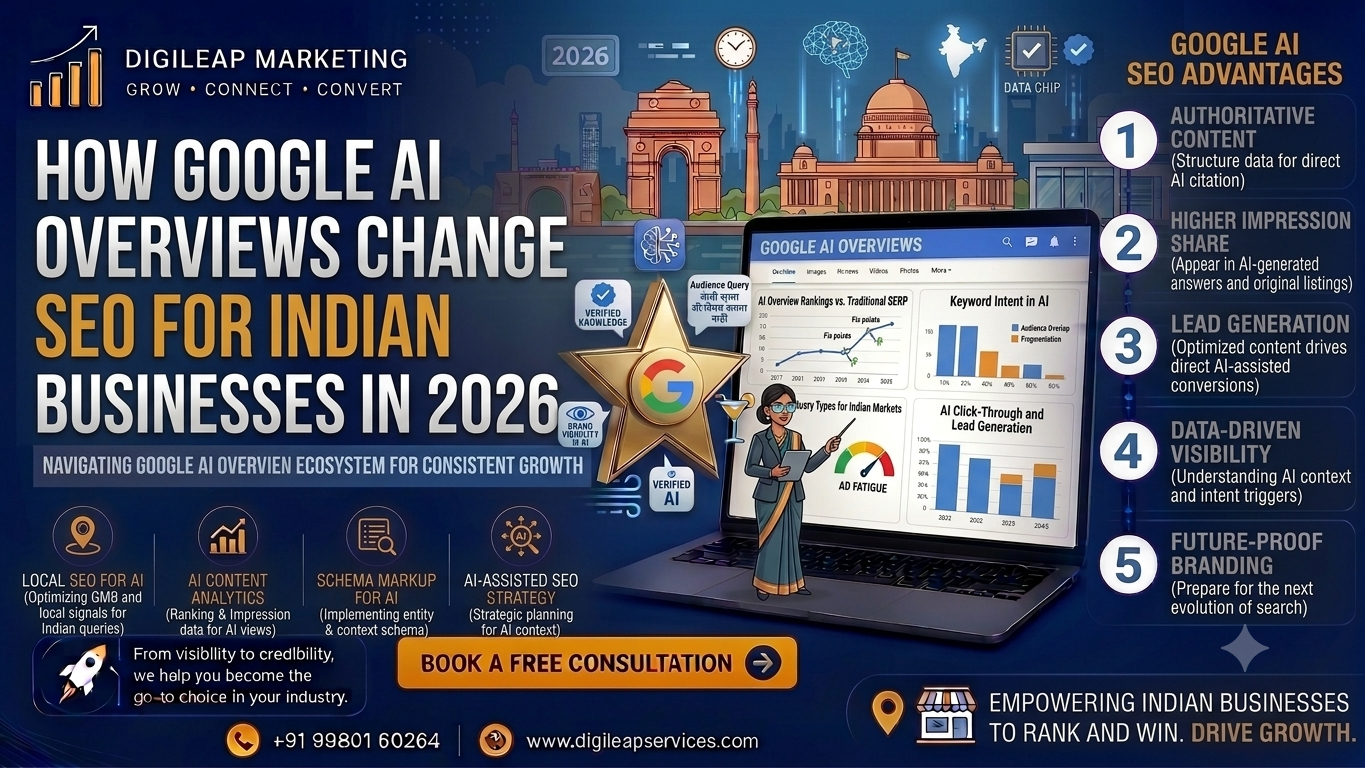
Google Search is changing fast, and Indian businesses can no longer rely only on traditional blue-link rankings to attract customers. As search becomes more conversational and AI-generated answers become more common, brands need to rethink how they create, structure, and measure their online content. This is where an effective AI overviews SEO strategy becomes important. Instead of focusing only on ranking for individual keywords, businesses now need to create useful content that Google can understand, trust, and potentially use when generating AI-powered answers.
The change is already significant. Google reported in 2026 that AI Overviews had reached more than 2.5 billion monthly active users globally. For Indian companies, this means AI-powered search is no longer a distant development. It is becoming part of the way customers discover information, compare brands, research products, and make purchasing decisions. Therefore, businesses that adjust their SEO approach now can build stronger visibility as search continues to evolve.
AI Overviews Are Changing the Search Journey
Traditional Google searches usually followed a simple pattern. A person typed a keyword, reviewed a list of websites, clicked one or two results, and then decided what information was useful. AI Overviews can change that journey by providing an AI-generated summary directly within the search results, followed by links to relevant sources.
As a result, users may not always begin their journey by clicking the first organic result. Instead, they may read the overview, explore supporting links, ask a follow-up question, and then visit a website when they need more detailed information. Consequently, businesses must think beyond rankings and consider how their content contributes to the entire search journey.
Google has also expanded AI-powered search experiences in India. AI Mode was introduced to Indian users with support for complex, longer questions, follow-up searches, voice interactions, and visual search. Google reported that early AI Mode testers were asking queries two to three times longer than traditional searches. This shift makes it increasingly important for Indian businesses to understand customer questions rather than simply target short keywords.
Why Traditional SEO Still Matters
The arrival of AI Overviews does not mean traditional SEO is dead. In fact, the opposite is true. Strong technical SEO, useful content, crawlability, internal linking, structured information, and authority continue to provide the foundation for visibility.
Google’s guidance makes this clear. Websites do not need a completely separate technical system just to appear in AI search features. Existing SEO best practices remain relevant because AI-powered Search still needs to discover, understand, and evaluate web content.
Therefore, an AI overviews SEO strategy should build on existing SEO rather than replace it. Indian businesses should continue improving their websites while also adapting content for more conversational and complex searches.
For example, a dental clinic should not create a page simply targeting “dentist Mumbai.” Instead, it could answer questions such as how much a dental implant costs, what happens during the procedure, how long recovery takes, and how patients can choose the right treatment. Similarly, an Indian e-commerce company can create detailed product comparisons, buying guides, sizing information, and practical answers to common customer concerns.
The goal is to become useful across several stages of the customer’s research process.
Search Intent Is Becoming More Important
Keywords still matter, but search intent matters even more. AI-powered search can understand relationships between words, concepts, questions, and topics. Therefore, businesses should stop treating every keyword as an isolated target.
Consider a customer searching for “best skincare clinic in Delhi.” That query may represent several underlying questions. The customer could want to compare treatments, understand prices, check reviews, evaluate expertise, or find a clinic nearby.
An effective AI overviews SEO strategy should therefore cover the broader topic instead of producing one shallow page for every keyword variation. Content should answer related questions naturally and provide enough context for both users and search systems.
Transitioning from keyword-focused writing to intent-focused content also makes pages more valuable. When businesses understand what customers are trying to accomplish, they can create content that supports real decisions rather than simply chasing search volume.
Create Content That Adds Original Value
AI can generate generic explanations quickly. Consequently, publishing another basic article that repeats information already available online may not give a business a strong competitive advantage.
Instead, Indian businesses should provide original information, practical experience, expert opinions, examples, comparisons, case studies, customer questions, and useful data. This approach gives Google more reasons to consider a website a valuable source.
For instance, a financial services company could explain common mistakes Indian investors make when comparing financial products. A healthcare business could answer patient questions using insights from qualified professionals. A local service provider could explain real pricing factors, timelines, common problems, and regional considerations.
This is particularly important because Google’s guidance encourages websites to provide unique, non-commodity content rather than content created simply to manipulate search rankings.
In other words, businesses should ask a simple question before publishing: “What does this page offer that another website does not?”
Local SEO Has a Bigger Role to Play
Local businesses should pay close attention to this development because customers increasingly use detailed searches to find nearby services. A person may search for a “best physiotherapist near me,” “affordable interior designer in Pune,” or “family restaurant in Bangalore with parking.”
These searches contain strong commercial and local intent. Therefore, businesses need accurate business information, strong location pages, customer reviews, relevant local content, and a well-maintained Google Business Profile.
India is particularly important in this environment because Google and YouTube are deeply involved in consumer discovery. According to Google, the two platforms were present in 93% of Indian consumer journeys where people said they discovered a new brand, product, retailer, or provider.
That statistic highlights why Indian brands should not treat search visibility as only a website-ranking exercise. Customers can discover businesses through several connected Google surfaces before they ever reach a website.
Build Strong Topical Authority
Another important change is the growing value of topical depth. Rather than publishing dozens of disconnected articles, businesses should build content clusters around the subjects that matter most to their customers.
For example, an Indian real estate company could build a content hub around buying property in Mumbai. It could discuss home-buying costs, locality comparisons, documentation, home loans, registration charges, investment considerations, and common mistakes.
Each page can then connect naturally to other relevant pages. This structure helps users move through the website while giving search engines clearer context about the site’s expertise.
Consequently, businesses should think about content as an interconnected knowledge base rather than a collection of individual blog posts.
Make Content Easy to Understand
Clear writing matters more as search becomes more conversational. AI systems need to understand the meaning and relationships within a page, while users need information that is easy to scan and trust.
Businesses should therefore use descriptive headings, short paragraphs, clear explanations, relevant examples, and direct answers. Important information should not be hidden behind unnecessary wording.
At the same time, companies should avoid stuffing keywords into every paragraph. Natural language is more useful for readers and allows businesses to cover related concepts without making the content sound artificial.
An AI overviews SEO strategy should focus on clarity first and optimisation second. When content genuinely helps a reader understand a topic, it becomes more useful across traditional search and newer AI-powered experiences.
Don’t Ignore Technical SEO
Content quality alone cannot solve every SEO problem. If Google cannot properly crawl, render, or index a website, valuable content may struggle to gain visibility.
Indian businesses should regularly check indexing, website speed, mobile usability, internal links, canonical settings, redirects, broken pages, and other technical elements. Businesses should also ensure that important content is available as readable text rather than relying entirely on images or inaccessible formats.
However, companies should avoid chasing unnecessary “AI SEO hacks.” Google has stated that there are no special technical requirements specifically designed for AI Overviews. Existing SEO fundamentals continue to matter.
Therefore, technical improvements should strengthen the website as a whole instead of targeting a temporary search trick.
Measure More Than Organic Rankings
One of the biggest challenges for businesses is measurement. A website may continue receiving organic visibility even as the way users interact with search changes.
For this reason, companies should track more than keyword positions. Organic traffic, impressions, clicks, conversions, branded searches, engagement, assisted conversions, and page-level performance can provide a more complete picture.
Google has also introduced new Search Console insights for generative AI search features. As of August 31, 2026, these insights were rolled out globally and include information such as impressions, pages appearing in AI responses, countries, and performance over time.
This gives businesses a better opportunity to understand how their content performs within the changing search environment.
Adapt Content for Indian Audiences
India’s search ecosystem is multilingual, mobile-first, and highly diverse. Therefore, businesses should consider how customers actually communicate when searching for products and services.
Depending on the audience, useful content may need to address English, Hindi, regional-language, voice, and conversational searches. Google has already highlighted the importance of local language experiences in India, including Hindi support for AI Overviews.
Businesses should not simply translate English pages word for word. Instead, they should understand how Indian customers naturally ask questions and build content around those behaviours.
For example, an education company could address questions students and parents actually ask about courses, fees, eligibility, placements, and career outcomes. A healthcare brand could explain treatments in simple language while providing accurate professional information.
This combination of local relevance and useful information can help businesses create stronger connections with their audiences.
Focus on Brand Authority
AI-powered search also makes brand credibility increasingly important. When customers repeatedly encounter a business across search results, useful articles, reviews, videos, social platforms, and other trusted sources, the brand becomes easier to recognise and evaluate.
Therefore, businesses should build authority beyond their own websites. Expert contributions, genuine reviews, industry mentions, partnerships, useful research, and strong digital PR can all contribute to a broader online presence.
This does not mean businesses should create artificial mentions everywhere. Instead, they should build genuine authority by consistently demonstrating expertise.
For Indian businesses competing in crowded sectors, this can become a major differentiator. A website with hundreds of generic articles may be less convincing than a smaller website that demonstrates genuine knowledge and provides useful answers.
What Indian Businesses Should Do in 2026
The most practical approach is to combine established SEO with content designed for conversational discovery. Businesses should begin by auditing their existing pages and identifying content that is outdated, thin, repetitive, or focused too narrowly on keywords.
Next, they should identify the questions customers ask before making a purchase. Those questions can become the foundation for new articles, service pages, FAQs, comparison pages, guides, and local content.
Businesses should also strengthen internal linking so related information connects naturally. At the same time, they should improve technical SEO, maintain accurate local information, demonstrate expertise, and monitor Search Console data.
Companies that need help developing this approach can also explore the digital marketing and SEO services offered by Digileap India to build a broader search visibility strategy.
Most importantly, businesses should avoid producing large amounts of low-value AI-generated content simply because it is faster. AI can support research, ideation, editing, and workflows, but the final content should provide real value and reflect the business’s expertise.
The Future of SEO Is About Being the Best Answer
The biggest lesson from AI-powered Search is simple: ranking is still important, but being useful is becoming even more important.
Google is increasingly helping users ask longer and more complex questions. At the same time, AI Overviews and AI Mode are creating new ways for people to discover information and websites. Google reported that AI Overviews and AI Mode were contributing to increased Search usage, while AI-powered features were sending billions of clicks to websites each week in 2026.
For Indian businesses, this creates both a challenge and an opportunity. Companies that continue using outdated keyword tactics may struggle to stand out. Meanwhile, brands that provide accurate, original, locally relevant, and genuinely helpful information can build stronger visibility across the evolving search journey.
An effective AI overviews SEO strategy is therefore not about trying to manipulate Google’s AI. It is about making a website genuinely useful, easy to understand, technically accessible, and authoritative enough to deserve attention.
Conclusion
AI Overviews are changing how people discover and consume information, but they are not eliminating SEO. Instead, they are pushing SEO toward better content, stronger expertise, clearer answers, and deeper topical authority.
For Indian businesses, 2026 is the right time to adapt. By combining technical SEO with useful content, local relevance, original insights, strong brand authority, and careful measurement, businesses can remain competitive as Google Search becomes increasingly AI-driven.
TL;DR
Google AI Overviews are changing the way Indian customers search, compare, and discover businesses. Traditional SEO still matters, but businesses now need to focus more heavily on search intent, original content, topical authority, local relevance, technical accessibility, and brand credibility. A strong AI overviews SEO strategy should build on existing SEO fundamentals rather than replace them. Businesses that consistently provide the best and most useful answers will be better positioned for search visibility in 2026 and beyond.