How D2C Brands & B2B Services in India Can Scale ROAS Using Performance Marketing (2026 Guide)
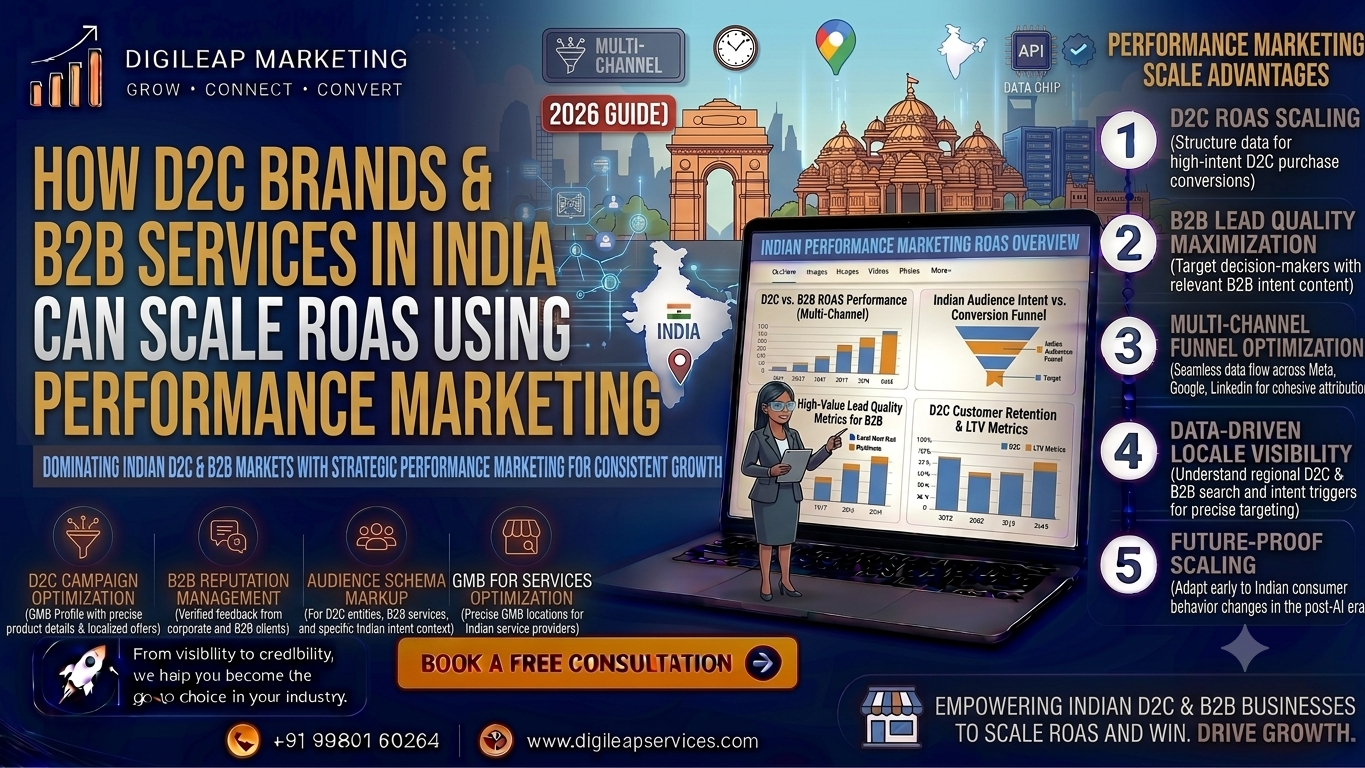
For Indian D2C brands and B2B service companies, performance marketing in 2026 is no longer about spending more on ads and hoping sales follow. It is about connecting media spend with revenue, customer quality, and repeat value. A digital marketing agency in india can help build this connection through paid search, paid social, analytics, landing pages, creative testing, and conversion optimisation. Before increasing budgets, however, brands need a scalable system.
Why ROAS Needs a Smarter Approach in 2026
Return on ad spend, or ROAS, shows how much revenue a business generates for every rupee spent on advertising. Yet a strong ROAS number does not automatically mean a campaign is profitable. A D2C brand may report ₹5 in revenue for every ₹1 spent, but discounts, shipping, returns, payment fees, product costs, and other expenses can reduce actual contribution margin.
Therefore, businesses should track both platform ROAS and business-level profitability. This matters because advertising platforms increasingly use automation and machine learning. Google’s value-based bidding system can optimise towards conversion value and Target ROAS when suitable conversion data is available.
India’s advertising market is becoming increasingly digital. Dentsu forecasts India’s advertising market to grow by 8.6% in 2026, while global digital advertising is forecast to grow by 6.7%. These statistics show why competition for online attention will remain strong.
Build the Funnel Before Increasing Ad Spend
Scaling ROAS starts before the campaign goes live. First, map the customer journey from discovery to purchase or qualified enquiry. D2C brands usually move users from product discovery to consideration, cart activity, purchase, and repeat buying. B2B services follow a longer path from search or social discovery to a landing page, lead form, sales call, proposal, and closed deal.
A digital marketing agency in india can support this process by separating campaigns according to funnel intent. High-intent Google searches can capture people who already want a solution, while Meta, YouTube, and other social platforms can create demand and retarget interested audiences. Each campaign should have a clear job rather than forcing every user through the same journey.
The landing page must continue the promise made in the advertisement. If an ad promotes a specific product, service, price, or benefit, the landing page should make that information immediately visible. Strong relevance can reduce wasted clicks because visitors understand what they will receive before taking action.
Use First-Party Data to Improve Campaign Decisions
As tracking becomes more complex, first-party data is becoming a major performance advantage. D2C brands can use purchase history, product preferences, repeat-purchase behaviour, and customer value to build better audiences. B2B companies can use CRM data, lead stages, industry, company size, sales outcomes, and deal value.
Instead of treating every lead as equal, businesses can send stronger value signals. A completed sale, qualified opportunity, or high-value customer can carry more importance than a simple form submission. This helps automated bidding systems learn which outcomes matter.
A digital marketing agency in india can connect advertising data with analytics and CRM information so marketers can identify where revenue actually comes from. This prevents teams from celebrating cheap leads that never become customers.
Create Separate ROAS Strategies for D2C Brands
D2C businesses should not rely on one campaign type or audience. Product price, margin, repeat-purchase rate, seasonality, and average order value all influence sustainable advertising spend.
For example, a skincare brand with strong repeat purchases can tolerate a different first-order acquisition cost than a furniture brand with infrequent purchases. Therefore, first-purchase ROAS may not tell the whole story; customer lifetime value can show whether acquisition is sustainable.
Creative testing is equally important. Brands should test different product angles, hooks, offers, demonstrations, testimonials, creator-style videos, and formats. Instead of changing everything at once, marketers should isolate variables and compare results. Over time, winning creative themes can become part of the acquisition strategy.
Build a Different Measurement Model for B2B Services
B2B service companies need a different definition of performance. A lead is not necessarily revenue. A form submission from an irrelevant prospect may increase the lead count while adding little commercial value.
Therefore, B2B businesses should connect advertising platforms with their sales pipeline. Track marketing-qualified leads, sales-qualified leads, meetings, proposals, opportunities, and closed revenue. Then compare campaign spend against the value of those stages.
A digital marketing agency in india can help service companies create this measurement structure across Google Ads, LinkedIn, Meta, analytics tools, and CRM systems. The goal is to identify which campaigns produce serious business conversations, not simply which campaigns generate the cheapest forms.
Improve Landing Pages Before Raising Budgets
Many businesses try to solve weak ROAS by changing targeting when the real problem is the website. A slow page, unclear offer, weak proof, confusing navigation, or difficult checkout can waste paid traffic.
For D2C brands, product pages should make the value proposition, price, benefits, reviews, delivery information, returns, and purchase action easy to understand. For B2B services, landing pages should explain the problem, solution, proof, process, and next step without forcing visitors to search for basic information.
Small improvements can matter. A clearer headline, stronger call to action, better product imagery, shorter form, visible trust signals, or faster mobile experience can improve conversion rates without increasing media spend.
Use Creative and Offer Testing as a Growth Engine
Performance marketing is increasingly a creative competition. Automated targeting can help platforms find audiences, but the advertisement still needs to earn attention. Therefore, brands should create a structured testing system rather than producing random variations.
A D2C brand can test product demonstrations against customer stories, educational content, comparison creatives, and limited-time offers. A B2B company can test industry-specific messaging against pain-point messaging, case studies, and outcome-focused offers. The objective is to learn which message attracts valuable customers at an acceptable acquisition cost.
This approach also protects budgets. Instead of increasing spend after one strong result, marketers can test whether performance survives different audiences, creatives, placements, and time periods.
Scale Budgets Without Destroying Efficiency
Scaling does not always mean doubling the budget overnight. When a campaign performs consistently, businesses can increase spending gradually while monitoring conversion volume, acquisition cost, revenue, and marginal ROAS.
Google’s guidance for value-based bidding highlights the importance of stable conversion data and sensible Target ROAS changes. Frequent target changes can make performance harder to evaluate because automated systems need time to adjust.
A digital marketing agency in india can help teams create practical scaling rules based on business targets. A campaign may qualify for a budget increase after maintaining a defined ROAS and conversion volume over a suitable period. If efficiency falls, the team can investigate creative fatigue, audience saturation, offer weakness, landing-page problems, or rising competition before cutting spend blindly.
Add Retargeting and Customer Retention
Acquiring a new customer is only one part of profitable growth. Retargeting can bring back product viewers, cart abandoners, service-page visitors, or engaged users. However, it should not simply repeat the same advertisement.
D2C brands can use different messages for product viewers, cart abandoners, previous customers, and high-value buyers. They can also promote complementary products or replenishment offers. B2B companies can retarget website visitors with case studies, industry insights, webinars, service explanations, or consultation offers.
Retention can improve overall economics because repeat purchases add revenue without requiring the same level of acquisition effort. This is why ROAS should be considered alongside customer lifetime value and repeat revenue.
Use AI Without Losing Human Strategy
AI is changing how advertisers create variations, analyse performance, and automate bidding. However, automation does not remove strategy. Businesses still need to define the customer, problem, offer, and desired outcome.
In 2026, the stronger approach is human strategy combined with machine optimisation. Marketers can use AI to generate creative concepts, analyse patterns, summarise performance data, and speed up testing. They should still review claims, brand voice, customer feedback, profitability, and business context before making major decisions.
Dentsu expects digital advertising to represent 68.7% of global advertising investment in 2026, highlighting the growing role of algorithm-led media buying.
Choose the Right Performance Marketing Partner
When internal teams lack specialist knowledge, an experienced digital marketing agency in india can combine media buying, analytics, creative testing, landing-page optimisation, and reporting. However, businesses should evaluate agencies based on the measurement framework they propose rather than promises of a fixed ROAS.
Ask how the agency defines a conversion, tracks revenue, handles attribution, tests creative, and connects advertising data with sales outcomes. For D2C brands, also ask how it considers contribution margin, repeat purchases, and customer lifetime value. For B2B companies, ask how it distinguishes leads from qualified opportunities and closed revenue.
DigiLeap India offers paid advertising, lead generation, SEO, analytics, social media, and e-commerce marketing services. Its website also describes Facebook and Google advertising and reports performance outcomes from its client work.
A Practical 2026 ROAS Framework
The framework is simple: define the outcome, track the right value, build the funnel, improve the offer, test creative, optimise the landing page, connect CRM or purchase data, and scale only after performance becomes repeatable.
For D2C brands, that means looking beyond clicks and first-order revenue. For B2B services, it means moving beyond lead volume and measuring qualified pipeline and closed revenue. In both cases, the goal is to make advertising accountable to commercial outcomes.
Businesses that want to strengthen their measurement approach can also explore DigiLeap marketing guide to measuring digital marketing ROI in 2026, which covers goals, tracking, attribution, and long-term value.
Conclusion
Performance marketing can help Indian D2C brands and B2B service companies scale, but a digital marketing agency in india cannot create sustainable ROAS through higher ad spend alone. The stronger path combines accurate tracking, valuable conversion signals, relevant landing pages, better creative, customer data, and disciplined budget scaling.
When these elements work together, advertising becomes more than a traffic source. It becomes a measurable growth system that can support better decisions throughout 2026.
TL;DR
Indian D2C and B2B businesses can improve ROAS by connecting ad spend with real business value. Build the funnel first, use first-party data, track qualified outcomes, test creatives, improve landing pages, retarget intelligently, and scale budgets gradually. Most importantly, measure profit and customer value alongside platform ROAS so growth remains sustainable.