
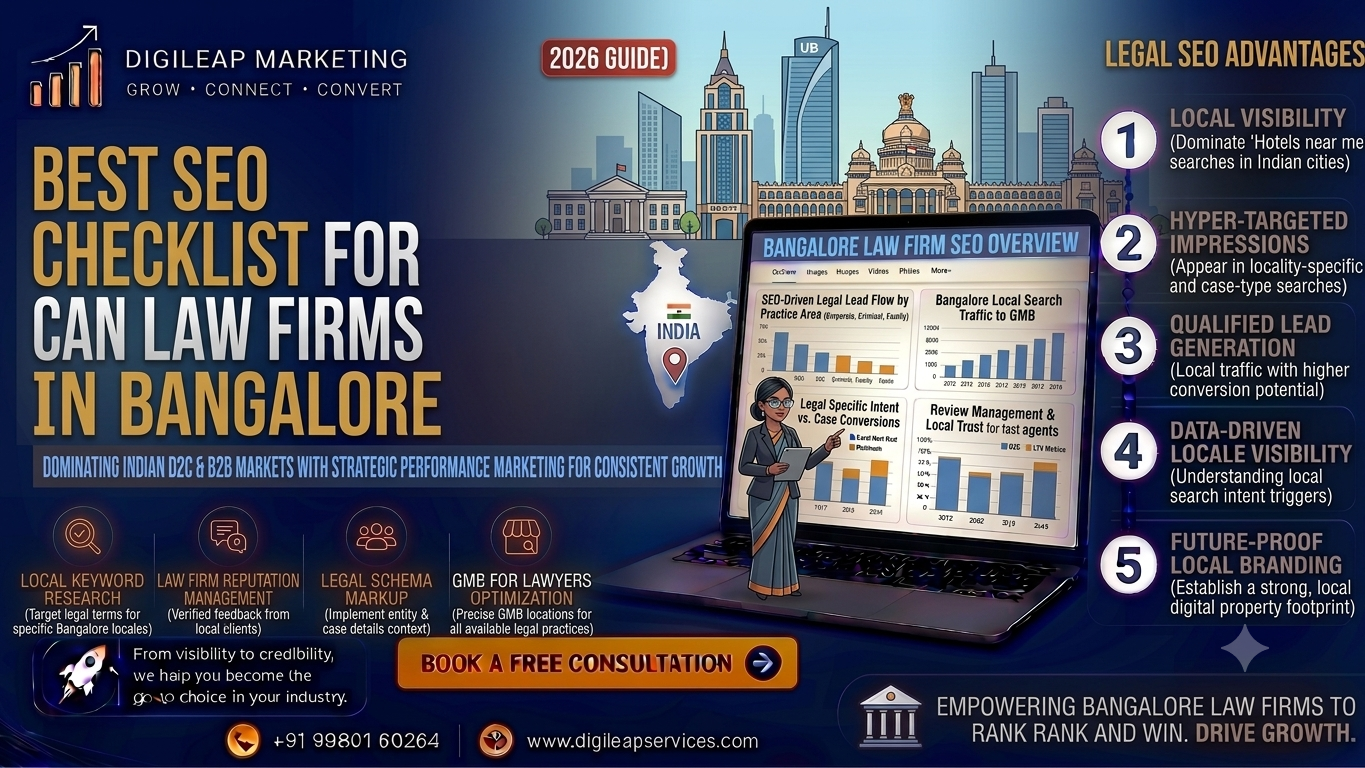
Best SEO Checklist for Law Firms in Bangalore
For law firms in Bangalore, having a professional website is no longer enough to attract new clients. People now use Google to find lawyers, compare legal services, check locations, read reviews, and understand whether a firm can handle their needs. Therefore, law firms need a clear search strategy that improves visibility while building trust. A strong Law Firm SEO Bangalore strategy can help legal websites appear for relevant searches, reach local audiences, and turn search traffic into genuine enquiries. The goal is not simply to rank for more keywords. Instead, firms should create useful pages that answer real legal questions and make it easy for potential clients to contact them.
Start With Local Keyword Research
Keyword research should be the first step in any SEO campaign for a law firm. However, legal businesses should not target keywords only because they have high search volume. Instead, they should understand what potential clients actually search for before choosing a lawyer. Searches such as “family lawyer in Bangalore,” “property lawyer Bangalore,” “corporate lawyer near me,” and “criminal lawyer in Bangalore” can indicate different levels of user intent. Therefore, group keywords according to legal service, location, and search purpose.
A good Law Firm SEO Bangalore strategy should also include long-tail keywords. These phrases are usually more specific and can match users who already know what type of legal help they need. For example, a person searching for “divorce lawyer for mutual consent in Bangalore” has a much clearer requirement than someone searching for “lawyer Bangalore.” Create dedicated service pages for important practice areas instead of placing every keyword on one page. This structure helps users find relevant information and also gives search engines clearer signals about the purpose of each page.
Optimise the Google Business Profile
Local search is especially important for law firms because many clients want legal help close to their home, office, or court. Google states that local results are mainly influenced by relevance, distance, and prominence. It also recommends keeping business information complete and accurate, responding to reviews, and adding useful photos and videos to the Business Profile.
Therefore, your Law Firm SEO Bangalore checklist should include a fully verified and updated Google Business Profile. Make sure the firm’s name, address, phone number, website, business category, opening hours, and service information are accurate. If the firm has more than one office, maintain each eligible location separately and ensure that the information matches the website.
Reviews also deserve regular attention. Encourage genuine clients to leave honest feedback where appropriate and respond professionally to reviews. Do not use copied replies for every review. Instead, provide natural responses that show attention and professionalism. Google also provides Business Profile performance data that can show searches, views, and customer interactions, which can help firms understand how people discover their local listing.
Build Strong Service Pages
A law firm’s website should make its legal services easy to understand. Create separate pages for important practice areas rather than placing every service on a single “Legal Services” page. For example, a firm may have dedicated pages for corporate law, property disputes, family law, employment law, intellectual property, criminal law, or civil litigation, depending on its actual practice areas.
Each service page should clearly explain what the service involves, who may need it, the common legal concerns involved, and how the firm can help. Avoid making unsupported promises such as guaranteeing a particular legal result. Instead, provide factual and useful information that helps visitors understand their options.
The page title, H1 heading, URL, introduction, internal links, and supporting content should all clearly reflect the service. However, avoid repeating the same keyword unnaturally. Google recommends creating helpful, reliable, people-first content rather than content designed mainly to manipulate rankings.
Improve On-Page SEO Elements
On-page optimisation connects your content with the searches you want to target. Start by giving every important page a unique title tag and meta description. Include the primary topic naturally while making the text useful for searchers. Next, use a clear H1 heading and logical H2 headings so visitors can quickly understand the page.
URLs should also remain short and descriptive. For example, a service page can use a structure such as /family-law/ or /property-lawyer-bangalore/ when it accurately represents the page. Add descriptive image alt text when images provide useful information. Also, review internal links throughout the website so important service pages are connected from relevant blog posts and other authoritative pages.
Google’s SEO guidance explains that descriptive titles, headings, links, and relevant text can help search engines understand webpages. A practical Law Firm SEO Bangalore approach should therefore focus on making every important page clear to both visitors and search engines.
Create Helpful Legal Content
Legal clients often search for information before they contact a law firm. They may ask questions about legal procedures, documentation, timelines, eligibility, costs, rights, or common mistakes. This creates an opportunity for law firms to build topical authority through useful educational content.
Instead of publishing generic articles every week, create content around real questions your prospective clients ask. For example, articles could explain the basic steps involved in a property dispute, documents commonly required for a particular legal process, or questions to ask before hiring a lawyer. Keep the information accurate, easy to understand, and updated when laws or procedures change.
Experience and expertise also matter in legal content. Where appropriate, identify the author, provide professional credentials, cite reliable sources, and distinguish general information from advice relating to a specific case. This approach supports trust while also making the content more useful for people.
Google’s guidance encourages original, complete, reliable, people-first content and recommends demonstrating appropriate expertise and first-hand knowledge. Consequently, content quality should remain more important than publishing a large number of low-value articles.
Make the Website Mobile-Friendly and Fast
Many potential clients will first visit a law firm’s website from a mobile device. Therefore, the website should work smoothly on smaller screens. Menus should be simple, text should remain readable, and contact buttons should be easy to find. Important information such as phone numbers, office locations, practice areas, and enquiry forms should not require excessive scrolling.
Website speed also matters because slow pages can create friction. Compress large images, reduce unnecessary scripts, use reliable hosting, and check Core Web Vitals regularly. At the same time, do not sacrifice useful information simply to make a page shorter. The aim is to create a fast and useful experience.
Technical SEO should also cover crawlability, indexing, broken links, redirects, XML sitemaps, canonical URLs, HTTPS, and mobile usability. Google explains that technical requirements form the basic foundation for pages to be eligible to appear in Search.
Use Structured Data Correctly
Structured data can help search engines understand important information about a website. For a law firm, relevant organisation and local business information can include the firm’s name, address, telephone number, website, logo, and other appropriate details.
Google recommends using structured data to provide explicit clues about the meaning of webpage content. It also provides guidance for local business structured data and recommends validating the implementation before deployment.
However, structured data should support accurate information already visible on the website. It should not be used to mark up information that does not exist or to create misleading search features. Review the implementation regularly, especially after website redesigns or changes to business information.
Strengthen Internal Linking
Internal linking is often overlooked by local businesses. Yet, it can help visitors discover related services and help search engines understand the relationship between pages. A blog about property disputes, for example, can naturally link to the firm’s property law service page. Similarly, an article about employment contracts can link to the relevant employment law service.
Use descriptive anchor text that tells users what they will find after clicking. Avoid using the same anchor text repeatedly when it does not fit the context. A logical internal linking structure also helps distribute users across the website instead of leaving valuable service pages isolated.
For additional SEO guidance, law firms can also refer to Digileap India’s SEO and digital marketing services, which covers areas such as keyword research, on-page optimisation, content, technical performance, local SEO, and reporting.
Earn Relevant Authority and Local Mentions
Off-page SEO should focus on earning relevant and credible references rather than collecting large numbers of low-quality backlinks. A law firm can build authority through professional associations, reputable legal publications, local business directories, industry websites, educational resources, and genuine media coverage where appropriate.
Local relevance also matters. Mentions that accurately connect the firm with Bangalore and its actual practice areas can support its wider online presence. However, avoid buying spammy links or participating in artificial link schemes. Google’s Search Essentials warns against practices that violate its spam policies.
Quality matters more than quantity. A small number of relevant, trustworthy references can provide more useful context than hundreds of unrelated directory links.
Track Rankings, Traffic and Enquiries
SEO should be measured through more than keyword rankings. A law firm should monitor organic clicks, impressions, important search queries, landing-page performance, engagement, phone calls, enquiry forms, and other meaningful conversions. Google Search Console can help website owners understand how their pages perform in Google Search.
Google also reports that structured data implementation has produced measurable results in individual case studies. For example, Google says Rotten Tomatoes measured a 25% higher click-through rate on pages enhanced with structured data, while Food Network reported a 35% increase in visits after implementing search features across much of its site. These are individual case studies, not guarantees for law firms, but they show why testing and measurement can be useful.
Review performance every month and identify which pages attract relevant visitors and which pages generate enquiries. Then improve underperforming pages based on actual search data rather than making changes only because a competitor has done something different.
Keep Legal SEO Updated
SEO is not a one-time project. Search behaviour, competition, website technology, legal information, and Google’s search systems can change over time. Therefore, law firms should review important pages regularly and update outdated information.
Check whether contact details remain accurate, whether service pages reflect current practice areas, whether old blog posts contain outdated information, and whether important pages still provide useful answers. Also, monitor Google Business Profile information and review new search queries in Search Console.
A successful Law Firm SEO Bangalore strategy should therefore combine local SEO, useful content, technical health, on-page optimisation, authority building, and ongoing measurement. Instead of chasing every new SEO trend, focus on whether the website genuinely helps people find reliable information and understand the firm’s services.
Conclusion
For law firms in Bangalore, SEO works best when it connects technical optimisation with real client needs. A complete strategy should cover keyword research, Google Business Profile optimisation, service pages, helpful legal content, mobile performance, structured data, internal links, relevant authority, and measurable conversions. Most importantly, every improvement should make the website clearer and more useful for potential clients.
TL;DR
A strong Law Firm SEO Bangalore checklist should cover local keyword research, an accurate Google Business Profile, dedicated service pages, useful legal content, on-page SEO, mobile performance, structured data, internal linking, relevant backlinks, and regular performance tracking. Law firms should focus on accurate, helpful, people-first content while continuously improving their website based on real search and enquiry data.
Book now to know more about seo stratigies