How Pune Educational Institutes Can Increase Admissions Through SEO
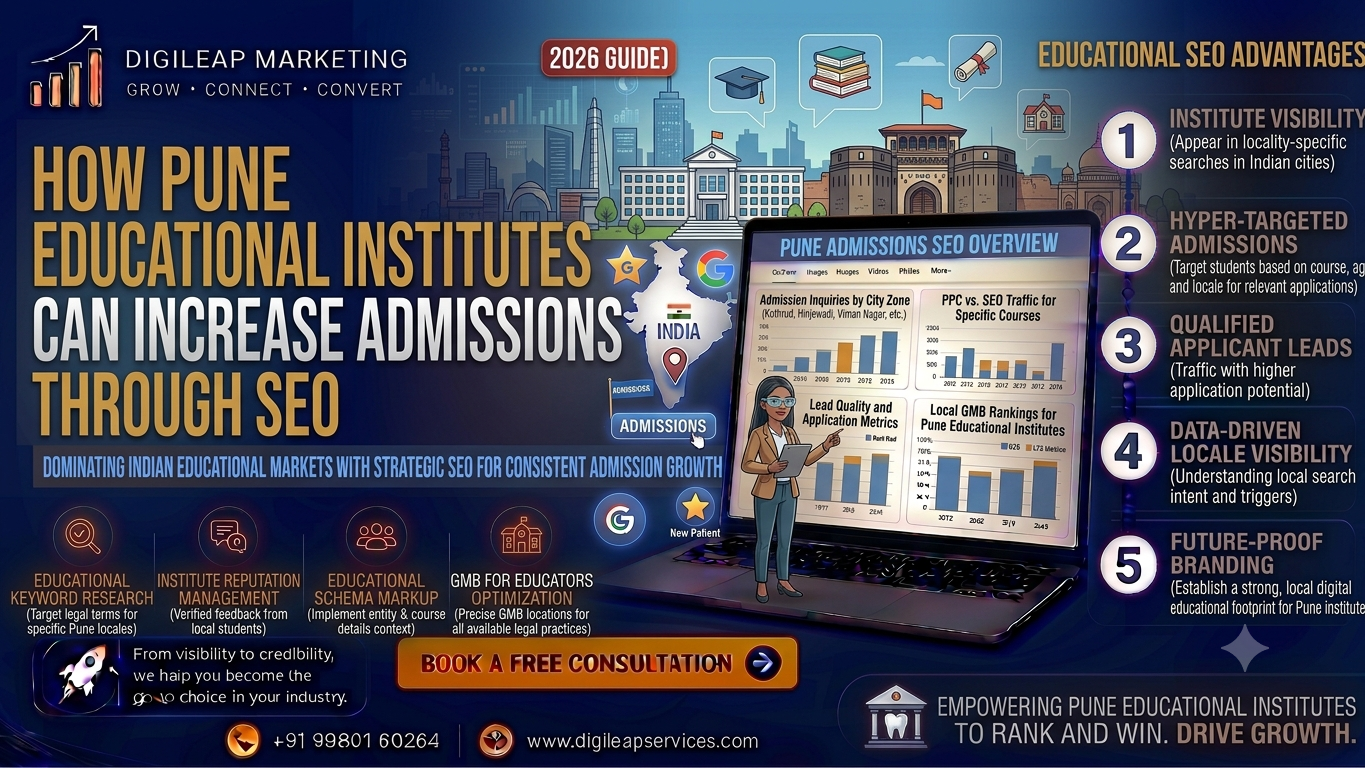
Pune has become a major education hub in India, attracting students from Maharashtra and many other parts of the country. However, strong academic programs alone may not bring enough applications. Today, students and parents often search online before choosing a school, college, coaching centre, university, or professional institute. Therefore, educational institutes need a strong digital presence that helps them appear when prospective students are actively looking for courses and admissions. A well-planned Education SEO Pune strategy can help institutes improve search visibility, attract relevant website visitors, build trust, and generate more admission enquiries.
Why SEO Matters for Educational Institutes in Pune
The education search journey usually starts long before a student fills out an application form. A student may first search for the best colleges in Pune, compare course fees, check placement records, explore campus facilities, or look for reviews. Parents may also search for schools, entrance coaching, vocational courses, and professional programs based on location and reputation. Therefore, institutes that appear at the right stage can influence the decision-making process.
India’s digital audience makes this opportunity even more important. According to the IAMAI-Kantar Internet in India 2024 report, India was projected to cross 900 million internet users in 2025. This means educational institutes can reach a very large pool of digitally active students and parents through search. Moreover, organic search can continue bringing relevant visitors without requiring an institute to pay for every click.
Build Pages Around Student Search Intent
The first step is understanding what prospective students actually search for. Instead of creating pages only around broad terms such as “college in Pune”, institutes should target different stages of the admission journey. For example, students may search for “BBA colleges in Pune”, “MBA colleges near me”, “best engineering courses in Pune”, “digital marketing courses in Pune”, or “Pune colleges with placement assistance”.
Each search represents a different need. Someone searching for course eligibility wants information, while someone searching for admission dates may already be closer to applying. Therefore, educational websites should create useful pages that answer these specific questions.
A strong Education SEO Pune strategy connects keywords with real student intent. Course pages should explain eligibility, curriculum, duration, fees, career opportunities, admission requirements, and frequently asked questions. This approach gives students useful information while helping search engines understand the purpose of each page.
Create Dedicated Course and Admission Pages
Many educational websites lose potential enquiries because they place all their courses on one general page. Instead, each important course should have its own detailed landing page. This gives students a clear path from search to enquiry.
For example, an institute offering management programs could create individual pages for MBA, BBA, executive management, and specialised certification programs. Each page can target relevant searches while providing information that helps students make a decision.
Admission pages should also be easy to find. They should clearly explain application steps, important dates, eligibility criteria, required documents, entrance requirements, and contact options. A visible enquiry form or admission CTA can reduce friction and help turn organic visitors into potential applicants.
Strengthen Local SEO for Pune Searches
Educational institutes compete not only with other institutes in Pune but also with national platforms and directories. Local SEO can therefore help institutions become more visible to students searching for nearby options.
Institutes should maintain accurate business information across their Google Business Profile and other trusted platforms. The institute name, address, phone number, website, operating hours, and categories should remain consistent. Photos of the campus, classrooms, laboratories, events, and facilities can also give prospective students a better understanding of the institution.
Location-specific pages can further support local visibility. For example, institutes can create useful pages for areas where they attract students, provided those pages offer genuine information rather than simply repeating location names.
Optimise the Website for Mobile Users
Students often discover courses through smartphones. Therefore, a website that works poorly on mobile devices can lose potential enquiries even when it ranks well.
Pages should load quickly, text should be easy to read, buttons should be simple to tap, and enquiry forms should work smoothly on smaller screens. Important information such as fees, admission dates, course details, and contact information should not be difficult to find.
Google’s Search Essentials recommends creating helpful, reliable, people-first content and ensuring that search engines can properly understand and access website content. Institutes should therefore treat technical SEO and user experience as part of the admission journey rather than as separate activities.
Publish Helpful Content for Students and Parents
A strong education website should answer questions before students even contact the admissions team. This is where educational blogging can support long-term organic growth.
Institutes can publish content around topics such as entrance exam preparation, course comparisons, career opportunities, subject choices, admission guides, scholarship information, placement expectations, and student life in Pune. For example, an institute offering management education could publish an article explaining how to choose between different management specialisations.
The content should provide original and useful information instead of simply repeating information found on other websites. Google’s guidance states that helpful, reliable, people-first content should provide substantial value and demonstrate appropriate expertise.
This content can also help institutes appear for long-tail searches. Over time, several useful articles can create topical authority and bring students into the website through different search queries.
Use Student Questions as SEO Opportunities
The questions students ask admissions teams are valuable SEO ideas. If prospective students repeatedly ask about placement opportunities, hostel facilities, course difficulty, internship options, eligibility, or admission deadlines, these questions can become website content.
An institute can create FAQ sections on course pages and detailed articles for more complex questions. This makes the website more useful and can also help search engines understand the context of the content.
For example, instead of simply stating that an institute offers an MBA program, the page could answer questions such as who can apply, what specialisations are available, what the admission process involves, and what students can expect after completing the program.
Build Trust With Real Educational Information
Students and parents need confidence before submitting an enquiry. Therefore, SEO content should not focus only on keywords. It should also communicate evidence of the institute’s credibility.
Educational websites can highlight faculty experience, accreditation, affiliations, campus facilities, student achievements, placement information, industry partnerships, internships, academic events, and alumni stories where the information is accurate and verifiable.
Reviews and testimonials can also provide useful social proof. However, institutes should avoid exaggerated claims. Clear, specific, and authentic information is more useful for both prospective students and search engines.
Improve Internal Linking Across the Website
Internal linking helps visitors move from one relevant page to another. It also helps search engines discover and understand relationships between pages.
For example, a blog about choosing an MBA specialisation can link to relevant MBA course pages. An admission guide can link to the application page. A course comparison article can link to individual program pages.
Institutes can also strengthen their broader digital marketing strategy through Digileap India’s digital marketing services, particularly when SEO needs to work alongside content, lead generation, and other digital channels.
Use Data to Measure Admission-Focused SEO
SEO should not be measured only by rankings. Educational institutes should connect organic search performance with actual admission goals.
Google Search Console can show which queries generate impressions and clicks, while analytics platforms can help track user behaviour after visitors reach the website. Institutes should monitor organic enquiries, application-page visits, form submissions, phone clicks, brochure downloads, and other meaningful actions.
For example, a course page may receive thousands of visitors but generate very few enquiries. Another page may receive less traffic but produce highly relevant admission leads. Therefore, the second page may deserve more attention even if its overall traffic is lower.
Regular measurement allows institutes to improve pages based on real student behaviour rather than assumptions.
Optimise for AI-Powered Search and Modern Search Results
Search is changing as students increasingly use AI-powered experiences to research courses and institutions. Educational websites should therefore provide clear, factual, well-structured information that can be understood by both traditional search systems and newer AI-powered search features.
Google’s 2026 guidance on generative AI search recommends valuable, unique content and explains that established SEO practices remain foundational for visibility in AI features.
This means institutes should focus on answering real questions clearly rather than producing large volumes of repetitive content. Course details, admission requirements, fees, facilities, faculty information, and student resources should be presented in a structured and trustworthy way.
Turn Organic Traffic Into Admission Enquiries
Getting students to a website is only the first step. The website must also make it easy for them to take action.
Every important course page should have a clear next step. Depending on the institute, this could include “Apply Now”, “Request a Call”, “Download Course Brochure”, “Book a Campus Visit”, or “Talk to an Admissions Counsellor”.
Forms should ask only for information that the admissions team genuinely needs at the first stage. A complicated form can discourage students from completing it. Similarly, contact information should be easy to find across the website.
This is where Education SEO Pune becomes more than a ranking exercise. The real objective is to connect relevant searches with useful information and then guide interested students towards an admission action.
Create a Long-Term SEO Strategy
SEO rarely produces sustainable results through one campaign or a handful of keywords. Educational institutes should treat it as an ongoing process. Search trends change, courses change, competitors publish new content, and students develop new questions.
Institutes should regularly review their keyword performance, update old course information, improve underperforming pages, publish useful new content, strengthen internal links, and monitor technical issues.
They should also study competing institutes to understand which topics attract search visibility. However, copying competitor content is not the answer. Instead, institutes should identify information gaps and create more useful resources based on their own expertise and student experience.
A consistent Education SEO Pune strategy can help institutes build visibility across course searches, local searches, informational queries, and admission-related searches. Over time, this creates a stronger organic channel that can support admissions throughout the academic year.
Conclusion
Pune’s education market is competitive, so institutes need more than an attractive website to generate admissions. They need to appear when students and parents are searching, provide useful answers, demonstrate credibility, and make the next admission step simple.
A focused SEO strategy can connect educational institutes with students who are already researching courses and admission options. By combining local SEO, course-page optimisation, helpful content, technical improvements, internal linking, and conversion-focused pages, institutes can build a stronger digital path from search visibility to admission enquiries.
TL;DR
Educational institutes in Pune can increase admission opportunities by targeting student search intent, creating dedicated course pages, strengthening local SEO, publishing helpful content, improving mobile experience, building trust, tracking organic enquiries, and optimising pages for modern AI-powered search. A consistent Education SEO Pune strategy can help institutes attract more relevant students and turn search visibility into meaningful admission enquiries.