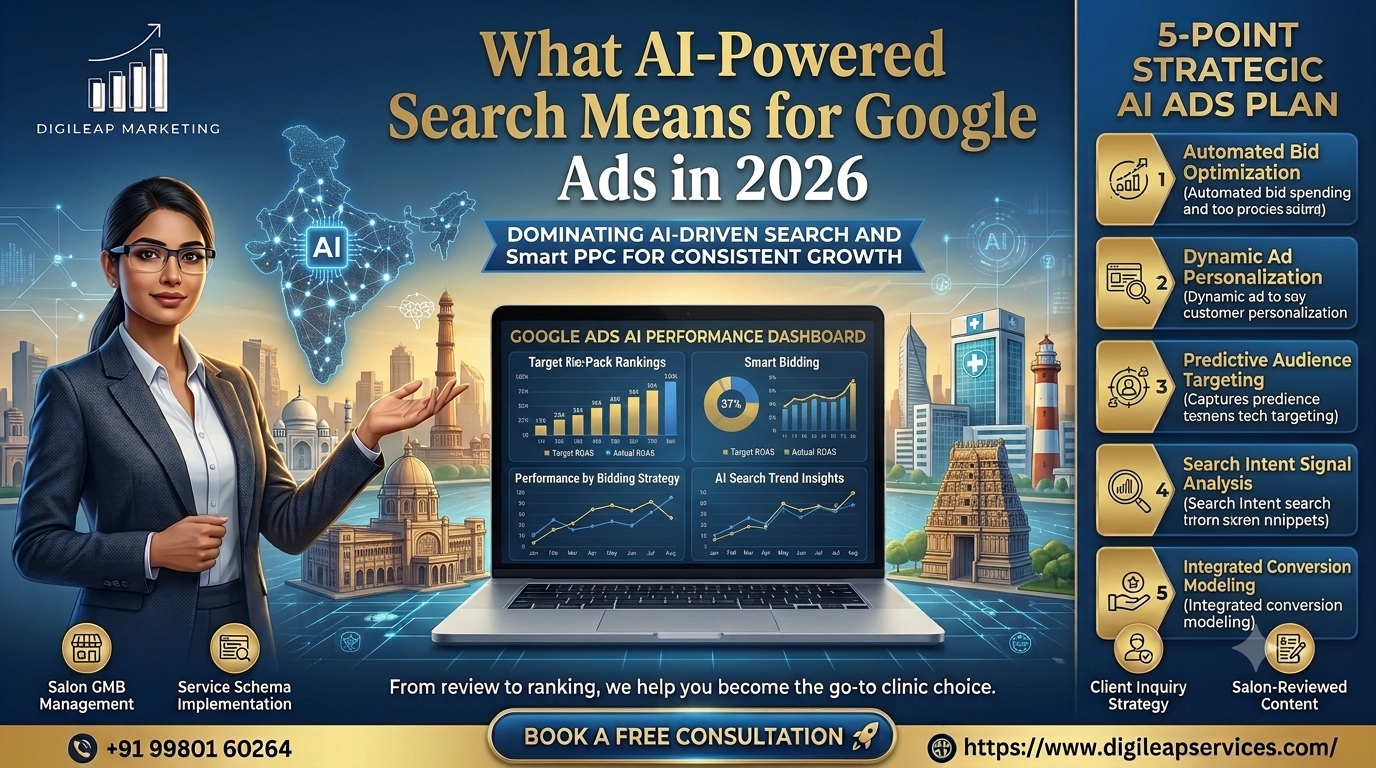
What AI-Powered Search Means for Google Ads in 2026
Google Search is changing fast. People no longer search only with short phrases. Instead, they ask full questions, compare products and look for solutions through AI-powered answers. As a result, businesses must change how they plan and run their ads.
AI Search and Google Ads now work together in new ways. Google can use the meaning of a search, the user’s needs and the content of an AI Overview to match relevant ads with potential customers. Therefore, businesses need more than a list of keywords. They need useful ads, clear landing pages and a strong plan to turn clicks into leads.
In this blog, we will explore how AI-powered search affects Google Ads in 2026, what businesses should do next and how the H.O.O.K. + V.A.L.U.E. framework can help them attract the right audience.
How AI Is Changing Google Search in 2026
Google Search now offers AI Overviews, which give users AI-generated summaries for selected questions. Users can also explore topics through AI Mode and ask follow-up questions without starting a new search each time. This makes online research more conversational and helps people compare their options.
According to Google’s January 2026 Search update, Gemini 3 became the default model for AI Overviews globally. This shows how Google continues to improve its ability to understand questions and provide useful answers.
For businesses, this change creates new chances to reach people. For example, a customer may search for ways to reduce energy bills before looking for a local insulation company. An AI-generated answer may explain different options. A relevant ad can then help the customer take the next step.
Consequently, AI Search and Google Ads give businesses more ways to connect with customers during research, comparison and buying decisions. However, success still depends on relevance, ad quality and the value offered to users.
What AI-Powered Search Means for Google Ads
In traditional search advertising, marketers often focus on specific keywords. They choose search terms, write ads and direct visitors to a landing page. Although keywords still matter, AI-powered search adds more context to the process.
Google can consider the user’s question and the information in an AI Overview when deciding whether an eligible ad is relevant. For instance, someone searching for how to fix a leaking roof may first want advice. However, that search could also show a need for roofing services.
According to Google Ads Help, eligible Search, Shopping and Performance Max ads can appear above or below AI Overviews in markets where those summaries are available. In selected countries, including India, eligible text and Shopping ads can also appear within AI Overviews.
This means advertisers should create ads that answer real customer needs rather than simply repeat popular search terms. Moreover, they should use landing pages that explain their services, prices, benefits and next steps in simple language.
AI does not guarantee lower costs or more sales. Instead, it creates new opportunities that businesses must measure and improve over time.
Why AI Max Matters for Google Ads Campaigns
Google has also introduced AI Max for Search campaigns. This tool helps advertisers reach more relevant searches, improve ad messages and send visitors to suitable pages on their websites.
For example, a local plumbing company may target “emergency plumber Belfast”. However, customers might also search for “who can fix a burst pipe near me today?” AI-powered matching can help advertisers reach people who use different words but have a similar need.
According to Google’s AI Max announcement, advertisers who activate AI Max typically see 14% more conversions or conversion value at a similar cost per action (CPA) or return on ad spend (ROAS). For campaigns that rely mainly on exact and phrase match keywords, Google reported a typical increase of 27%.
These figures come from Google’s internal data, so actual results may vary by business and campaign. Nevertheless, they show why testing AI-powered tools can be useful.
Therefore, businesses should review their current campaigns and test AI features with clear goals. This approach helps them understand whether the changes bring more valuable leads rather than simply more clicks.
How to Use the H.O.O.K. + V.A.L.U.E. Framework
The H.O.O.K. + V.A.L.U.E. framework helps businesses create ads that attract attention, answer customer needs and encourage action. In 2026, this approach can support AI Search and Google Ads because people expect useful answers throughout their search journey.
H.O.O.K.: Capture Attention and Build Interest
H — Hook the audience. Start with a clear message that speaks to a real problem. For example, a roofing company could use the headline “Need a Reliable Roofer in Canterbury?” This tells users what the business offers and who it serves.
O — Offer a clear benefit. Explain why customers should choose your business. You could mention fast appointments, clear quotes or a local team. However, only make claims that your business can support.
O — Outline the solution. Show how your service solves the customer’s problem. For example, a digital marketing agency could explain how its Google Ads service helps local firms reach people who are ready to enquire.
K — Keep the next step simple. Use a direct call to action, such as “Request a Free Quote” or “Book a Consultation”. As a result, visitors can quickly understand what to do next.
V.A.L.U.E.: Turn Interest into Action
V — Verify your claims. Add real reviews, case studies and clear service details to build trust. Also, make sure your ads match the information on your website.
A — Align ads with search intent. Match your message to what customers need. Someone comparing services may want prices and benefits, while someone ready to buy may prefer a direct booking option.
L — Link to relevant pages. Send each visitor to a page that matches the ad. For example, a roofing ad should lead to a roofing service page rather than a general homepage.
U — Use data to improve results. Track enquiries, calls, sales and conversion costs. Then, use this information to improve your keywords, ads and landing pages.
E — Evaluate and refine. Review results regularly. Remove irrelevant search terms, test new headlines and adjust your budget based on performance.
Together, these steps help businesses create a more useful customer journey. They also give AI-powered advertising tools better information about the services you offer.
Make Your Website Ready for AI-Powered Ads
Your ad is only one part of the customer journey. Once people click, your website must help them find answers and take action.
First, write clear service pages that explain what you offer, who you help and where you work. Next, include useful details about pricing, delivery, appointment times or service areas where relevant. In addition, make sure your website loads quickly and works well on mobile devices.
For online shops, keep product titles, prices, images and stock details accurate. For local businesses, display correct contact details and service locations. These steps help visitors make decisions and give advertising systems better information.
You can also improve your wider digital strategy with Digileap India, which offers digital marketing services for businesses looking to strengthen their online visibility and generate leads.
Ultimately, AI Search and Google Ads work best when your ads, website content and customer experience support the same goal. AI can help match your message to a search, but your business must still provide a useful answer and a strong reason to choose you.
Measure the Results That Matter
More impressions and clicks do not always mean more business. Therefore, track the results that support your goals.
For lead generation, measure qualified enquiries, phone calls, booked appointments and cost per lead. For online shops, monitor sales, conversion rates and revenue from advertising. Meanwhile, check search terms and landing page performance to find areas that need improvement.
Also, give campaign changes enough time to produce useful data. Avoid changing several settings at once, because this can make results harder to understand. Instead, test one major change at a time and compare its impact.
Remember that Google does not offer a separate placement switch for ads within AI Overviews. Eligible ads may appear above, below or within these experiences, depending on the campaign and the search. Therefore, focus on relevance, quality and measurable results rather than trying to force a specific placement.
Conclusion
AI-powered search is changing how customers discover businesses and make buying decisions. In 2026, advertisers need to focus on user intent, useful ad copy, relevant landing pages and strong conversion tracking.
By applying the H.O.O.K. + V.A.L.U.E. framework, businesses can create clearer messages and guide customers towards action. In addition, they can test AI Max, review campaign data and improve their websites to make better use of new search opportunities.
AI Search and Google Ads should support a clear business goal: reaching the right people and turning their interest into valuable leads or sales. With regular testing and a customer-first approach, businesses can prepare their campaigns for the next stage of search.
TL;DR
AI-powered search helps Google understand longer questions and customer needs. In 2026, businesses should test AI Max, create relevant ads, improve landing pages and track conversions. The H.O.O.K. + V.A.L.U.E. framework offers a practical way to attract attention, build trust and turn clicks into leads.