Best Lead Generation Strategies for Clinics in India
Introduction
Patients in India are becoming more digital with every passing year. Before choosing a clinic, many people search online, compare doctors, read reviews, check services, and look for convenient appointment options. Therefore, clinics can no longer depend only on referrals, walk-ins, or traditional advertising. A strong online presence can help a clinic reach the right audience at the right stage of the patient journey. This is where Lead Generation for Clinics becomes important. Instead of simply attracting website visitors or social media followers, clinics need strategies that turn genuine interest into enquiries, calls, WhatsApp conversations, and appointments.
India’s digital healthcare ecosystem is expanding rapidly. According to IBEF, more than 93.95 crore Ayushman Bharat Health Account IDs had been created by July 2026, showing the enormous scale of digital healthcare adoption in the country. Moreover, India’s healthcare sector continues to expand alongside growing adoption of telemedicine and digital services. Consequently, clinics that build a patient-focused digital acquisition system can create a stronger pipeline of potential patients while improving visibility and trust.
Build a Strong Local SEO Strategy
First, clinics should focus on local SEO because patients often search for healthcare services based on their location. Searches such as “dentist near me,” “skin clinic in Mumbai,” “physiotherapist in Pune,” or “best fertility clinic in Delhi” show clear intent. Therefore, appearing prominently for these searches can put a clinic in front of people who are already looking for care.
A well-optimised Google Business Profile should form the foundation of this strategy. Clinics should maintain accurate information about their address, phone number, opening hours, services, website, and appointment options. High-quality photographs can also help patients understand the clinic before visiting. Furthermore, clinics should regularly publish useful updates and respond professionally to reviews.
Local landing pages can strengthen this approach further. For example, a dental clinic serving several neighbourhoods can create useful location-specific pages that explain its services and accessibility. However, clinics should avoid creating thin pages simply by changing city names. Instead, each page should provide genuinely useful information for patients in that area.
Optimise the Clinic Website for Conversions
Getting visitors to a website is only the first step. If the website does not make it easy for visitors to take action, valuable traffic can disappear. Therefore, clinics should design their websites around patient needs rather than simply displaying information.
The homepage should clearly explain what the clinic offers, who it serves, and how patients can book an appointment. Prominent call-to-action buttons such as “Book an Appointment,” “Call Now,” or “Chat on WhatsApp” can reduce friction. In addition, service pages should explain treatments in simple language while highlighting the clinic’s expertise, facilities, and patient experience.
The website should also work smoothly on smartphones. This is particularly important because patients frequently search for healthcare services while using mobile devices. A slow or confusing mobile website can make potential patients leave before contacting the clinic.
Trust signals matter as well. Doctor profiles, qualifications, clinic photographs, patient reviews, frequently asked questions, accreditation information, and transparent service details can help visitors feel more confident. Since healthcare decisions involve considerable trust, the website should communicate credibility without making exaggerated promises.
Use Google Ads to Capture High-Intent Patients
While SEO can produce long-term visibility, Google Ads can help clinics reach high-intent users more quickly. Patients searching for terms related to specific treatments or appointments may already be close to making a decision. Consequently, paid search can become an effective part of Lead Generation for Clinics when campaigns focus on relevant keywords and strong conversion paths.
Instead of sending every advertisement to the homepage, clinics should create dedicated landing pages for important services. Someone searching for “laser hair removal clinic in Bangalore” should ideally reach a page specifically about that service rather than a generic clinic page. This alignment improves relevance and can make the next step much clearer.
Campaigns should also separate keywords based on intent. Terms related to symptoms may indicate early research, while searches containing words such as “clinic,” “doctor,” “appointment,” or “near me” can indicate stronger commercial intent. Accordingly, clinics can allocate more budget toward keywords that consistently generate qualified enquiries.
Tracking is equally important. Clinics should monitor calls, form submissions, WhatsApp enquiries, appointment bookings, and cost per lead rather than focusing only on clicks. Over time, this data can reveal which campaigns produce actual patients.
Create Educational Content That Builds Trust
Healthcare decisions rarely happen instantly. Patients often research symptoms, treatment options, costs, recovery periods, risks, and specialist qualifications before contacting a clinic. Therefore, educational content can help clinics become useful resources during the research stage.
A clinic can create blogs, videos, FAQs, guides, and social media posts around genuine patient questions. A dermatologist, for example, could explain common acne triggers, treatment options, skincare mistakes, and when professional consultation may be necessary. Similarly, a dental clinic could create content about tooth sensitivity, preventive care, dental implants, and children’s oral health.
However, content should not become a sales pitch. Patients want clear and trustworthy information. By answering questions honestly and encouraging professional consultation where appropriate, clinics can build authority without appearing overly promotional.
Video content is particularly useful because doctors can explain complex subjects in a simple and approachable way. Short videos can introduce specialists, explain procedures, answer common questions, or show the clinic environment. Consequently, educational content can support both awareness and conversion.
Leverage Social Media for Patient Engagement
Social media gives clinics an opportunity to communicate with potential patients before they are ready to book an appointment. Platforms such as Instagram, Facebook, and YouTube can help healthcare brands demonstrate expertise and build familiarity.
Rather than posting only promotional offers, clinics should maintain a balanced content strategy. Educational videos, doctor introductions, frequently asked questions, treatment explanations, clinic updates, wellness advice, and patient-friendly information can create meaningful engagement.
Instagram Reels can be useful for short educational content, while YouTube can support longer explanations. Facebook can help clinics reach local communities and specific demographic groups. Meanwhile, social media advertising can amplify high-performing content and direct interested users toward landing pages or enquiry channels.
The key is consistency. A clinic does not need to publish dozens of posts every week. Instead, it should create useful content regularly and maintain a recognisable, professional presence.
Use WhatsApp to Convert Enquiries Faster
Once a potential patient shows interest, response speed can influence whether that person eventually books an appointment. Therefore, WhatsApp can play an important role in the conversion process for Indian clinics.
Clinics can use WhatsApp to answer basic questions, share appointment availability, provide directions, send reminders, and follow up with people who have already made an enquiry. Automated responses can handle simple questions outside working hours, while staff can manage conversations that require human attention.
However, automation should not replace appropriate human communication. Healthcare enquiries can be sensitive and complex, so clinics should ensure that automated messages remain professional and do not provide inappropriate medical advice.
A clear WhatsApp button on the website, landing pages, Google Business Profile where available, and social media profiles can make it easier for potential patients to start a conversation. As a result, clinics can reduce the number of steps between discovery and appointment enquiry.
Run Targeted Meta Ads
Meta advertising can help clinics reach specific audiences based on location, interests, demographics, and online behaviour. Facebook and Instagram campaigns can be especially useful for awareness, remarketing, and appointment-focused promotions where permitted by applicable healthcare advertising rules.
For example, a clinic can promote an educational video about preventive dental care to a local audience and then use remarketing to reconnect with people who interacted with its content or website. The messaging should remain ethical, accurate, and compliant with applicable medical advertising requirements.
Lead forms can also simplify the enquiry process by allowing interested users to submit basic contact information without leaving the platform. However, clinics should qualify these leads quickly. A large number of inexpensive leads does not necessarily mean a successful campaign if most people are irrelevant or unreachable.
Strengthen Online Reviews and Reputation
Trust is one of the biggest factors in healthcare decisions. Patients want reassurance that a clinic is professional, reliable, accessible, and patient-focused. Therefore, online reviews can significantly influence the decision-making process.
Clinics should encourage genuine patients to share honest feedback after their experience. They should also respond to reviews professionally, including negative ones. A thoughtful response can demonstrate that the clinic listens and takes patient concerns seriously.
At the same time, clinics should never purchase fake reviews or manipulate ratings. Authentic reputation management creates stronger long-term credibility than artificially inflated ratings.
Google’s digital ecosystem also makes reputation particularly important because reviews can appear alongside local search results. Consequently, strong reviews combined with accurate business information can support both visibility and patient confidence.
Build Referral and Remarketing Campaigns
Not every patient becomes a customer after the first interaction. Someone may visit a treatment page, watch a video, submit an enquiry, or call the clinic but postpone the appointment. Therefore, remarketing can help clinics remain visible to previous website visitors and engaged audiences, subject to platform policies and healthcare privacy requirements.
Referral marketing can also complement digital campaigns. Satisfied patients may recommend a clinic to family members or friends, particularly when the clinic delivers a strong experience. Clinics can encourage referrals through ethical patient communication rather than relying entirely on advertising.
Email and WhatsApp follow-ups can also help maintain relationships with existing patients when appropriate consent and privacy practices are followed. Appointment reminders, educational information, and service updates can keep communication useful rather than intrusive.
Use Analytics to Improve Lead Quality
Effective Lead Generation for Clinics requires measurement. Clinics should know where enquiries originate, which campaigns generate appointments, which services attract the highest demand, and where potential patients leave the conversion journey.
For example, a campaign may generate 200 enquiries but only five appointments, while another campaign produces 50 enquiries and 20 appointments. Looking only at lead volume would make the first campaign appear better. However, appointment conversion shows that the second campaign delivers more valuable results.
Clinics should therefore monitor metrics such as cost per lead, qualified leads, appointment conversion rate, cost per appointment, phone calls, WhatsApp enquiries, landing-page conversion rate, and return on advertising spend where appropriate.
Digileap India provides digital marketing services including SEO, PPC, social media marketing, lead generation, analytics, and website services, which can help businesses build data-driven acquisition strategies.
Combine Strategies Into One Patient Journey
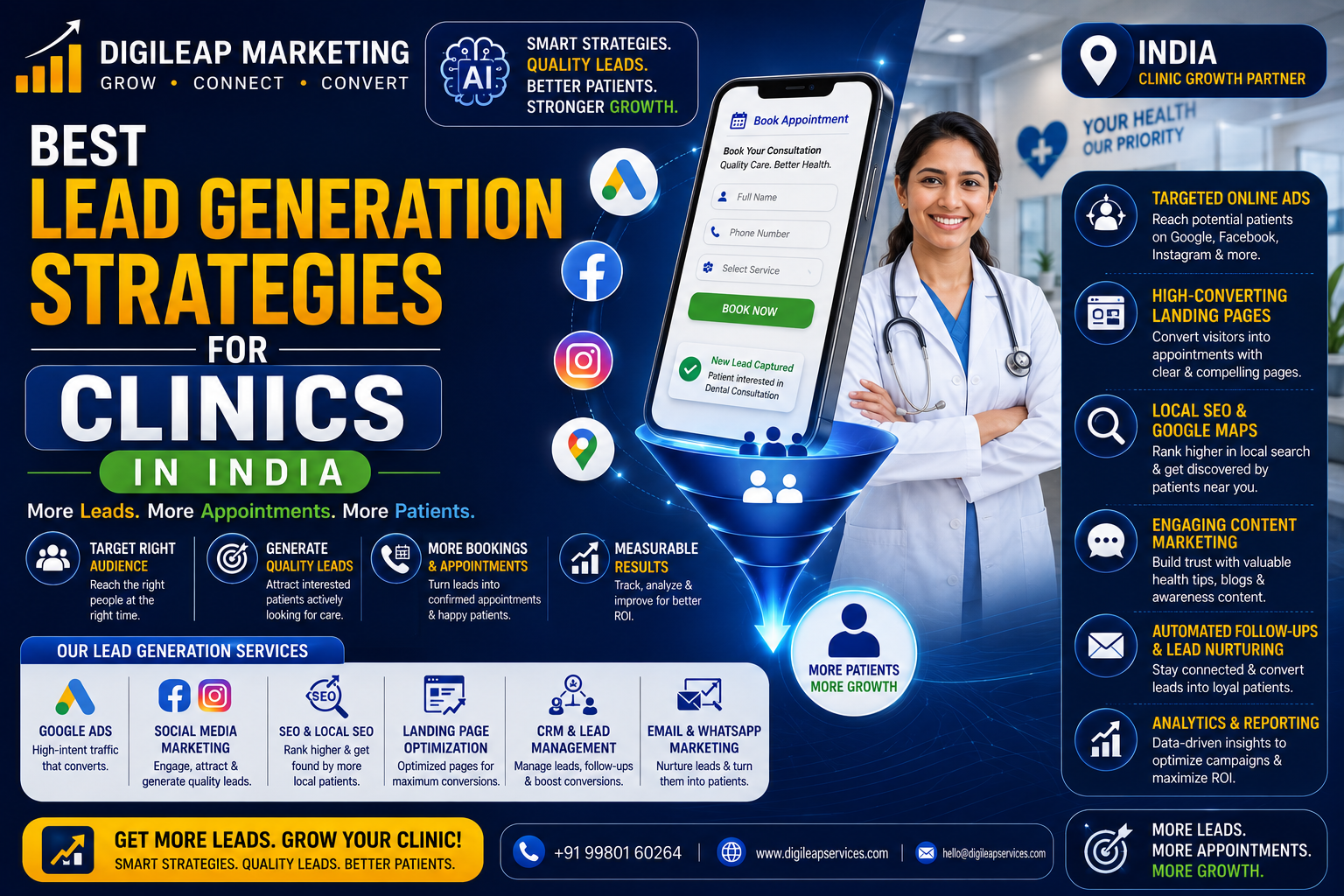
The strongest approach does not depend on one marketing channel. Instead, clinics should connect SEO, paid advertising, content, social media, WhatsApp, websites, and reputation management into one patient journey.
For example, a patient may discover a clinic through Google, read a service page, watch a video on Instagram, check reviews, visit the website again, and finally contact the clinic through WhatsApp. If every stage provides a consistent and trustworthy experience, the probability of conversion can improve.
This integrated approach makes Lead Generation for Clinics more sustainable because each channel supports another. SEO can bring organic traffic, paid advertising can capture immediate demand, social media can build familiarity, content can answer questions, and WhatsApp can simplify communication.
Focus on Patient Experience After the Lead
Generating an enquiry is not the end of the process. Clinics should also improve what happens after a potential patient contacts them. Staff should respond promptly, provide clear information, and make appointment scheduling simple.
Missed calls should receive timely follow-ups. Online forms should be monitored regularly. Appointment confirmations should be clear. Directions and necessary preparation information should be easy to understand.
Furthermore, clinics should analyse why leads fail to convert. Sometimes the problem is not advertising. It may be slow responses, unclear pricing information, difficult booking processes, or poor communication. Fixing these issues can improve results without increasing advertising expenditure.
Why Digital Lead Generation Matters for Indian Clinics
India’s healthcare market is becoming increasingly connected to digital platforms. IBEF reports that India’s telemedicine sector reached approximately ₹31,191 crore in 2025 and is projected to reach around ₹90,660 crore by 2030. This growth reflects a wider shift toward digitally enabled healthcare experiences.
At the same time, patients increasingly expect convenience. A 2026 Bain report cited by IBEF found that 88% of Indian consumers want healthcare to be more convenient, while nearly 80% expect doctors to be reachable through calls or messaging platforms. Therefore, clinics that make discovery, communication, and booking easier can better match changing patient expectations.
Ultimately, Lead Generation for Clinics is not simply about running advertisements. It is about creating a complete system that helps the right patients discover the clinic, understand its services, trust its expertise, contact the team, and take the next step.
Conclusion
Indian clinics have a major opportunity to grow through digital channels, but success requires more than simply being present online. Local SEO, conversion-focused websites, Google Ads, educational content, social media, WhatsApp, reputation management, remarketing, and analytics can work together to create a reliable patient acquisition system. Most importantly, clinics should focus on quality leads and patient experience rather than chasing vanity metrics.
When every digital touchpoint answers a patient question or removes a barrier to booking, marketing becomes more useful and measurable. With a patient-first approach, consistent optimisation, and responsible communication, Lead Generation for Clinics can become a sustainable part of clinic growth.
TL;DR
Lead Generation for Clinics works best when clinics combine local SEO, Google Ads, social media, educational content, WhatsApp, online reviews, remarketing, and conversion tracking. A strong Google Business Profile helps patients discover the clinic, while a fast and trustworthy website turns visitors into enquiries. Paid advertising can capture high-intent searches, whereas useful content builds authority over time. WhatsApp can make communication faster, and analytics can reveal which campaigns generate actual appointments. Ultimately, clinics should build an integrated digital journey that makes it easy for patients to discover, trust, contact, and choose the right healthcare provider.