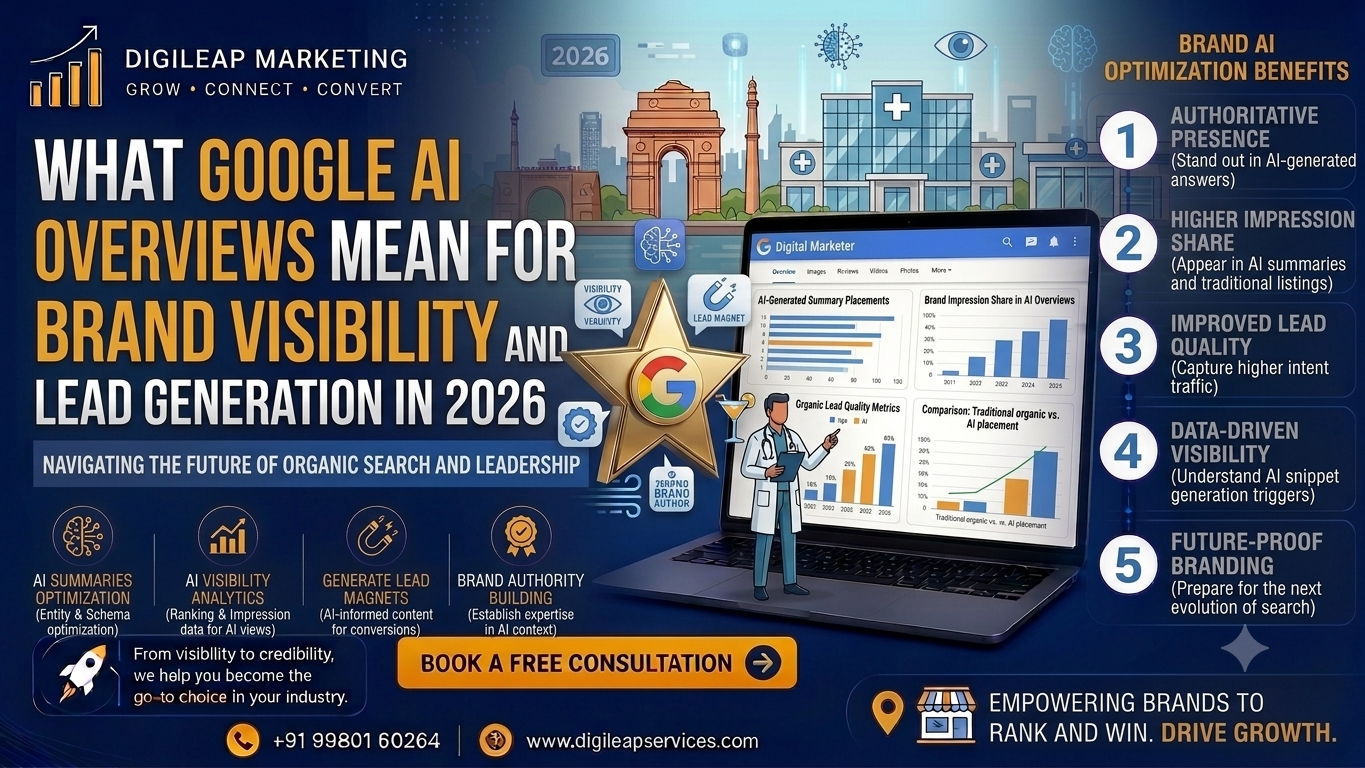
What Google AI Overviews Mean for Brand Visibility and Organic Lead Generation in 2026
Google Search is changing faster than ever. In 2026, users are no longer relying only on traditional blue links to find information, compare businesses, or make buying decisions. Instead, Google increasingly uses AI-powered experiences such as AI Overviews and AI Mode to understand complex questions and provide direct answers. For businesses, this shift creates both a challenge and an opportunity. Traditional rankings still matter, but brands now need to think about how they appear inside AI-generated search experiences. This is where AI Search Lead Generation becomes important because visibility is no longer limited to getting a website into the top ten results. Brands must become trusted sources that Google can understand, reference, and recommend while also giving searchers a strong reason to visit their websites.
How Google AI Overviews Are Changing Search
Google AI Overviews provide users with an AI-generated summary directly within the search results. Instead of scanning several websites to understand a topic, users can often get a concise explanation first and then explore supporting links included within the AI-generated response. Consequently, the traditional search journey is becoming more conversational, contextual, and discovery-driven.
Google itself explains that AI Overviews and AI Mode continue to use links to help people explore information beyond the initial AI-generated response. The company also states that websites appearing through AI-powered search can benefit from highly engaged visitors.
This means brands should not assume that AI Overviews simply eliminate organic traffic. Instead, they change the way people interact with search results. A user might first discover a brand through an AI-generated answer, examine the cited source, visit the website, read another page, and eventually submit an enquiry. Therefore, the path from search visibility to conversion can become longer and more complex.
For marketers, AI Search Lead Generation now requires a broader understanding of visibility. Ranking for one keyword is no longer enough. Businesses need to establish topical authority, answer relevant questions clearly, build trust, and create content that supports users at different stages of their decision-making process.
Why Brand Visibility Matters Beyond Traditional Rankings
For years, SEO teams focused heavily on rankings. Getting into position one was considered the ultimate goal because higher rankings generally created more opportunities for clicks. However, AI-powered search introduces another layer of visibility.
A brand can now appear as a source within an AI Overview even when the user’s interaction with the search result looks very different from traditional search. This creates an important branding opportunity. Even if a user does not immediately click, seeing a company referenced as a useful source can increase familiarity and credibility.
Moreover, AI Overviews can bring several sources together to answer one complicated question. As a result, businesses may compete not only for rankings but also for inclusion among the sources Google considers useful for a particular query.
This changes the meaning of organic visibility. Instead of asking only, “Where do we rank?” marketers should also ask, “Where does our brand appear when customers ask questions related to our expertise?”
That shift is particularly important for B2B companies, professional service providers, healthcare businesses, technology companies, consultants, and local businesses. Their customers often conduct several searches before making contact. Therefore, being visible across informational, comparison, commercial, and local queries can create repeated exposure throughout the customer journey.
AI Search Lead Generation Is About Being the Answer Behind the Click
The biggest mistake businesses can make in the AI search era is treating AI Overviews as another ranking position. They are not simply another place to insert keywords. Instead, they reflect Google’s attempt to understand information, connect concepts, and provide useful answers.
Therefore, businesses should create content that genuinely answers the questions their customers ask. A roofing company, for example, should not only target “roofing services near me.” It can also answer questions about roof replacement costs, warning signs of roof damage, maintenance schedules, material choices, insurance considerations, and project timelines.
Similarly, a digital marketing agency should not only publish pages targeting “digital marketing agency.” It can explain how SEO works, how AI search is changing organic traffic, how businesses can measure leads, and how different channels work together.
This approach gives Google more useful information to understand the business. At the same time, it gives customers more reasons to trust the company.
Consequently, AI Search Lead Generation depends heavily on building a content ecosystem rather than producing isolated keyword-focused pages. Each useful page should strengthen the brand’s authority while guiding potential customers toward the next step.
Original Content Can Become a Competitive Advantage
AI search makes original information more valuable. When thousands of websites repeat the same generic advice, it becomes difficult for a brand to stand out. However, original research, first-hand insights, expert opinions, customer experiences, case studies, proprietary data, and real examples can provide stronger reasons for search engines and users to pay attention.
Google’s guidance continues to emphasise helpful, reliable, people-first content rather than special tricks designed specifically for AI Overviews. Google also states that there are no additional technical requirements specifically required for inclusion in AI Overviews or AI Mode. Instead, fundamental SEO practices remain important.
This is an important distinction. Businesses do not need to create an entirely separate “AI SEO” website. Instead, they need to improve the quality, structure, relevance, and usefulness of their existing content.
For example, rather than writing another generic article about “Benefits of Digital Marketing,” a company could publish an analysis based on its own campaign experience. It could discuss what worked, what failed, how conversion rates changed, and what businesses should consider before investing.
Such content creates stronger signals of expertise while also giving potential customers practical information.
Search Behaviour Is Becoming More Conversational
AI search is also changing how people phrase questions. Traditional keyword searches were often short, such as “best CRM software” or “SEO agency Mumbai.” With conversational search, users can ask much longer questions containing context, preferences, problems, and multiple requirements.
For example, someone might search, “What is the best SEO strategy for a small healthcare business that wants more local enquiries without spending heavily on ads?”
That query contains several concepts at once. A strong content strategy should therefore address complete questions rather than relying only on short keywords.
This is another reason AI Search Lead Generation should focus on search intent rather than keyword repetition. Businesses need to understand what customers want to know, why they are asking, what concerns they have, and what action they may take after receiving an answer.
Long-form content can help here, but length alone does not guarantee visibility. A 2,000-word article filled with repetitive information will not automatically outperform a concise, original resource that answers the user’s actual question.
The goal should be clarity. Use simple language, logical headings, direct explanations, relevant examples, and supporting evidence. This makes content easier for both users and search systems to understand.
Organic Leads May Become More Valuable Than Raw Traffic
One of the most important changes in 2026 is the need to reconsider how businesses measure SEO success. A decline in clicks does not automatically mean that organic search has become less valuable.
Google reported that clicks from search results pages containing AI Overviews can be higher quality, with users more likely to spend more time on the destination website.
That creates an important opportunity for businesses. Instead of measuring success only through sessions, marketers should examine what happens after users arrive. Do they submit forms? Do they request quotations? Do they call? Do they download resources? Do they book consultations? Do they spend meaningful time exploring service pages?
In June 2026, Google also announced new Search Console reporting for generative AI visibility. The new reports provide dedicated views for impressions generated through AI features such as AI Overviews and AI Mode, although the rollout initially targeted a subset of websites.
This development shows how search measurement is evolving. Visibility within generative search is becoming measurable, which means businesses can increasingly connect AI-powered discovery with broader organic performance.
As a result, AI Search Lead Generation should be measured through business outcomes rather than traffic alone. The real question is whether search visibility contributes to qualified customer journeys.
Build Content Around Customer Problems
A strong AI-search strategy begins with customer problems. Businesses should identify the questions people ask before they choose a product or service.
Consider a potential customer searching for a financial consultant. They may first ask about investment planning, then compare different financial services, then research costs, then look for reviews, and finally search for a specific consultant.
Each query represents a different stage of intent.
A business that only targets the final commercial keyword misses the earlier opportunities to build trust. However, a company that creates helpful resources across the entire journey can introduce its brand much earlier.
This creates a stronger relationship between content and lead generation. The customer may not enquire after reading the first article, but the brand becomes familiar. Later, when the customer reaches a commercial search, that familiarity can influence the final decision.
Therefore, businesses should create interconnected content covering awareness, education, comparison, evaluation, and conversion.
Technical SEO Still Matters in the AI Era
AI-powered search does not make technical SEO irrelevant. In fact, strong technical foundations remain essential because Google needs to crawl, index, and understand website content before it can potentially surface that content.
Google confirms that pages must be indexed and eligible to appear in normal Google Search to be considered as supporting links in AI Overviews or AI Mode.
Therefore, businesses should continue improving website speed, mobile usability, internal linking, structured content, crawlability, indexation, metadata, and overall user experience.
However, technical optimisation should support useful content rather than replace it. A technically perfect website with thin or unhelpful content will struggle to establish meaningful authority.
Similarly, publishing excellent content will not deliver its full potential if search engines cannot access or understand the website properly.
The strongest approach combines technical SEO, useful content, authority building, brand visibility, and conversion optimisation.
Brand Authority Will Influence Organic Growth
AI search makes brand authority increasingly important because Google’s systems need to determine which sources are useful and reliable for specific questions.
Businesses should therefore build authority across multiple channels. A company can publish expert content on its website, share insights on LinkedIn, contribute industry commentary, earn relevant mentions, develop case studies, collect genuine reviews, and maintain consistent business information.
Over time, these activities help create a stronger digital footprint.
For Indian businesses especially, local relevance can also make a major difference. Businesses should maintain accurate Google Business Profile information, develop location-specific content where appropriate, encourage genuine customer reviews, and make service information easy to understand.
A strong local presence combined with authoritative website content can help businesses become more discoverable when customers search for services within specific cities or regions.
Businesses looking to strengthen their broader digital marketing foundation can also explore Digileap India’s digital marketing services, which cover SEO, lead generation, content marketing, social media, PPC, and other digital growth channels.
The Future of AI Search Lead Generation
The future of organic search will not be about choosing between traditional SEO and AI search. Instead, successful brands will integrate both.
Traditional rankings still provide valuable visibility. At the same time, AI Overviews create new opportunities for brands to become part of the answers customers see before they visit a website.
This means businesses need to create content that works at multiple levels. It should answer the immediate question, demonstrate expertise, provide evidence, encourage deeper exploration, and ultimately support a conversion.
Marketers should also monitor brand mentions, assisted conversions, organic enquiries, qualified traffic, engagement, and visibility across AI-powered search experiences. These metrics provide a more complete picture than rankings alone.
Most importantly, businesses should avoid chasing every new AI trend. Google’s own guidance makes one thing clear: strong fundamentals remain important. Helpful content, technical accessibility, reliable information, and a satisfying user experience continue to form the foundation of search success.
Therefore, AI Search Lead Generation is not about writing content for machines. It is about creating such useful and trustworthy content that both search systems and real customers recognise its value.
Conclusion
Google AI Overviews are changing how people discover information, evaluate brands, and move through the buying journey. However, this does not mean organic search is disappearing. Instead, organic visibility is expanding into a more complex environment where rankings, citations, brand authority, content quality, and user engagement work together.
Businesses that adapt early can turn this change into an advantage. By answering real customer questions, publishing original insights, strengthening technical SEO, building authority, and measuring conversions rather than clicks alone, brands can create stronger opportunities for sustainable organic growth.
In 2026, AI Search Lead Generation is ultimately about becoming a trusted answer before becoming the chosen business.
TL;DR
Google AI Overviews are transforming organic search by placing AI-generated answers and supporting links directly within search results. Brands now need to focus on more than traditional rankings. Helpful content, original expertise, strong technical SEO, topical authority, local relevance, and conversion-focused websites can improve visibility across the evolving search journey. Businesses should also measure qualified leads, engagement, and conversions instead of relying only on organic traffic. The brands that consistently provide useful answers and build genuine authority will be better positioned to turn AI-powered search visibility into meaningful business growth.