
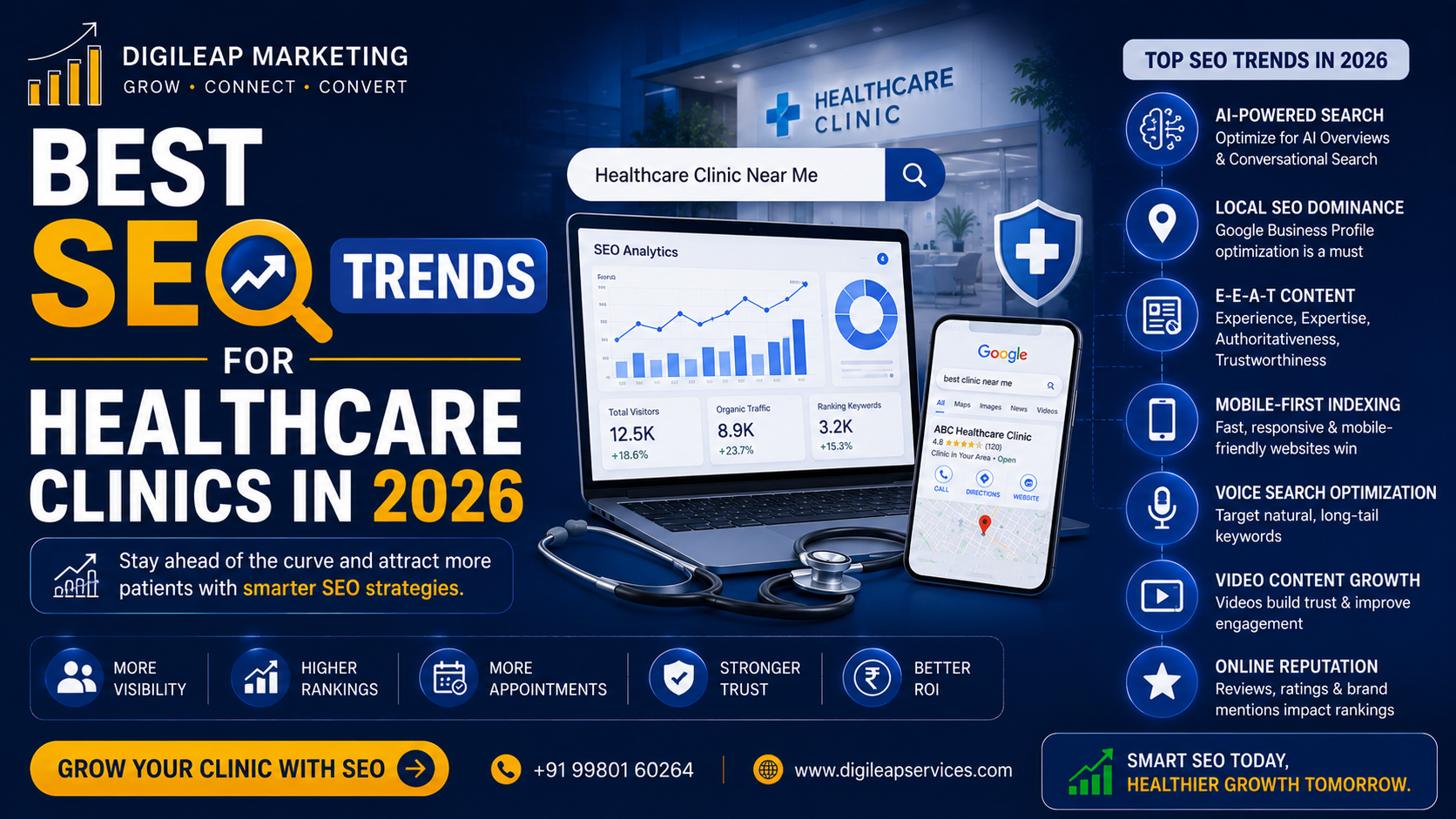
Best SEO Trends for Healthcare Clinics in 2026
Healthcare clinics have experienced a major digital shift over the last few years. Today, patients no longer rely only on referrals from friends or family. Instead, they search online, compare reviews, check clinic websites, and book appointments through Google. As a result, clinics that invest in search engine optimization continue to attract more qualified patients than those that depend only on traditional marketing. Healthcare SEO Trends 2026 show that Google is rewarding websites that offer trustworthy information, excellent user experiences, and locally relevant content. Therefore, healthcare providers must adapt their digital strategies to remain visible and competitive. Whether you run a dental clinic, physiotherapy center, skin clinic, or multispecialty practice, understanding the latest SEO developments will help you reach more patients and build long-term credibility.
AI-Powered Search Is Changing Patient Discovery
Artificial intelligence has become one of Google’s strongest ranking factors. Google Search now understands user intent better than ever before, meaning healthcare clinics must create content that genuinely answers patient questions instead of simply repeating keywords. Consequently, blogs, FAQs, treatment pages, and educational resources need to provide accurate and useful information.
Moreover, AI-generated search summaries and conversational search experiences encourage clinics to write naturally while maintaining medical accuracy. Instead of focusing solely on technical optimization, clinics should combine informative content with practical solutions for patients. This approach increases visibility while also improving patient trust. According to Google, helpful, people-first content continues to receive greater visibility in search results because it demonstrates expertise and satisfies user intent.
Local SEO Will Remain the Biggest Growth Driver
Most healthcare searches include local intent. Patients often search phrases like “clinic near me,” “best dermatologist nearby,” or “dentist open today.” Therefore, optimizing local SEO has become essential rather than optional.
A fully optimized Google Business Profile, consistent business information, high-quality patient reviews, and localized landing pages significantly improve local rankings. Furthermore, clinics should encourage satisfied patients to leave detailed reviews because Google considers review quality and frequency as ranking signals.
According to BrightLocal, 98% of consumers used the internet to find information about local businesses in 2024, demonstrating how important local search has become for healthcare providers.
Additionally, creating city-specific service pages allows clinics to rank for location-based searches while improving relevance for nearby patients.
Helpful Content Will Outperform Promotional Content
Patients rarely search for advertisements. Instead, they search for answers to symptoms, treatments, recovery times, and preventive care. Therefore, educational content continues to outperform promotional pages.
Healthcare websites should publish comprehensive articles that answer common patient questions while maintaining factual accuracy. Moreover, every article should reflect medical expertise, cite reliable information where appropriate, and explain complex procedures in simple language.
Google’s Helpful Content System favors websites that demonstrate experience, expertise, authority, and trustworthiness (E-E-A-T). Consequently, clinics should highlight doctor profiles, certifications, years of experience, and patient success stories throughout their websites.
Mobile Experience Has Become a Ranking Priority
Most healthcare searches now happen on smartphones. Patients often search while traveling, during emergencies, or between appointments. Consequently, a slow or poorly designed mobile website can significantly reduce conversions.
Fast-loading pages, readable text, easy appointment booking, click-to-call buttons, and mobile-friendly navigation improve both rankings and user satisfaction. Furthermore, Core Web Vitals remain important ranking signals because they directly affect user experience.
According to Statista, mobile devices generated approximately 63% of global website traffic in early 2025, highlighting why healthcare websites must prioritize mobile optimization.
Therefore, responsive design should remain one of every healthcare clinic’s highest SEO priorities.
E-E-A-T Will Continue to Influence Medical Rankings
Healthcare belongs to Google’s Your Money or Your Life (YMYL) category, meaning Google applies stricter quality standards to medical websites.
Therefore, clinics should showcase qualified healthcare professionals, publish medically reviewed content, update outdated articles regularly, and include detailed author information. Additionally, displaying awards, certifications, memberships, and patient testimonials strengthens website credibility.
These improvements reassure both Google and potential patients that the information provided is trustworthy and professionally verified.
Voice Search Is Becoming More Important
Voice assistants continue changing the way patients search online. Instead of typing short keywords, users increasingly ask complete questions.
For example, patients may ask, “Which clinic treats back pain near me?” or “What are the symptoms of sinus infection?” Consequently, healthcare websites should include conversational content, question-based headings, and detailed FAQ sections.
Long-tail keywords naturally match voice search behavior while improving opportunities to appear in featured snippets and AI-generated search responses.
Video SEO Will Increase Patient Engagement
Healthcare videos help simplify complicated medical topics while building trust before patients visit the clinic.
Short educational videos explaining treatments, preventive care, doctor introductions, and patient experiences can significantly improve engagement. Moreover, embedding optimized videos on treatment pages increases average session duration, which sends positive engagement signals to search engines.
Clinics should also optimize video titles, descriptions, transcripts, and structured data to improve discoverability across Google Search and YouTube.
Structured Data Will Improve Search Visibility
Schema markup helps search engines understand healthcare websites more effectively. Consequently, implementing Medical Organization Schema, Local Business Schema, FAQ Schema, Review Schema, and Physician Schema can improve rich search results.
Structured data may increase click-through rates by displaying additional information such as ratings, business hours, FAQs, and appointment details directly within search results.
Although schema alone does not guarantee higher rankings, it enhances search visibility and improves user experience.
Patient Reviews Have Become Stronger Trust Signals
Online reputation directly affects both SEO performance and patient decisions.
Positive reviews increase local search visibility while encouraging more appointment bookings. Therefore, clinics should establish a consistent review collection strategy after every successful consultation.
Furthermore, responding professionally to both positive and negative reviews demonstrates transparency and patient care. Google values businesses that actively engage with customer feedback.
Clinics should also display verified testimonials throughout their websites because authentic patient experiences strengthen credibility and improve conversion rates.
Content Clusters Will Replace Individual Blog Posts
Rather than publishing isolated articles, successful healthcare websites now organize content into topic clusters.
For example, a dental clinic may build an entire content hub around dental implants by connecting blogs about implant costs, recovery, aftercare, candidacy, benefits, and frequently asked questions.
This internal linking strategy helps search engines understand topical authority while making navigation easier for patients. As a result, websites often achieve stronger rankings for competitive healthcare keywords.
Zero-Click Searches Require Smarter Optimization
Google increasingly answers user questions directly on the search results page through featured snippets, AI Overviews, knowledge panels, and FAQs.
Therefore, clinics should structure their content using concise answers, descriptive headings, question-based sections, and well-organized paragraphs.
Even when users receive immediate answers, appearing in these prominent search features significantly increases brand awareness and authority.
Technical SEO Remains the Foundation
While content drives visibility, technical SEO ensures search engines can properly crawl and index healthcare websites.
Regular technical audits should identify broken links, duplicate pages, crawl errors, slow-loading resources, and indexing issues. HTTPS security, XML sitemaps, canonical tags, optimized images, and clean URL structures also contribute to better rankings.
Additionally, accessibility improvements make websites easier for every patient to use while supporting SEO performance.
Long-Term SEO Strategy Creates Sustainable Growth
Healthcare marketing is becoming increasingly competitive every year. Consequently, clinics that continuously publish valuable content, maintain accurate local profiles, optimize technical performance, and strengthen their authority will outperform competitors over time.
Instead of chasing algorithm updates, clinics should focus on delivering excellent patient experiences both online and offline. This patient-first approach naturally aligns with Google’s evolving ranking systems.
Businesses looking to implement advanced healthcare SEO strategies can also explore professional digital marketing solutions from Digileap India: https://digileapservices.com/
As competition continues to increase, Healthcare SEO Trends 2026 emphasize quality over quantity, expertise over shortcuts, and patient trust over aggressive promotion. Clinics that consistently invest in educational content, technical optimization, local SEO, reputation management, and user experience will achieve stronger search visibility while attracting more qualified patients. Furthermore, adopting these evolving practices today will create a sustainable competitive advantage for years to come. Ultimately, Healthcare SEO Trends 2026 encourage healthcare providers to build websites that genuinely help patients while meeting Google’s highest quality standards. By following Healthcare SEO Trends 2026, clinics can improve online visibility, strengthen credibility, increase appointment bookings, and establish long-term digital success. As search technology continues evolving, Healthcare SEO Trends 2026 will remain centered on trust, relevance, user experience, and authoritative medical information. Therefore, clinics that embrace Healthcare SEO Trends 2026 now will be better positioned to thrive in the future digital healthcare landscape.
Conclusion
SEO for healthcare clinics is evolving rapidly, but the core objective remains the same: helping patients find reliable healthcare information and trusted providers. Clinics that prioritize valuable content, local optimization, technical excellence, and patient trust will continue to earn stronger rankings and attract more appointments throughout 2026 and beyond.
TL;DR
Healthcare SEO Trends 2026 focus on AI-powered search, local SEO, E-E-A-T, mobile optimization, helpful content, voice search, structured data, patient reviews, video SEO, technical performance, and topic clusters. Healthcare clinics that embrace these trends will improve Google rankings, build greater patient trust, and generate sustainable long-term growth.