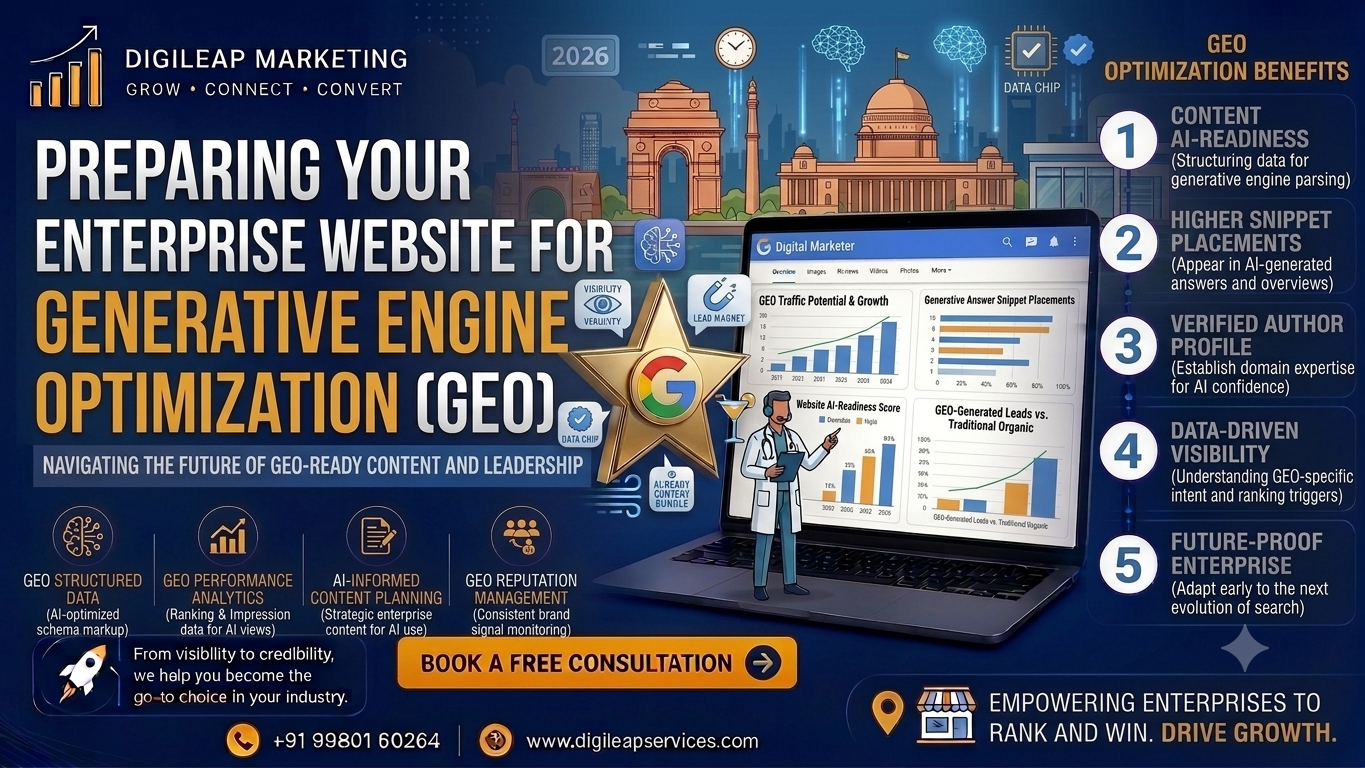
Preparing Your Enterprise Website for Generative Engine Optimization (GEO)
As search continues to evolve, enterprise brands can no longer rely only on traditional rankings to stay visible online. People are increasingly using AI-powered search experiences to research companies, compare products, understand complex topics, and make purchase decisions. Therefore, businesses need to prepare their websites for a new form of discovery. Enterprise Generative Engine Optimization helps organizations make their content easier for generative AI systems to understand, trust, retrieve, and reference. Instead of focusing only on where a page ranks in a traditional search engine, enterprises now need to consider whether their brand appears in AI-generated answers and whether those answers accurately represent the business.
This shift is already producing measurable changes in online behavior. Google reported in 2026 that AI Overviews had more than 2.5 billion monthly active users, while AI Mode had surpassed 1 billion monthly active users. At the same time, Adobe reported that AI-driven traffic to U.S. retail websites increased by 693.4% year over year during the 2025 holiday season. Clearly, generative search is moving from an experimental technology to an important part of the digital customer journey.
What Is Enterprise Generative Engine Optimization?
Enterprise Generative Engine Optimization is the process of improving a large organization’s website, content, brand signals, and digital presence so generative AI systems can understand and potentially reference the brand when answering user questions. These systems include AI-powered search experiences and conversational tools that synthesize information from multiple sources rather than simply displaying a traditional list of blue links.
Traditional SEO focuses heavily on rankings, keywords, backlinks, technical performance, and organic traffic. GEO still depends on many of these fundamentals, but it adds another layer. The content must also provide clear, reliable, useful, and context-rich information that AI systems can interpret easily.
For enterprise organizations, this becomes more complex because their websites often contain thousands or even millions of pages. Different departments may publish content using different standards. Product information can become outdated, regional websites can contain conflicting details, and multiple pages may compete for the same topic. Consequently, enterprises need a structured approach that connects technical SEO, content strategy, brand authority, data management, and digital PR.
Why GEO Matters for Enterprise Websites
AI-powered search is changing how people discover information. Instead of entering several searches and visiting multiple websites, users can now ask a detailed question and receive a synthesized response. As a result, a company can influence a customer’s decision even when the customer never visits its website directly.
Google’s own documentation now includes guidance for websites appearing in AI Overviews and AI Mode, while its 2026 updates emphasize that established SEO best practices remain relevant for generative AI features. This means enterprises do not need to abandon SEO and start from scratch. Instead, they should strengthen their existing SEO foundation while making content more useful for AI-driven discovery.
The opportunity is particularly significant for complex businesses. Enterprise buyers often research software, financial services, healthcare solutions, manufacturing products, consulting firms, and technology platforms through detailed questions. Generative engines can summarize these topics and recommend potential solutions. Therefore, the companies that provide authoritative information across these questions have a stronger opportunity to become part of the conversation.
Build a Strong Technical Foundation
A successful GEO strategy starts with a technically healthy website. AI systems need to discover, crawl, interpret, and retrieve information from your website. If important pages are blocked, poorly structured, slow, duplicated, or difficult to understand, your content becomes harder to use.
Enterprise websites should therefore review crawlability, indexation, internal linking, canonicalization, XML sitemaps, mobile usability, page speed, JavaScript rendering, and structured data. These elements help search systems understand the relationship between different pages and identify the most important information.
However, technical optimization should not become an isolated SEO activity. Enterprise development teams, IT teams, SEO specialists, content teams, and product managers should work together. For example, changing a website’s URL structure without considering redirects can create unnecessary problems. Similarly, launching thousands of regional pages without unique value can create large amounts of low-quality content.
Therefore, enterprises should treat technical SEO as a long-term digital infrastructure project rather than a one-time optimization exercise.
Create Content That Answers Real Questions
Generative AI systems are designed to answer questions, so enterprise content should reflect the way people actually ask those questions. Instead of creating pages around isolated keywords, brands should develop content around topics, entities, problems, comparisons, use cases, and customer needs.
For example, a cybersecurity company should not only publish a page targeting “enterprise cybersecurity solutions.” It should also answer questions such as how enterprise cybersecurity works, what security challenges large organizations face, how different solutions compare, what implementation involves, and how businesses can measure security performance.
This approach creates a broader information ecosystem. Consequently, an AI system has more useful information to draw from when responding to related questions.
Content should also provide direct answers before moving into deeper explanations. Clear definitions, practical examples, original research, expert commentary, statistics, comparisons, and supporting evidence can make a page more useful. At the same time, writers should avoid unnecessary filler because concise and meaningful information is easier for both users and machines to process.
Strengthen Your Enterprise Brand Authority
Generative engines do not evaluate a website in isolation. They can consider information from multiple sources when developing an answer. Therefore, enterprises need strong brand signals beyond their own websites.
This makes digital PR, industry publications, expert interviews, research reports, reputable backlinks, reviews, partner websites, and authoritative third-party mentions increasingly valuable. When independent sources consistently describe a company, product, or executive in a particular context, they can reinforce the entity’s digital identity.
For example, if a technology company publishes research about artificial intelligence and respected industry publications discuss that research, the company gains stronger contextual signals. Similarly, if experts from the organization regularly contribute useful insights to reputable publications, those external references can strengthen perceived authority.
As a result, Enterprise Generative Engine Optimization should not be treated as an on-page content exercise alone. It should connect owned, earned, and external digital presence into one consistent brand ecosystem.
Make Enterprise Content Easy to Understand
Large organizations often use internal terminology that customers may not understand. Product teams may use technical language, while marketing teams may use promotional phrases. However, AI systems and users both benefit from straightforward language.
Therefore, enterprise websites should explain complex concepts using clear terminology and consistent definitions. Important products, services, people, locations, industries, and technologies should be described consistently across the website.
This is especially important when an organization has multiple regional websites. If one page describes a product differently from another regional page, the inconsistency can create confusion. Enterprises should establish clear content governance guidelines so teams use consistent names, descriptions, product specifications, and claims.
In addition, companies should regularly audit outdated pages. Old statistics, discontinued products, incorrect executive information, and obsolete service descriptions can reduce trust and create inaccurate representations of the brand.
Use Structured Data Strategically
Structured data can help search engines understand the meaning and relationships behind website content. For enterprise websites, this can be especially useful because organizations often have complex information about products, services, locations, articles, people, events, and corporate entities.
However, structured data should support visible and accurate content rather than attempt to manipulate search systems. Enterprises should implement relevant schema types correctly and ensure that the markup reflects the information users can actually see on the page.
For example, an enterprise with hundreds of offices can maintain consistent information about each location. A technology company can provide structured information about eligible products. A publishing organization can clearly identify articles and authors.
Consequently, structured data becomes part of a broader information architecture strategy. It helps create clarity, but it cannot compensate for weak content or poor technical foundations.
Improve Internal Linking and Information Architecture
Enterprise websites frequently struggle with disconnected content. A product page may link to a pricing page, while related research, customer stories, documentation, and industry resources remain isolated.
A strong internal linking structure can solve this problem. Related pages should connect naturally so users and search systems can understand how information fits together.
For instance, an enterprise software company could connect its core product page with implementation guides, industry use cases, customer stories, technical documentation, comparison pages, and research reports. This creates topical depth and helps establish relationships between important concepts.
Moreover, internal linking can distribute authority across important pages. Instead of allowing valuable resources to become buried deep within the website, enterprises can build logical content hubs around their most important topics.
Create Original Information AI Systems Can Reference
Generic content is easy to reproduce. Original information is much harder to replace.
Therefore, enterprises should invest in proprietary research, original statistics, surveys, expert opinions, case studies, technical documentation, customer insights, and industry analysis. These assets give AI systems useful information that may not be available everywhere else.
Adobe’s research illustrates how quickly AI-driven discovery can grow. Its 2025 data showed that generative AI traffic to U.S. retail websites increased more than tenfold between July 2024 and February 2025, while AI-referred visitors also showed stronger engagement. This demonstrates why original, useful information can become an important digital asset as AI-mediated discovery expands.
For enterprises, original research can also generate secondary benefits. A strong report can earn backlinks, media coverage, social engagement, citations, and branded searches. Therefore, one research project can strengthen both traditional SEO and GEO efforts.
Align Content With the Customer Journey
Enterprise buyers rarely make decisions after reading one page. Instead, they move through multiple stages, from awareness and research to comparison, evaluation, and purchase.
Consequently, GEO content should address the entire journey. Early-stage content can explain industry challenges. Mid-stage content can compare approaches and solutions. Later-stage content can provide pricing information, implementation guidance, case studies, specifications, and frequently asked questions.
This creates a deeper content ecosystem. More importantly, it increases the number of questions for which an enterprise can provide useful answers.
Companies should also consider conversational search patterns. A customer may ask an AI assistant, “What is the best enterprise CRM for a global company with multiple sales teams?” That question contains several concepts. Enterprises need content that explains their solution, target customer, capabilities, differentiators, integrations, limitations, and use cases clearly enough to support such complex queries.
Monitor AI Visibility, Not Just Rankings
Traditional SEO reporting often focuses on rankings, impressions, clicks, organic traffic, and conversions. These metrics remain important, but enterprises should add new indicators as AI search becomes more influential.
Teams can monitor how frequently their brand appears in AI-generated responses, which pages are referenced, what sources mention the brand, whether product descriptions are accurate, and how competitors are represented. AI referral traffic can also be tracked where analytics platforms provide reliable identification.
Adobe now provides tools for analyzing traffic from conversational AI sources, including traffic generated when AI systems search websites and include their content in responses.
Therefore, enterprises should develop an AI visibility dashboard alongside their existing SEO reporting. Over time, this can reveal which topics generate visibility, which pages attract AI referrals, and where content gaps exist.
Combine SEO With Enterprise GEO
One of the biggest mistakes businesses can make is treating GEO as a replacement for SEO. In reality, the two strategies work together.
Search engines still depend heavily on crawlable websites, quality content, strong technical foundations, relevant links, and useful information. Google’s current guidance also reinforces the importance of established SEO practices for appearing in its generative AI experiences.
Therefore, businesses should first build strong SEO fundamentals and then expand their strategy toward AI visibility. This includes improving content clarity, strengthening brand authority, publishing original research, organizing information effectively, and monitoring AI-generated representations of the brand.
For businesses looking to strengthen their broader digital presence, Digileap India’s digital marketing services can complement SEO, content marketing, lead generation, paid advertising, and other digital growth activities.
Establish Enterprise Content Governance
Large organizations cannot achieve consistent GEO performance without governance. Hundreds of writers, agencies, product teams, and regional offices may contribute to the same digital ecosystem. Without clear standards, inconsistencies quickly appear.
Enterprises should establish guidelines for terminology, factual claims, statistics, author information, product descriptions, publishing standards, updates, and content ownership. Each important page should have a clear business owner and review process.
Furthermore, companies should create regular content audits. These audits can identify outdated information, duplicate pages, weak content, broken links, inaccurate claims, and opportunities for consolidation.
As a result, the website becomes a reliable information source rather than a collection of disconnected pages.
Prepare for the Next Stage of AI Search
Generative search will continue to evolve. AI Overviews, AI Mode, conversational assistants, AI-powered browsers, and emerging agentic experiences are changing how people interact with online information. Recent Google updates also show that AI experiences are becoming a more established part of search rather than a temporary experiment.
Therefore, enterprises should build strategies that can adapt rather than chase individual algorithm changes. The goal should be to make the organization easy to understand, easy to verify, and useful to customers across every digital touchpoint.
In practical terms, this means creating authoritative content, maintaining technical quality, strengthening brand mentions, publishing original research, improving information architecture, and measuring AI visibility. Over time, these activities can create a digital ecosystem that supports both traditional search and generative discovery.
Conclusion
Enterprise Generative Engine Optimization is becoming an important extension of modern search strategy. Enterprise websites need more than keywords and rankings to succeed in an environment where AI systems summarize information and influence customer decisions.
The strongest approach combines technical SEO, high-quality content, structured information, brand authority, original research, internal linking, content governance, and AI visibility measurement. Most importantly, enterprises should focus on becoming a trustworthy source of information rather than trying to manipulate AI-generated answers.
TL;DR
Enterprise Generative Engine Optimization helps large organizations prepare their websites for AI-powered search and conversational discovery. Enterprises should strengthen technical SEO, create direct and authoritative answers, publish original research, improve internal linking, use relevant structured data, maintain consistent brand information, build external authority, and track AI visibility. Traditional SEO still matters, but combining it with GEO can help enterprises remain discoverable as search becomes increasingly conversational and AI-driven.