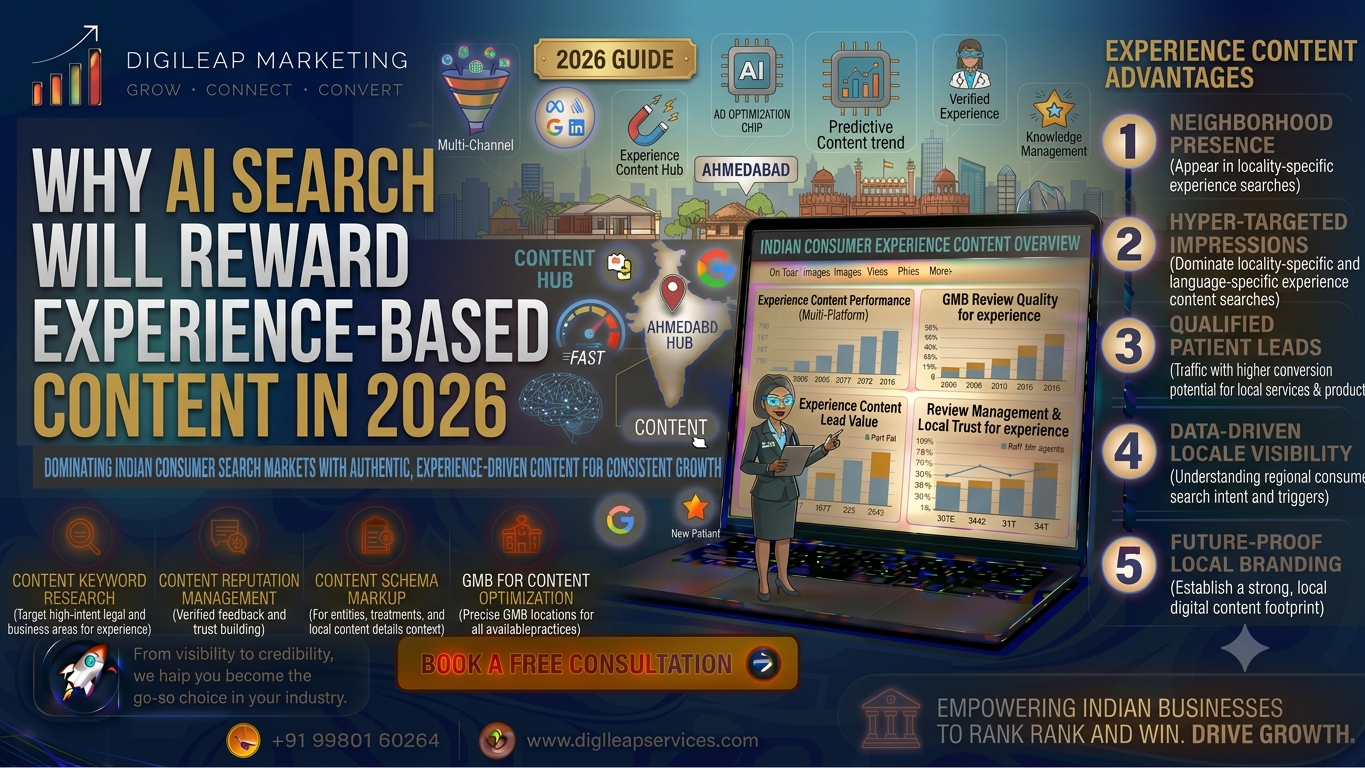
Why AI Search Will Reward Experience-Based Content in 2026
Search is changing quickly in 2026. Instead of relying only on traditional keyword-based results, users are increasingly asking longer, more specific questions and expecting direct, useful answers. Google’s AI-powered search experiences are designed to understand these complex queries and connect users with relevant information across the web. In this environment, Experience-Based SEO 2026 is becoming increasingly important because content based on real expertise, practical knowledge, original insights, and first-hand experience gives search systems more meaningful information to understand and reference.
AI Search Is Moving Beyond Basic Information
Traditional SEO often focused on matching keywords with search queries. While keywords still matter, AI search can now understand context, intent, relationships between topics, and detailed questions. Consequently, simply publishing another article that repeats information already available online may not give a business a strong competitive advantage.
Google’s own guidance encourages creators to develop people-first content that demonstrates first-hand expertise and depth of knowledge. This includes experience gained from actually using a product, providing a service, visiting a location, conducting research, or working directly within an industry.
As a result, Experience-Based SEO 2026 is not about adding the word “experience” to an article. Instead, it means creating content that contains information an ordinary generic article cannot easily reproduce. This could include customer questions, real project lessons, original observations, expert opinions, practical examples, case studies, comparisons, or insights from professionals.
Why First-Hand Experience Matters More
AI systems can process enormous amounts of information. However, much of that information comes from existing online sources. Therefore, websites that simply repeat common advice may struggle to provide something distinctive.
Experience adds another layer of value. For example, instead of writing “website speed is important for SEO,” a digital marketing agency could explain how slow pages affected enquiries for a particular type of business, what problems were discovered, which improvements were implemented, and what changed afterwards. That information provides context and practical value.
This is where Experience-Based SEO 2026 can give businesses an advantage. Real experiences create original information that can support stronger credibility and make content more useful to both users and search systems.
Google has also said that people are increasingly clicking on content where they can find authentic voices and first-hand perspectives, including in-depth reviews, original posts, unique perspectives, and thoughtful first-person analysis.
AI Search Is Handling More Complex Questions
Another reason experience matters is the growing complexity of search queries. Users are no longer limited to short searches such as “SEO agency India.” They can ask detailed questions that include multiple requirements, comparisons, locations, budgets, problems, and expected outcomes.
Google reported that AI Mode queries were, on average, twice as long as traditional Search queries.
As queries become more detailed, users also expect more detailed answers. Therefore, businesses need content that goes beyond definitions and surface-level explanations. They need to demonstrate that they understand the real problems customers face.
For example, a business selling accounting software could explain how different industries use its platform, what implementation problems customers commonly face, how long onboarding takes, and which mistakes businesses should avoid. Such information answers deeper questions and demonstrates genuine knowledge.
That makes Experience-Based SEO 2026 particularly valuable for businesses competing in crowded industries where many websites publish similar generic content.
Original Insights Can Strengthen AI Visibility
AI search systems need reliable information to construct useful answers. Therefore, original research, unique data, expert commentary, and first-hand observations can help a website stand apart from pages that simply summarise existing information.
For instance, a healthcare provider could publish anonymised insights about common patient questions. A real estate agency could explain changing buyer preferences in a specific city. A software company could publish lessons learned from implementation projects. Similarly, a marketing agency could share campaign findings and explain why certain strategies worked or failed.
These examples demonstrate how Experience-Based SEO 2026 connects content with real business knowledge. Instead of creating content only because a keyword has search volume, businesses can build articles around questions their customers genuinely ask.
Google’s people-first content guidance specifically asks whether content demonstrates first-hand expertise and whether readers will leave the page feeling they have learned enough to achieve their goal.
Case Studies Can Become Powerful SEO Assets
Case studies are particularly useful because they combine experience, evidence, context, and outcomes. They can show what a business actually did instead of simply claiming expertise.
A strong case study can explain the original challenge, the customer’s situation, the strategy used, the implementation process, the obstacles encountered, and the outcome. Where appropriate, businesses can include measurable results, screenshots, original data, expert commentary, or customer feedback.
Moreover, case studies can support multiple content opportunities. A single project can become a detailed case study, a supporting blog article, a social media post, an expert commentary piece, or an FAQ. This creates a stronger content ecosystem while keeping the information connected to genuine business experience.
Therefore, businesses should treat real projects as valuable content sources rather than publishing disconnected articles simply to maintain a posting schedule.
Experience Can Improve Trust and Brand Authority
Search visibility is only one part of the modern customer journey. Once users discover a business through search or an AI-generated answer, they still need a reason to trust it.
Experience can help bridge that gap. When a website explains how its team works, what customers can expect, which challenges it has handled, and what lessons it has learned, the brand becomes more transparent.
Google describes E-E-A-T as experience, expertise, authoritativeness, and trustworthiness. Google also explains that E-E-A-T itself is not a single ranking factor, but its systems use various signals to identify content that demonstrates these qualities.
Consequently, Experience-Based SEO 2026 should support a wider trust strategy. Businesses can strengthen content with clear authorship, expert contributions, real examples, original research, customer experiences, accurate claims, and transparent explanations.
AI Does Not Make Human Experience Less Important
The growth of generative AI might seem like a reason to produce more content faster. However, that approach can create a major problem: large volumes of similar information.
AI can help businesses research, organise, edit, and improve content. Nevertheless, the strongest source material should come from people who understand the business, customers, products, services, and industry.
For example, an AI tool can help structure an article about local SEO. However, an experienced SEO professional can add insights about why a particular local campaign struggled, how customer reviews influenced enquiries, or which changes improved lead quality.
That combination creates more valuable content than generic AI-generated explanations alone. The technology can support production, but genuine experience supplies the information that makes the content distinctive.
How Businesses Can Create Experience-Based Content
Businesses should start by looking internally. Sales teams, customer service staff, consultants, account managers, developers, and business owners often have valuable knowledge that never appears on the website.
Customer questions are another strong source. If customers repeatedly ask about pricing, timelines, common mistakes, implementation challenges, product differences, or expected results, those questions can become useful content topics.
Next, businesses should document real examples. Instead of saying that a service “delivers results,” explain how the process works, what challenges appeared, and what the team learned.
Businesses can also add original statistics, survey findings, expert quotes, screenshots, videos, reviews, demonstrations, and first-hand observations where relevant. These elements make content more concrete and easier for readers to evaluate.
For Indian businesses adapting to AI-powered search, an integrated approach combining SEO, content, local visibility, analytics, and AI-search optimisation can be especially useful. Digileap India’s digital marketing and SEO services
The Future of SEO Will Be More About Evidence
The biggest change in 2026 is not that keywords have become irrelevant. Rather, search is becoming better at understanding whether content actually helps users.
Google says AI Overviews are now used by more than 1.5 billion people each month, while AI-powered Search is encouraging users to ask longer and more complex questions.
That shift creates an important opportunity for businesses. Instead of competing only on how much content they publish, they can compete on the quality of their knowledge.
Experience-Based SEO 2026 therefore represents a broader move towards evidence-led content. Brands that share genuine expertise, original information, practical lessons, and useful customer insights can create content that is harder to replicate and more valuable to searchers.
Conclusion
AI search is changing how people discover information, compare businesses, and make decisions. Therefore, generic content alone is unlikely to remain enough. Businesses need to show what they know through real examples, expert insights, original research, customer experiences, and practical lessons. By making genuine experience part of their content strategy, brands can build stronger trust while creating information that is more useful for modern AI-powered search.
TL;DR
AI search is rewarding content that provides useful, original, and trustworthy information. Experience-Based SEO 2026 focuses on first-hand expertise, case studies, original research, customer insights, expert opinions, and practical examples. Businesses that turn their real-world knowledge into helpful content can build stronger authority, improve user trust, and create a more competitive search presence in 2026.