Direct Bookings over OTAs: 5 Digital Marketing Strategies for Indian Boutique Hotels to Slash Commission Costs
For Indian boutique hotels, online travel agencies can be a useful source of visibility. However, every OTA booking can also reduce the revenue a property keeps. Commission fees, promotional costs, and limited access to guest data can slowly make OTA dependency expensive. Therefore, boutique hotels need a stronger direct-booking strategy that attracts travellers to their own website, WhatsApp, phone, and other owned channels.
The goal is not to abandon OTAs completely. Instead, hotels should use them for discovery while gradually moving repeat and high-intent guests toward direct channels. A well-planned digital strategy can help Boost Direct Hotel Bookings while protecting profit margins and strengthening the hotel’s own brand.
According to a 2026 report from the National Council for Hotel Management and Catering Technology, a scenario with 50% OTA bookings and ₹2 lakh in revenue showed ₹40,000 in commissions, compared with ₹24,000 when the OTA share fell to 30%. That difference shows why even a moderate shift towards direct bookings can have a meaningful financial impact.
At the same time, OTAs remain important for attracting new travellers. STAAH’s 2024 channel insights found that GoMMT remained the leading online booking channel for Indian travellers, while its hotel website booking engine also climbed in the ranking. So, rather than treating OTAs as the enemy, boutique hotels should build a digital ecosystem where OTAs support discovery and direct channels support profitability.
1. Turn Your Hotel Website into a Booking Engine
Your hotel website should do much more than display beautiful photographs and a list of room types. Instead, it should actively sell the stay. When a traveller searches for your property, the website should immediately communicate what makes your hotel different, why the guest should trust you, and how they can reserve a room.
First, make the booking process simple. Visitors should be able to check room availability, select dates, understand inclusions, and complete payment without calling the front desk. Moreover, the booking experience must work smoothly on mobile because many travellers research hotels while commuting, waiting, or travelling.
Your homepage should also communicate a clear reason to book directly. This could include complimentary breakfast, flexible cancellation, a room upgrade, welcome amenities, early check-in when available, or a direct-booking loyalty benefit. The value does not always need to mean a lower room rate. In fact, offering additional benefits can help you compete with OTAs without creating unnecessary rate conflicts.
Speed matters as well. A slow website can create hesitation at the exact moment when a guest is ready to book. Therefore, compress large images, simplify navigation, remove unnecessary pop-ups, and keep the booking button visible throughout the journey.
The website should also answer practical questions before guests ask them. Include information about parking, check-in times, nearby attractions, dining, transport, room facilities, policies, and accessibility. Consequently, visitors have fewer reasons to return to an OTA to compare information.
Most importantly, track what happens after visitors arrive. Monitor booking-engine visits, completed reservations, abandoned bookings, source traffic, and device behaviour. This data helps you identify where potential guests are dropping out and where the booking journey needs improvement.
2. Use Local SEO to Capture High-Intent Travellers
Search visibility is one of the strongest long-term assets a boutique hotel can build. Someone searching for “boutique hotel in Jaipur”, “heritage hotel near Udaipur”, or “romantic hotel in Goa” already has travel intent. Therefore, appearing in those searches gives your hotel an opportunity to capture demand before the traveller chooses an OTA.
Local SEO should begin with your Google Business Profile. Keep your hotel name, address, phone number, website, amenities, photos, opening information, and room details accurate. Encourage genuine guests to leave reviews and respond to those reviews professionally. Furthermore, regularly add fresh photographs that show rooms, common areas, food, views, experiences, and seasonal activities.
Google explains that hotel results can consider factors such as location, price, ratings, and reviews when determining relevance. Google also provides hotel booking links that can connect travellers with booking partners, including direct hotel booking options.
Your website should then support your local visibility. Create useful pages around the destination and the experiences your guests care about. A boutique hotel in Kerala, for example, could publish content about local attractions, monsoon travel, nearby cultural experiences, airport transfers, and weekend itineraries.
This approach does more than attract generic traffic. It builds topical relevance around your destination and property. Over time, consistent SEO can help you Boost Direct Hotel Bookings by bringing travellers to your own website instead of sending every searcher to an OTA listing.
You can also strengthen your visibility through structured content. Add clear room information, location details, FAQs, policies, and internal links. In addition, make sure every important page has a descriptive title and a useful meta description.
For a broader approach to hotel marketing, hotels can also explore Digileap India’s hotel digital marketing strategies, which covers SEO, social media, and other digital channels that can support booking growth.
3. Combine Google Ads and Remarketing with Direct Offers
SEO can build sustainable traffic, but paid advertising can help boutique hotels reach travellers much faster. However, simply running Google Ads for broad terms such as “hotels in India” can waste money. Instead, focus on high-intent searches connected to your location, property type, experiences, and brand.
For example, a boutique hotel in Rishikesh could target searches related to boutique stays in Rishikesh, hotels near the Ganga, luxury stays near specific attractions, or accommodation for particular travel occasions. Consequently, your advertisements reach people who are closer to making a decision.
Brand campaigns are equally important. If someone discovers your hotel through Instagram, an OTA, travel content, or word of mouth and then searches your hotel name, your advertisement and organic listing should reinforce the brand. Otherwise, another platform may capture that search.
Remarketing can take this further. A visitor may look at your rooms today but decide to book tomorrow. Instead of losing that potential guest, you can show them a relevant advertisement later. The message could highlight a seasonal package, complimentary breakfast, an experience, or a direct-booking benefit.
However, avoid aggressive advertising. Boutique hotels sell experiences, not just beds. Therefore, your ads should communicate the atmosphere of the property. A peaceful courtyard, mountain view, heritage architecture, local cuisine, or personalised service can create a stronger emotional connection than generic phrases such as “best hotel deal”.
Google’s hotel ecosystem also provides booking links and paid hotel advertising options, giving properties additional ways to appear when travellers compare accommodation. The key is to connect these campaigns to a fast, trustworthy direct booking page.
Ultimately, advertising should be measured by bookings and revenue, not clicks alone. Track cost per booking, conversion rate, revenue generated, and the percentage of paid traffic that converts through your own booking engine. With consistent optimisation, paid search and remarketing can help Boost Direct Hotel Bookings without relying entirely on OTA visibility.
4. Make Instagram, Video and WhatsApp Part of the Booking Journey
Boutique hotels have one major advantage over many large hotel chains: personality. Your property may have a unique story, architecture, local connection, cuisine, location, or guest experience. Digital content gives you the opportunity to show that personality before a traveller arrives.
Instagram Reels, short videos, Stories, and user-generated content can demonstrate what staying at your property actually feels like. Show the morning view from a room. Film the preparation of a local breakfast. Walk through the property. Introduce the chef. Show a nearby attraction. Capture a sunset from the terrace.
Most importantly, don’t make every post look like an advertisement. Travellers want to imagine themselves at your property. Therefore, authentic and experience-led content can create stronger interest than constant promotional graphics.
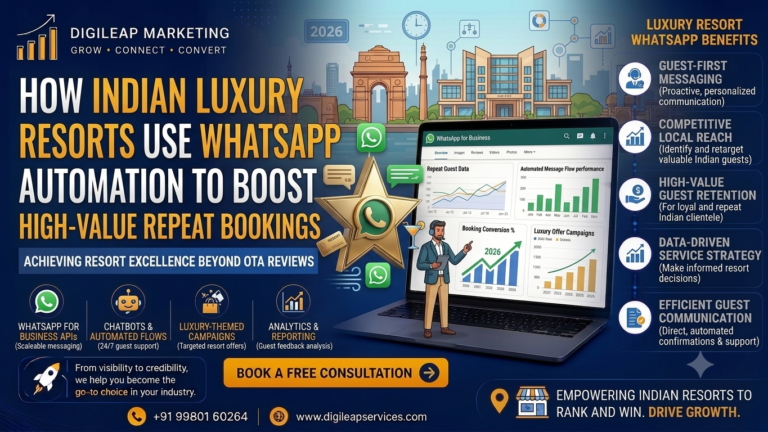
WhatsApp can then turn that interest into conversation. Add a clear WhatsApp contact option to your website and social profiles. Potential guests can ask about room availability, packages, transport, meals, celebrations, or special requests without leaving the platform they already use.
You can also create post-stay communication. After a guest checks out, thank them for staying and invite them to return with a direct-booking benefit. With appropriate consent and responsible data handling, you can build a first-party guest audience that becomes increasingly valuable over time.
Email marketing can support this process as well. Send seasonal offers, destination guides, anniversary packages, weekend experiences, or personalised return-stay messages. Because the guest already knows your property, these campaigns can require less persuasion than campaigns targeting completely new travellers.
The important shift is to stop thinking of social media as a follower-building exercise. Instead, treat it as part of the booking journey. A Reel creates awareness, the profile builds trust, the website answers questions, WhatsApp handles enquiries, and the booking engine completes the reservation. Together, these channels can Boost Direct Hotel Bookings while building a stronger relationship with guests.
5. Build a Direct-Booking Loyalty and Review Strategy
A guest who has already stayed at your hotel is one of your most valuable future customers. They know the property, understand the experience, and have already overcome the trust barrier that stops many first-time travellers from booking independently.
Therefore, boutique hotels should build a simple direct-booking loyalty system. It does not have to be complicated. A returning guest might receive priority room selection, complimentary breakfast, flexible check-in when possible, an experience upgrade, or a special member-only offer.
The key is to make the benefit meaningful. If guests can receive the same offer through an OTA, there is little reason to book directly. Instead, give direct guests an additional reason to choose your own channel.
Reviews are another essential part of this strategy. After a positive stay, encourage guests to share an honest review. Respond to reviews with warmth and detail rather than generic replies. When potential guests see recent reviews and thoughtful responses, they gain confidence in the property.
You should also use guest feedback to improve your marketing. If guests repeatedly praise your breakfast, location, staff, views, or peaceful atmosphere, those themes should appear in your website copy and advertising. In other words, let real customers tell you what makes your hotel attractive.
Over time, this creates a powerful cycle. Great experiences generate reviews. Reviews create trust. Trust improves conversion. Direct bookings create a stronger guest relationship. Stronger relationships encourage repeat stays. Repeat stays then reduce the need to pay acquisition costs repeatedly through OTAs.
This is how boutique hotels can Boost Direct Hotel Bookings without trying to eliminate every OTA reservation.
Measure the Shift from OTA Revenue to Direct Revenue
Digital marketing only works when hotel owners can see what is changing. Therefore, don’t judge your direct-booking strategy by website traffic alone. Measure the percentage of reservations coming directly from your website, the cost of acquiring those bookings, booking-engine conversion rate, average booking value, repeat-booking rate, and OTA commission savings.
For example, if your hotel currently receives most online reservations through OTAs, don’t expect the mix to change overnight. Start by setting a realistic target for increasing direct bookings over three, six, and twelve months.
Also compare net revenue rather than room rate alone. A ₹6,000 OTA reservation with a 20% commission does not produce the same net revenue as a ₹6,000 direct reservation after payment-processing costs. Once you understand this difference, the value of direct acquisition becomes much clearer.
At the same time, keep monitoring OTA performance. Some OTAs may bring valuable international or first-time customers that your hotel would struggle to reach independently. Therefore, the smarter approach is channel diversification rather than complete OTA elimination.
Conclusion
Indian boutique hotels don’t need to choose between OTAs and direct bookings. They need to choose the right role for each channel. OTAs can create discovery, while SEO, paid advertising, social media, WhatsApp, loyalty marketing, and a strong website can turn that discovery into profitable direct relationships.
The biggest opportunity lies in making direct booking easier, more visible, and more valuable. When guests have a clear reason to book through your website, every successful direct reservation keeps more revenue within your business.
With the right strategy, boutique hotels can Boost Direct Hotel Bookings, reduce unnecessary commission costs, strengthen their brand, and build a guest database they actually own.
TL;DR
Boutique hotels should not try to eliminate OTAs completely. Instead, they should use OTAs for visibility while building stronger direct channels. A fast booking-focused website, local SEO, Google Ads and remarketing, social media and WhatsApp, and a simple loyalty and review strategy can gradually shift bookings away from commission-heavy platforms. Track direct booking share, acquisition costs, conversion rates, repeat stays, and commission savings to understand what is working. The long-term goal is simple: attract guests through multiple channels but encourage more of them to complete their reservations directly with the hotel.