Best SEO Tools for Indian Digital Marketing Agencies in 2026
Why SEO Tools Matter More in 2026
The SEO landscape in India has changed quickly. Search engines now understand context, user intent, entities, location, and conversational queries far better than before. At the same time, AI-powered search is changing how people discover businesses, products, and services. Because of this shift, agencies can no longer depend only on keyword rankings. They need reliable data to understand technical performance, content quality, backlinks, competitors, search visibility, and emerging AI search opportunities. That is why choosing the right SEO Tools for Indian Digital Marketing Agencies can directly influence campaign performance, reporting quality, and client retention.
Indian agencies also face a unique challenge. A single agency may manage SEO campaigns for a local restaurant in Mumbai, an e-commerce company in Bengaluru, a SaaS business in Hyderabad, and a UK-based service company at the same time. Each client needs a different strategy. Therefore, agencies need tools that can handle local SEO, international SEO, keyword research, competitor analysis, technical audits, content optimisation, and performance tracking without creating unnecessary complexity.
Moreover, SEO is becoming increasingly data-driven. Google Search Console, for example, provides information about search queries, impressions, clicks, positions, indexing, and technical issues directly from Google’s search ecosystem. As a result, agencies that combine first-party data with specialist SEO platforms can make much stronger decisions.
Top SEO Tools for Agencies
Semrush for All-Round SEO Management
For an Indian agency, this can save considerable time. Instead of switching between multiple dashboards, an SEO team can investigate competitors, identify keyword opportunities, monitor rankings, and analyse website health from a central platform. This becomes particularly useful when an agency manages several clients with different industries and target locations.
Furthermore, Semrush has expanded its focus beyond traditional search. Its 2026 research and product direction increasingly cover AI visibility and AI-powered discovery. Semrush reported in June 2026 that its expanded AI Visibility Index analysed 126 million US AI search prompts, showing how seriously the industry is beginning to measure visibility beyond conventional search results.
For agencies planning long-term SEO strategies, this wider approach matters. Search visibility is no longer limited to a blue link on Google. Brands increasingly need to understand how they appear across search engines, AI interfaces, and other discovery environments.
Ahrefs for Keywords and Backlinks
Ahrefs is another powerful option for agencies that place strong emphasis on keyword research, competitor analysis, backlinks, and content opportunities. Its Site Explorer can help agencies examine organic traffic, backlink profiles, paid traffic, and website structures, while Keywords Explorer supports detailed keyword research and topic discovery.
One impressive statistic highlights the scale of its keyword database. Ahrefs currently states that Keywords Explorer works across 110 billion keywords, with 28.7 billion filtered keywords available through its keyword research system. This depth can be especially useful when agencies work with competitive Indian markets where broad keywords often have high competition.
For example, a digital marketing agency targeting searches such as “digital marketing agency Mumbai” may need to discover long-tail variations around specific services, industries, locations, and customer intent. Ahrefs can help identify those opportunities while also showing what competing websites are ranking for.
Backlink analysis is another major strength. Agencies can examine referring domains, identify link-building opportunities, compare competitors, and understand how authority is distributed across websites. Consequently, SEO Tools for Indian Digital Marketing Agencies should not focus only on keywords. They should also help agencies understand the authority and competitive landscape surrounding those keywords.
Google Search Console for First-Party Data
No professional SEO stack should ignore Google Search Console. Unlike many paid platforms, Search Console provides direct data from Google’s search environment and is available without a subscription fee.
Google states that Search Console helps website owners understand how their websites perform in Google Search. It can show search queries, clicks, impressions, average positions, indexing information, and technical issues. Therefore, agencies can use it to validate the insights they receive from third-party platforms.
This is especially important when client reporting is involved. Third-party tools estimate certain metrics, while Search Console provides actual performance data for the verified website. An agency can therefore compare ranking-tracker data with real impressions and clicks before making strategic decisions.
Search Console also helps agencies identify indexing problems and submit updated URLs for crawling. The URL Inspection tool provides information about how Google sees a particular page, while Core Web Vitals and other reports can highlight areas requiring technical attention.
For that reason, Google Search Console should form the foundation of SEO Tools for Indian Digital Marketing Agencies, even when an agency already pays for premium platforms.
Screaming Frog for Technical SEO
Technical SEO can become complicated quickly, especially when agencies manage large websites. Screaming Frog SEO Spider is therefore useful for crawling websites and identifying technical problems that may otherwise remain hidden.
A technical audit can reveal issues such as broken links, redirect problems, duplicate pages, missing metadata, canonicalisation concerns, incorrect status codes, and other crawl-related problems. Instead of manually checking hundreds or thousands of pages, an agency can use a crawler to analyse the website systematically.
This is particularly valuable for e-commerce websites, news websites, large corporate sites, and businesses with extensive service pages. For example, an agency working with an Indian e-commerce brand may need to investigate thousands of URLs. Manually checking every page would consume too much time. A technical crawler makes that process considerably more efficient.
However, agencies should remember that a crawler does not replace strategic thinking. The tool can identify problems, but an SEO professional still needs to determine which issues matter most and how they could affect search performance. That combination of automation and human judgement is what makes SEO Tools for Indian Digital Marketing Agencies genuinely valuable.
Google Analytics 4 for Measuring Results
SEO campaigns should not stop at rankings. Clients ultimately want traffic, engagement, leads, sales, bookings, enquiries, or revenue. Google Analytics 4 can help agencies connect organic traffic with user behaviour and conversions.
When agencies combine Google Analytics 4 with Search Console, they can build a clearer picture of the customer journey. Search Console can show which queries and pages generate visibility, while Analytics can provide deeper information about what users do after reaching the website.
For instance, a page may rank well and receive substantial organic traffic but generate very few enquiries. That result tells an agency something important. The problem may not be ranking. It could be the landing page, offer, call to action, page experience, or mismatch between search intent and content.
Consequently, agencies should measure SEO as a business activity rather than treating rankings as the final objective. Traffic quality and conversions often provide a more meaningful picture of campaign success.
Surfer for Content Optimisation
Content teams can also benefit from specialist optimisation platforms such as Surfer. These tools can help content writers and SEO professionals analyse competing pages, understand relevant topics, and improve content structure.
However, agencies should avoid treating content optimisation as a formula. Adding a specific number of keywords to a page does not automatically make it useful. Search engines increasingly evaluate meaning, relevance, experience, originality, and usefulness.
Therefore, agencies should use content tools as research assistants rather than automatic content generators. A writer should still understand the target audience, answer the real search intent, add original insights, and create content that provides genuine value.
This approach becomes even more important as AI-generated content becomes easier to produce. Agencies that simply publish large quantities of generic content may struggle to create meaningful differentiation. Instead, they should use technology to speed up research while keeping human expertise at the centre of content development.
BrightLocal for Local SEO
Local SEO is particularly important for Indian businesses because customers often search for services using location-based queries. A person looking for a dentist, restaurant, salon, clinic, gym, lawyer, or repair service may include a city or neighbourhood in the search.
BrightLocal can support agencies working on local search campaigns by helping with local rank tracking, citation management, reputation monitoring, and other local SEO activities. This makes it useful for agencies managing multiple local-business clients.
Local SEO also requires more than traditional keyword optimisation. Agencies need to monitor Google Business Profile visibility, reviews, local relevance, business information, and location-specific search behaviour.
For an agency handling dozens of local clients, dedicated local SEO software can make recurring monitoring and reporting more manageable. It can also help teams identify changes in local visibility before they become significant problems.
How Agencies Should Build Their SEO Stack
The best approach is not to purchase every available platform. Instead, agencies should build a stack around their workflow. A small agency may start with Google Search Console, Google Analytics 4, and one comprehensive paid platform. As the agency grows, it can add specialist tools for technical SEO, local SEO, content optimisation, and backlink research.
For example, Semrush or Ahrefs can handle broad SEO intelligence, Google Search Console can provide first-party search data, Screaming Frog can support technical audits, and a local SEO platform can support location-based campaigns. Together, these tools can cover most of the major SEO requirements faced by agencies.
Agencies should also consider reporting capabilities. A tool may have excellent data but still create problems if teams cannot turn that information into simple client-facing reports. Therefore, ease of use, data integration, user access, export options, and reporting workflows should influence purchasing decisions.
Cost is another important consideration for Indian agencies. Currency conversion, user seats, project limits, keyword tracking limits, and client accounts can significantly affect the total cost. Instead of choosing the most expensive platform, agencies should calculate how frequently the team will use each feature and whether the tool can support business growth.
AI Search Is Changing SEO Tool Requirements
The rise of AI search makes the selection of SEO software even more important. Agencies now need to think about traditional rankings alongside brand mentions, citations, conversational queries, content authority, and visibility in AI-generated answers.
BrightEdge research published in 2025 found that AI search referral traffic was growing rapidly, but it still accounted for less than 1% of referral traffic in the analysed period, while organic search remained the primary traffic source and delivered the majority of conversions. This statistic shows why agencies should not abandon traditional SEO simply because AI search is growing.
Instead, the smarter strategy is to prepare for both environments. Agencies should continue improving technical SEO, content quality, backlinks, structured information, and user experience while also monitoring how brands appear in AI-driven discovery.
For Indian agencies, this creates an opportunity. Businesses that adapt early can build stronger visibility across traditional and emerging search channels. However, the technology should support strategy rather than replace it.
Choosing the Right SEO Tools for Your Agency
There is no single platform that is perfect for every agency. The right choice depends on the agency’s clients, services, team size, budget, reporting requirements, and growth goals.
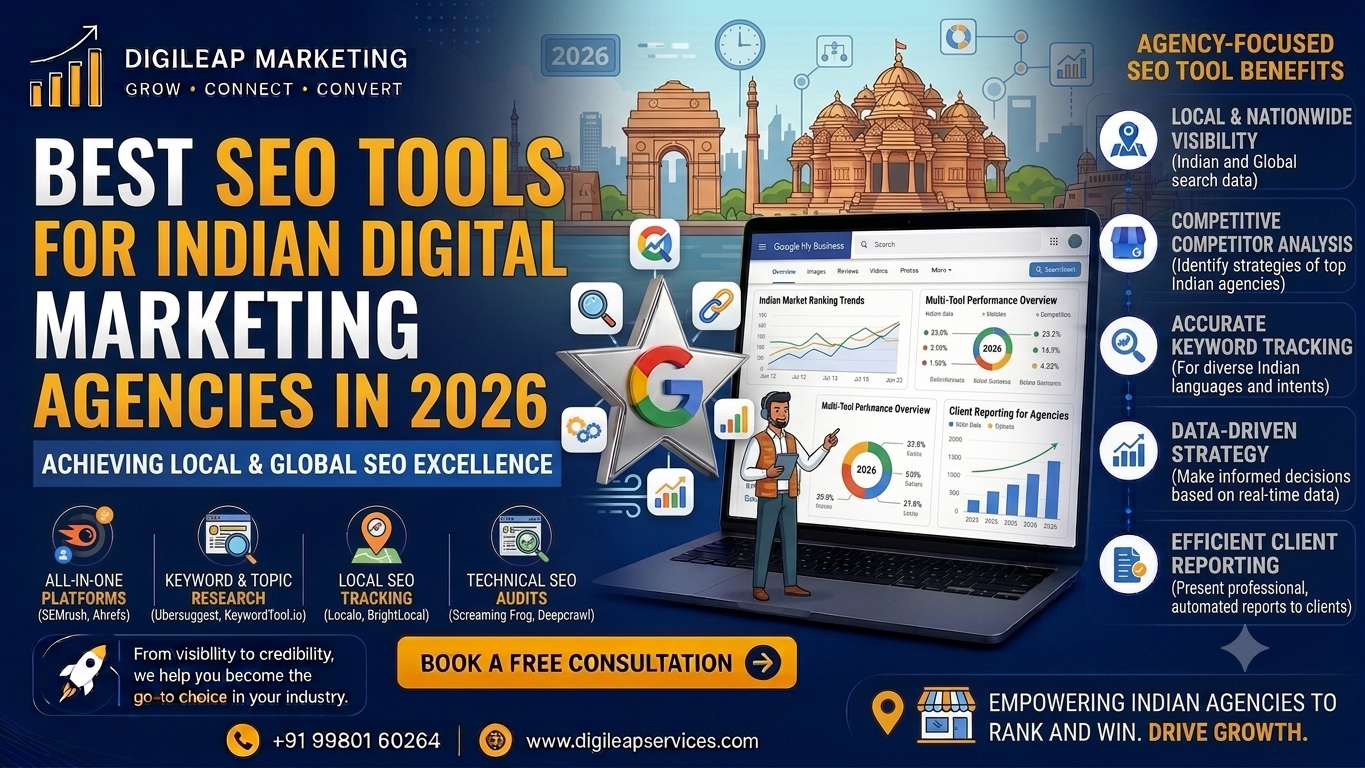
A full-service agency may benefit from Semrush or Ahrefs as its primary platform. A technical SEO team may place greater emphasis on Screaming Frog. A local SEO agency may prioritise BrightLocal. A content-focused team may add a content optimisation platform. Meanwhile, Google Search Console and Google Analytics 4 should remain important parts of the measurement framework.
Ultimately, the strongest SEO Tools for Indian Digital Marketing Agencies are not necessarily the ones with the longest feature lists. They are the tools that help teams turn search data into better decisions, faster execution, clearer reporting, and measurable business results.
If your agency is also looking to strengthen its overall SEO and digital marketing strategy, you can explore Digileap India’s digital marketing services to understand how a structured approach can support online growth.
Conclusion
SEO in 2026 requires a combination of technology, data, creativity, and strategic thinking. Semrush and Ahrefs can provide powerful competitive and keyword intelligence, Google Search Console delivers valuable first-party search data, Screaming Frog supports technical audits, and specialist platforms can strengthen content and local SEO workflows. The key is to build a practical technology stack instead of collecting tools without a clear purpose.
For Indian agencies, the future belongs to teams that can use these platforms efficiently while still understanding customers and search intent. The right SEO Tools for Indian Digital Marketing Agencies can make campaigns more efficient, but strong strategy is what turns that data into sustainable growth.
TL;DR
- Semrush & Ahrefs: All-round SEO research and competitive intelligence.
- Google Search Console: Essential first-party search and performance data.
- Screaming Frog: Technical site audits and crawling.
- Google Analytics 4: Traffic, user behavior, and conversion tracking.
- Surfer & BrightLocal: Specialist platforms for content optimization and local SEO.
Rather than relying on one platform, agencies should create a focused SEO stack that matches their clients, budget, reporting needs, and long-term search strategy.