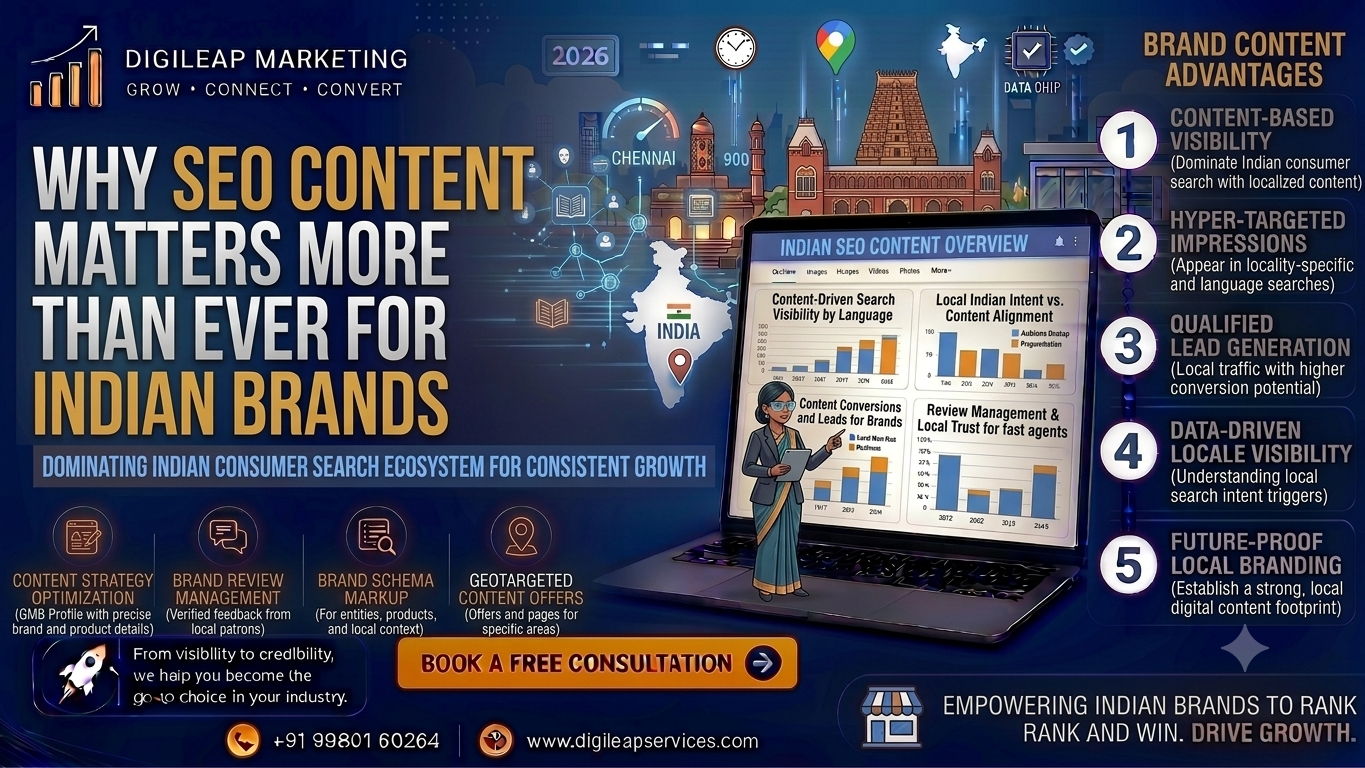
Why SEO Content Matters More Than Ever for Indian Brands
Indian consumers are spending more time online, researching products, comparing services, and looking for answers before making decisions. As competition grows across Google Search, social media, marketplaces, and AI-powered search experiences, brands need content that does more than fill a website. SEO Content for Indian Brands helps businesses connect with people when they are actively searching for information, products, and services. It can support visibility, build trust, answer customer questions, and guide people towards action.
The scale of India’s digital market makes this even more important. DataReportal reported 806 million internet users in India in January 2025, representing 55.3% of the population at that time. This large online audience gives Indian businesses a major opportunity, but it also creates more competition for attention. Therefore, brands need useful, relevant, and well-structured content that matches what their audiences actually want.
Indian Consumers Are Searching Before They Buy
Buying decisions often begin with research. Consumers may search for product comparisons, prices, reviews, locations, service providers, how-to guides, or answers to specific problems before they contact a business. Because of this, brands need to be present during these early research moments instead of appearing only when a customer is ready to buy.
Google and Bain’s India e-Conomy research found that 80% of digital consumers begin their search for a new product online rather than starting with a physical store visit or offline recommendation. This statistic shows why search visibility matters across different stages of the customer journey.
For example, someone looking for a dental clinic may first search for treatment information. Later, they may compare clinics, check reviews, look at locations, and finally book an appointment. A strong content strategy can support each stage. Instead of publishing only sales-focused pages, brands can answer real questions and provide useful information that helps potential customers move forward.
This is where SEO Content for Indian Brands becomes valuable. It connects content planning with actual search behaviour. Rather than guessing what customers want to read, businesses can use keyword research, search intent, customer questions, and industry trends to create pages that serve a clear purpose.
SEO Content Builds Visibility Beyond Product Pages
A website does not need to depend only on product or service pages to attract organic traffic. Blogs, guides, landing pages, FAQs, case studies, comparison pages, and location-based content can all create additional opportunities to appear in search results.
For instance, an Indian skincare brand could publish content about choosing products for different skin types, seasonal skincare routines, ingredient guides, or common skincare concerns. A B2B manufacturer could create articles explaining sourcing, quality checks, production processes, and supply chain considerations. A local business could create useful pages around services, locations, customer questions, and buying decisions.
However, creating more pages does not automatically produce better SEO results. Google recommends helpful, reliable, people-first content rather than content created mainly to manipulate rankings. Its guidance also stresses originality, clear expertise, useful information, and satisfying the reader’s needs.
Therefore, SEO Content for Indian Brands should focus on relevance before volume. A smaller collection of genuinely useful pages can provide more value than a large library of repetitive articles. Each page should answer a clear question, target a sensible search intent, and give readers a reason to continue exploring the website.
Search Intent Should Guide Every Piece of Content
Keywords are important, but they are only part of an effective SEO strategy. Brands also need to understand why someone is searching for a particular term.
A person searching for “best running shoes for beginners” may want guidance before buying. Someone searching for “Nike running shoes price India” may already be closer to a purchase. Meanwhile, someone searching for “how to clean running shoes” may simply want information. These searches require different types of content.
Indian brands can improve their content by identifying informational, commercial, navigational, and transactional intent. This approach helps businesses create pages that answer the actual need behind the search rather than simply repeating a keyword.
Google’s SEO Starter Guide recommends creating useful, easy-to-read, well-organised, unique, and up-to-date content. It also advises website owners to think about the words users might search for while avoiding an obsession with matching every possible keyword variation.
As a result, SEO Content for Indian Brands should sound natural and helpful. Keywords should fit the topic instead of interrupting the reader. When brands understand search intent, they can create content that supports both visibility and user experience.
Local Search Makes Content More Relevant
India’s market is diverse. Customer needs can change across cities, regions, languages, income groups, and industries. A generic page may not always address these differences effectively.
Local SEO content can help businesses communicate with customers in specific areas. A healthcare provider, restaurant, education company, real estate business, or service provider can create useful location-based content around genuine customer needs.
For example, a clinic in Bengaluru could publish a guide explaining what patients should consider when choosing a particular treatment in the city. A restaurant could create content around local dining occasions. A real estate company could publish useful neighbourhood information. These pages can give search engines more context while giving customers more relevant information.
However, businesses should avoid creating dozens of almost identical location pages simply by changing city names. Useful local content should contain real information about the area, service, customer need, or business offering.
This makes SEO Content for Indian Brands particularly useful for businesses operating across multiple cities. Content can support broader visibility while also addressing local search behaviour. Digileap’s recent guidance on hyperlocal SEO similarly highlights the value of content based on real questions from local customers and recommends building local relevance across websites, Google Business Profiles, reviews, citations, and related platforms.
Helpful Content Can Strengthen Brand Trust
SEO is not only about getting someone to visit a website. Once visitors arrive, the content needs to give them confidence in the brand.
Clear explanations, original insights, transparent information, useful examples, author details, customer experiences, and supporting evidence can all contribute to trust. This becomes especially important for industries where customers need to make careful decisions.
For example, a financial services company should explain its services clearly instead of relying on vague promotional statements. A healthcare website should provide accurate and responsible information. A technology company can demonstrate expertise through detailed guides, use cases, and practical explanations.
Google’s current guidance encourages creators to make it clear who created content, how it was produced when relevant, and why it exists. It also emphasises first-hand experience, expertise, and trustworthy information.
Therefore, SEO Content for Indian Brands can become part of a wider trust-building strategy. When useful content consistently answers customer questions, a brand can demonstrate knowledge before the customer ever makes direct contact.
AI Search Makes Original Content More Important
Search is also changing as AI-powered experiences become part of how people discover information. This does not mean traditional SEO has disappeared. Instead, brands need to make their content easier to understand, more useful, and more distinctive.
Google’s guidance for generative AI search states that unique, compelling, helpful, reliable, people-first content can support visibility in generative AI experiences. It also advises businesses to create content that offers value beyond information that can easily be found elsewhere.
This creates an important opportunity for Indian brands. Instead of publishing generic articles that repeat information already available online, businesses can share original research, first-hand experience, expert commentary, customer questions, industry insights, examples, and practical solutions.
AI tools can also help marketers research topics, organise ideas, or improve workflows. However, businesses should still review content for accuracy, originality, relevance, and brand voice. Google’s guidance makes clear that using automation to manipulate search rankings is not the goal; the focus should remain on creating useful content for people.
SEO Content Supports Long-Term Organic Growth
Paid advertising can help businesses reach audiences quickly, but content can continue attracting visitors after publication. A useful article can rank for several related searches, earn links, support internal pages, and bring visitors back to a website over time.
This does not mean every blog will rank immediately or generate leads automatically. Search performance depends on factors such as competition, technical SEO, authority, relevance, content quality, search intent, and user experience.
Still, consistent content gives brands more opportunities to be discovered. Businesses can update older pages, improve weak sections, add relevant internal links, and expand topics when customer needs change.
For brands looking to build a wider digital strategy, Digileap India’s SEO and digital marketing services include keyword research, on-page optimisation, content creation, technical SEO, and link-building as part of its SEO approach.
Quality Matters More Than Publishing More
One common mistake is treating SEO content as a numbers game. Publishing ten weak articles is not necessarily better than publishing two detailed and useful resources.
Brands should first identify the questions their customers ask. Then, they can study search results, examine competing content, identify gaps, and create something more useful. The content should have a clear purpose and should avoid unnecessary repetition.
Google’s Search Essentials specifically recommends helpful, reliable, people-first content and explains that meeting technical requirements alone does not guarantee that Google will crawl, index, or serve a page.
Therefore, brands should measure content by more than word count. Organic impressions, clicks, engagement, assisted conversions, leads, rankings for relevant terms, and conversions can provide a clearer picture of performance.
A Strong Content Strategy Connects SEO With Business Goals
The strongest content strategies connect search demand with business objectives. A brand should not create content simply because a keyword has search volume. The topic should have a relationship with the products, services, audience, or expertise of the business.
For example, an Indian SaaS company can create educational content that helps prospects understand a problem its software solves. An e-commerce brand can answer product questions and provide buying guidance. A professional service company can demonstrate expertise through detailed guides and case studies.
This approach makes content more useful throughout the customer journey. Informational content can attract new audiences, comparison content can support consideration, and service or product pages can help users take action.
As a result, SEO Content for Indian Brands works best when SEO, content, user experience, and conversion goals work together. The objective is not simply to attract traffic. It is to attract the right people and give them useful reasons to trust and engage with the business.
Conclusion
Indian brands now compete for attention across a large and rapidly changing digital market. With hundreds of millions of people using the internet, search remains an important part of how customers discover information and research products and services.
Effective SEO Content for Indian Brands should therefore focus on useful information, genuine search intent, local relevance, expertise, originality, and a clear connection to business goals. When brands consistently answer real customer questions and provide valuable information, their content can support visibility, trust, and long-term organic growth.
TL;DR
SEO Content for Indian Brands matters because Indian consumers increasingly research online before making decisions. Useful, original, search-focused content can help brands appear for relevant searches, answer customer questions, build trust, support local visibility, and adapt to changing search experiences. The focus should be on people-first quality rather than publishing large amounts of repetitive content.