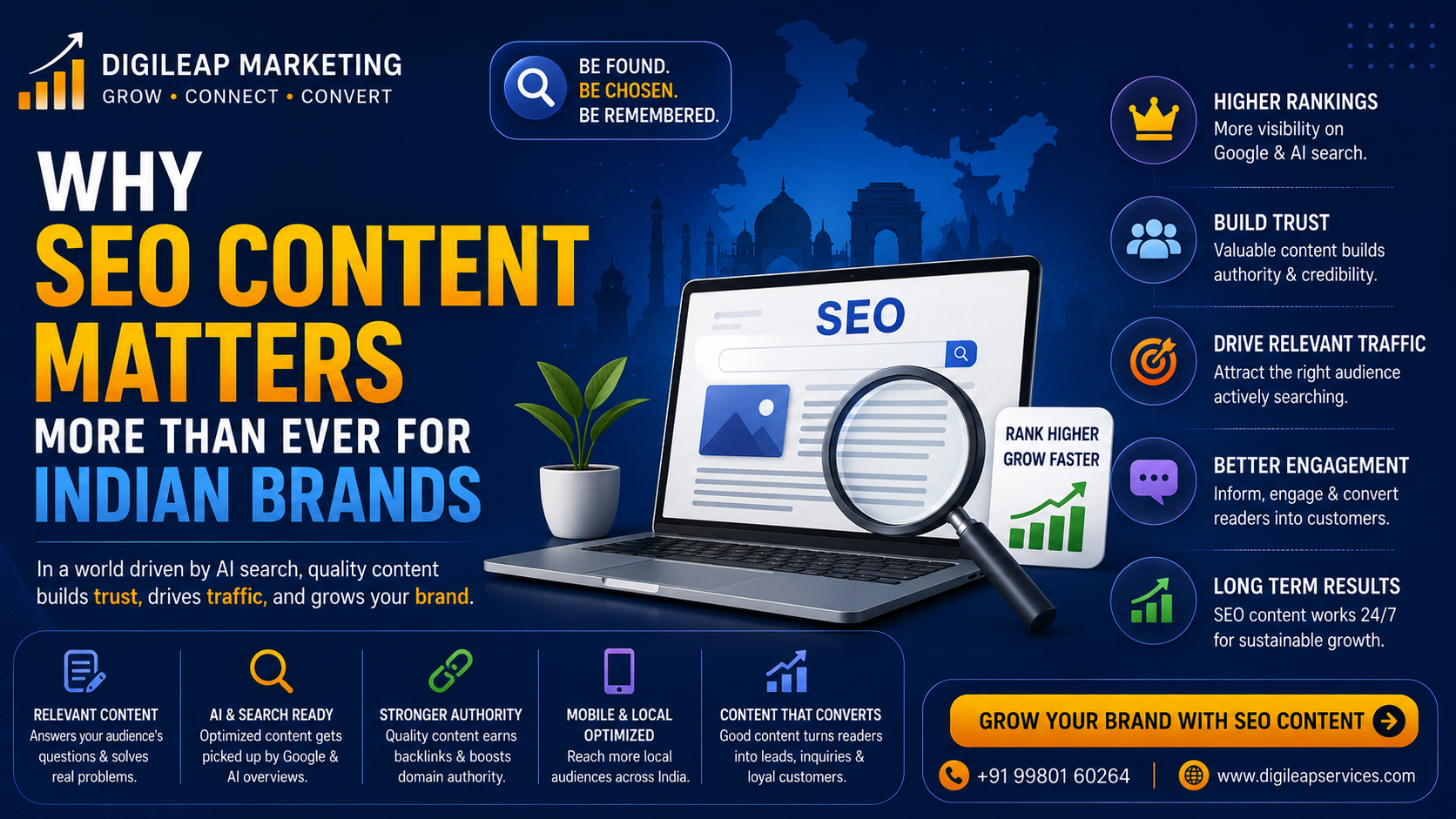
Why SEO Content Matters More Than Ever for Indian Brands
In India’s fast-growing digital market, customers often search online before they decide what to buy, where to shop, or which company to trust. As a result, brands can no longer depend only on advertisements, social media posts, or word-of-mouth referrals. They need useful information that answers customer questions and appears when people are actively searching. This is where SEO Content for Brands becomes increasingly important. Well-planned content can help Indian businesses improve visibility, build trust, attract relevant visitors, and create long-term opportunities for growth. Moreover, as search behavior changes because of mobile usage, voice search, and AI-powered search experiences, brands need content that works for both people and modern search systems.
India’s Digital Audience Is Growing
The Indian digital market has changed dramatically over the last decade. Today, customers from large cities, smaller towns, and rural areas use the internet to research products and services. They compare prices, read reviews, watch videos, explore websites, and search for solutions before making decisions. Therefore, having a strong digital presence is no longer optional for ambitious brands.
Statista reports that India had around 806 million active internet users in February 2025. The same source also highlights the country’s growing mobile internet usage and expanding digital population. This massive audience creates a huge opportunity for Indian businesses. However, reaching that audience requires more than simply having a website.
A website needs to provide the right information at the right time. For example, someone searching for “best skincare clinic in Mumbai” is already showing interest in a specific service. A helpful page answering their questions can introduce the brand, explain its expertise, and encourage the visitor to take the next step. Consequently, content becomes a bridge between a customer’s search and a company’s offering.
Search Behaviour Has Changed
Indian consumers are becoming more comfortable researching brands before contacting them. Instead of immediately calling a business, many people first search for information, compare alternatives, check online reviews, and look for evidence that a company can solve their problem.
This change makes SEO Content for Brands valuable because it allows businesses to become visible during different stages of the customer journey. A potential customer may initially search for a general question. Later, they may search for specific products, compare companies, and finally look for reviews or pricing. A brand with useful content can remain visible throughout this journey.
For instance, a furniture company can create content explaining how to choose furniture for small apartments. It can then publish another page comparing different materials and a product guide explaining maintenance. Finally, it can provide detailed product pages. Each piece serves a different search intent while gradually building familiarity with the brand.
As a result, SEO content does not simply attract visitors. It helps brands communicate with potential customers before a salesperson ever speaks to them.
Content Builds Brand Visibility
Search visibility is one of the biggest advantages of creating useful content. When people search for questions related to a company’s products or services, search engines need to decide which pages deserve visibility. Clear, relevant, useful, and trustworthy content gives search engines more information about a brand and its expertise.
However, businesses should not create content simply to insert keywords repeatedly. Google states that its systems are redesigned to prioritize helpful, reliable, people-first content rather than content created primarily to manipulate search rankings.
Therefore, successful SEO Content for Brands should begin with the audience rather than the keyword. Brands should understand what their customers want to know, what problems they face, and what information could help them make better decisions. Keywords should then naturally support that information.
This approach also makes content more useful beyond Google. A well-written article can be shared on social media, referenced by sales teams, included in email campaigns, and used to answer customer questions. In other words, one strong piece of content can support several marketing activities.
Indian Brands Need Local Relevance
India is not one uniform market. Consumer behavior differs significantly between cities, states, languages, income groups, and industries. Consequently, brands need content that reflects local needs and search behavior.
A business operating in Bengaluru may need different content from a company targeting customers in Jaipur or Kolkata. A healthcare provider may focus on location-based searches, while an e-commerce brand may focus on product comparisons and buying guides.
Local relevance can make content much more valuable. Instead of writing a generic article about a service, a brand can create content around the questions customers ask in a specific city. A restaurant can publish guides around local dining searches. A real estate company can discuss neighborhood-specific buying considerations. A clinic can answer questions related to its services and location.
This strategy helps businesses connect their expertise with actual customer needs. Furthermore, local content can support Google Business Profile visibility and strengthen the overall local SEO strategy.
Brands looking to improve their wider online presence can also explore Digileap India’s digital marketing services, which cover areas such as SEO, content marketing, social media marketing, and lead generation.
Content Builds Trust Before the Sale
Customers rarely trust a company simply because it claims to be the best. They want proof, useful information, experience, and transparency. Content provides a way for brands to demonstrate these qualities before asking customers to make a purchase.
For example, a financial company can explain complicated financial concepts in simple language. A healthcare business can publish educational information about its services. A technology company can create tutorials that help users solve common problems. Similarly, an education company can publish detailed guides that help students understand their options.
Over time, this information can establish the brand as a useful and knowledgeable source. Consequently, when customers are ready to purchase, the brand may already feel familiar and credible.
This is particularly important in industries where customers need considerable research before making a decision. Expensive products, professional services, healthcare, education, real estate, and technology often require multiple interactions before conversion. Content can support every one of those interactions.
AI Is Changing Search, Not Removing Content
The rise of AI-powered search has created a common misconception that traditional content is becoming irrelevant. In reality, useful content is becoming even more important because AI systems need reliable information to understand topics and provide answers.
Google has expanded AI-powered search experiences globally, changing how users discover information. This means brands should think beyond traditional rankings and focus on becoming credible sources of information. Content should answer questions clearly, demonstrate expertise, provide useful context, and avoid unnecessary filler.
Consequently, SEO Content for Brands needs to become more comprehensive and genuinely helpful. Instead of producing dozens of short articles that repeat the same information, businesses can build deeper resources around important topics.
For example, an Indian dental clinic could create content covering dental implants, treatment options, preparation, recovery, costs, common concerns, and aftercare. Each page can answer a specific question while connecting to related information. Together, these pages create topical depth and give users a stronger reason to trust the website.
This approach is especially useful as search engines increasingly understand topics, entities, context, and user intent rather than relying only on exact keyword matches.
Quality Matters More Than Quantity
Many brands make the mistake of believing that publishing more articles automatically leads to better SEO. However, producing content without a clear purpose can create a website full of repetitive or low-value pages.
Instead, brands should focus on content quality. Each page should have a clear purpose and answer a genuine customer question. It should use simple language, provide original insights where possible, and make the next step obvious.
Google’s guidance specifically encourages publishers to ask whether their intended audience would find the content useful, whether it demonstrates first-hand expertise, and whether readers leave with enough information to achieve their goal.
Therefore, a smaller library of strong resources can often be more valuable than a large collection of shallow articles.
Brands should also review older content regularly. Market conditions change, products are updated, statistics become outdated, and customer questions evolve. Updating existing pages can therefore help maintain their usefulness while protecting the value of previous SEO efforts.
Content Supports Long-Term Growth
Paid advertising can generate visibility quickly, but that visibility generally depends on continued spending. Once the campaign stops, the traffic generated by the campaign can decline immediately.
SEO content works differently. A useful page can continue attracting visitors from search after it is published. Of course, rankings are never guaranteed, and businesses still need to update and optimize their websites. Nevertheless, strong content can become a long-term digital asset.
This is one reason SEO Content for Brands matters so much for Indian businesses that want sustainable growth. Instead of paying for every visitor, companies can gradually build an organic presence that attracts people searching for their products and services.
The results can also compound. A useful article may attract backlinks, earn social shares, generate brand searches, support another page, and bring visitors to a product or service page. Over time, a well-structured content library can become an important part of the company’s marketing infrastructure.
Content Can Improve Customer Experience
SEO is often viewed as a traffic-generation activity. However, good content also improves the customer experience. When customers can quickly find answers to their questions, they do not have to contact support for every basic concern.
For example, an e-commerce company can explain delivery timelines, product differences, sizing, maintenance, returns, and usage instructions. A service company can explain its process, expected timelines, pricing factors, and common questions. This information reduces uncertainty and makes the buying journey easier.
Moreover, useful content can help customers feel more confident about contacting a business. Instead of reaching a company without knowing what to expect, they arrive with a better understanding of the service.
That creates a stronger relationship between search visibility and conversion. Traffic becomes more valuable when the visitor already understands the problem and sees the brand as a possible solution.
Content Should Match Search Intent
Another important reason brands need a strategic approach is search intent. Not every person searching for a keyword wants the same thing.
Someone searching “what is digital marketing” is probably looking for information. Someone searching “digital marketing agency India” may be comparing providers. Someone searching for a specific agency name already knows the brand and may want contact details.
Therefore, content should match the reason behind the search. Informational searches need educational content. Commercial searches need comparisons, benefits, proof, and detailed explanations. Transactional searches require clear product or service information and strong calls to action.
Understanding this difference makes content more effective because it gives users exactly what they expect. At the same time, it helps search engines understand the purpose of each page.
Strong Content Supports Every Marketing Channel
One of the biggest advantages of content is its flexibility. A single well-researched article can become a LinkedIn post, Instagram carousel, email newsletter, video script, sales resource, or FAQ section.
This creates consistency across marketing channels. Instead of developing completely different ideas for every platform, brands can build a central content asset and adapt it to different audiences.
For Indian businesses managing limited marketing budgets, this can be especially useful. A detailed guide can support organic search while also providing material for social media and email campaigns. Therefore, content investment can produce value across multiple channels rather than functioning as a standalone SEO activity.
Indian Brands Should Think Beyond Rankings
Ranking on Google is useful, but it should not be the only goal. A page that ranks well but fails to answer the visitor’s question will not necessarily generate meaningful business results.
Instead, brands should measure whether content attracts the right audience, keeps visitors engaged, supports conversions, generates enquiries, and strengthens brand awareness. They should also monitor which topics generate the strongest business outcomes.
This broader approach changes the way companies view SEO. The goal becomes less about chasing positions and more about creating a useful digital experience that contributes to business growth.
That is why SEO Content for Brands should be treated as a long-term business strategy rather than a collection of blog posts. When content connects search demand with customer needs, it can support visibility, credibility, engagement, and conversions simultaneously.
The Future of Content Marketing in India
India’s digital audience will continue to evolve. More users are coming online, mobile usage remains significant, and AI is changing how people discover information. Statista reports that internet penetration in India reached about 70% in 2025, showing how deeply digital access has expanded across the country.
As a result, brands will face increasing competition for online attention. Simply creating a website will not be enough. Companies will need to provide useful answers, demonstrate expertise, understand local audiences, and maintain a consistent digital presence.
At the same time, content will become more conversational and user-focused. Customers will ask more specific questions, expect faster answers, and compare multiple sources before making decisions. Brands that understand these behaviours can create content that meets people where they are.
The businesses that succeed will not necessarily be those that publish the most. Instead, they will be those that understand their audience best and consistently provide useful information.
Conclusion
The digital competition among Indian brands is becoming stronger every year. Customers have more choices, search behaviour is changing, and AI is transforming how information appears online. Consequently, businesses need a content strategy that focuses on people, relevance, expertise, and long-term value.
SEO Content for Brands can help businesses become more visible while also building trust and supporting customers throughout their buying journey. When brands create useful, locally relevant, search-focused content, they can turn their websites into valuable business assets rather than simple online brochures.
The future of SEO is not about creating content for search engines alone. It is about creating the best possible information for the people who matter most to the business.
TL;DR
Indian consumers are increasingly using the internet to research products, services, and businesses before making decisions. As a result, brands need useful content that answers real questions and matches search intent. SEO Content for Brands helps businesses improve organic visibility, build credibility, reach local audiences, support conversions, and create long-term digital assets. With India’s internet audience continuing to expand and AI changing search experiences, brands should focus on helpful, original, expert-led, and regularly updated content instead of publishing large amounts of repetitive material. A strong content strategy can therefore support SEO, customer experience, brand authority, and sustainable business growth.