
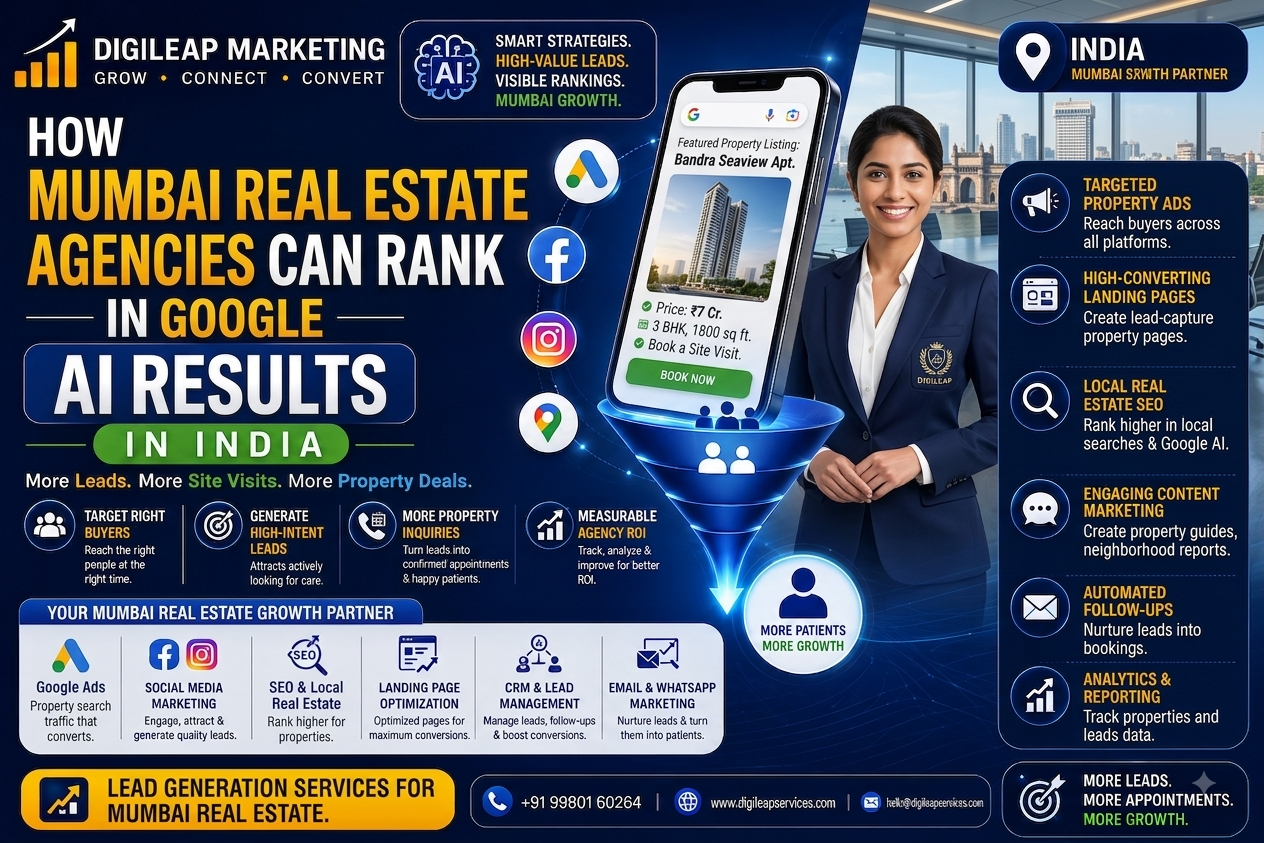
How Real Estate Agencies in Mumbai Can Rank in Google AI Results
Real estate search in Mumbai is becoming more conversational, research-driven and competitive. Buyers no longer rely only on traditional Google results when looking for flats, investment properties, resale homes or new projects. Instead, they ask detailed questions, compare locations, explore prices and look for trustworthy recommendations. This shift makes Google AI SEO Real Estate Mumbai an important part of a modern search strategy. Agencies that create useful, locally relevant and experience-led content can improve their chances of being discovered across traditional Search, AI Overviews and newer AI-powered search experiences.
Why Google AI Search Matters for Mumbai Real Estate
Mumbai’s property market is large, competitive and constantly changing. Therefore, real estate agencies need more than property listing pages to attract qualified buyers through organic search. Buyers may search for questions such as “Which Mumbai suburb is best for families?”, “Where should I invest in Mumbai under ₹2 crore?”, “What are the best areas near Mumbai Metro stations?” or “Is buying a flat in Andheri better than Thane?”
These searches reveal something important: users are looking for answers before they are ready to contact an agency. Consequently, agencies that answer these questions clearly can enter the buyer’s research journey much earlier.
The opportunity is significant. According to Knight Frank India’s 2025 residential market report, Mumbai recorded 97,188 residential sales during 2025, representing 29% of sales across India’s top eight residential markets. Mumbai also recorded 1% year-on-year growth in sales.
Furthermore, the market has remained active in 2026. Mumbai recorded 47,355 housing sales during H1 2026, while unsold inventory declined by 4% year on year to 157,410 units. This creates a strong opportunity for agencies that can connect their expertise with the questions potential buyers are already asking online.
Google’s own guidance makes the direction clear. AI Overviews and AI Mode still rely on foundational SEO, including crawlable pages, useful content, strong page experience and reliable information. Google also states that there are no special technical requirements or secret AI optimisation techniques required for appearing in these experiences.
That means agencies should not abandon traditional SEO. Instead, they should make their existing SEO strategy more useful, specific and trustworthy.
Build Google AI SEO Real Estate Mumbai Content Around Buyer Questions
One of the most effective ways to improve visibility is to stop creating content purely around keywords and start creating content around real buyer questions. Google AI SEO Real Estate Mumbai should focus on the complete search journey rather than one isolated phrase.
For example, a Mumbai real estate agency could create detailed guides about buying property in Powai, comparing Bandra and Andheri, understanding redevelopment projects, choosing homes near metro corridors, calculating stamp duty, evaluating rental yields or deciding between a new development and a resale property.
These topics can also be connected into content clusters. A broad guide about buying property in Mumbai could link to individual pages covering specific suburbs, budgets, property types, legal considerations and investment factors. As a result, Google can better understand the agency’s expertise across the subject.
However, the content should not simply repeat information already available on dozens of property websites. Google specifically recommends creating unique, valuable and non-commodity content for AI search. It highlights first-hand perspectives and information that adds something beyond commonly available knowledge.
For a Mumbai agency, local experience can become a major advantage. Instead of writing a generic article about “best areas to buy property”, explain how different neighbourhoods suit different buyer profiles. Discuss commute patterns, infrastructure developments, school access, lifestyle considerations, redevelopment activity and property price differences. When appropriate, support claims with current market data.
For instance, an agency could publish a detailed comparison between Western Suburbs, Central Suburbs and Navi Mumbai, explaining which areas may suit first-time buyers, investors, families or luxury buyers. This type of content gives AI systems more useful information to understand and potentially cite.
Make Local Expertise the Centre of Google AI SEO Real Estate Mumbai
Local relevance can become one of a Mumbai real estate agency’s strongest SEO assets. Buyers rarely search only for “property in Mumbai”. They often have a specific location, budget, lifestyle preference or property requirement in mind.
Therefore, agencies should build dedicated content around meaningful local areas such as Bandra, Andheri, Powai, Borivali, Kandivali, Goregaon, Malad, Mulund, Thane, Navi Mumbai and South Mumbai. However, each page should provide genuinely different information rather than replacing the location name in the same template.
A strong local page should explain what makes the area attractive, who typically considers it, what property types are common, how connectivity affects demand and what buyers should evaluate before making a decision. It should also include original photographs, project information, maps where useful and practical observations from people who understand the local market.
This approach aligns with Google’s current guidance for generative AI search, which encourages valuable local content alongside relevant image and video content.
Reviews can strengthen this strategy as well. Genuine client experiences can demonstrate that an agency actually works in the locations it discusses. Instead of publishing vague testimonials, agencies can explain how they helped a buyer compare properties, negotiate a purchase or identify a suitable neighbourhood. With appropriate client permission, these experiences can become useful case studies.
At the same time, Google Business Profile optimisation should support the website strategy. Agencies should maintain accurate business information, collect genuine reviews, publish useful updates and make sure their business details remain consistent across important platforms.
The objective is not simply to add the word “Mumbai” everywhere. Rather, the goal is to demonstrate genuine knowledge of Mumbai’s property market.
Create Content That Answers Complex Real Estate Searches
Real estate decisions involve multiple factors. Therefore, AI search can be particularly useful for consumers who want a quick overview before exploring individual websites.
For example, a buyer might ask, “What should I check before buying a resale flat in Mumbai?” A useful agency article could answer the question directly and then explain documentation, title verification, society records, maintenance obligations, renovation costs, parking arrangements and other practical considerations.
Similarly, an investor might ask, “Is Mumbai property still a good investment in 2026?” Instead of giving a simple yes or no, an agency can discuss location, entry price, rental demand, infrastructure, liquidity, holding period and property type.
This is where Google AI SEO Real Estate Mumbai becomes less about keyword repetition and more about information architecture and expertise. Content should provide clear answers first and deeper explanations afterwards. This structure makes pages easier for users to navigate and easier for search systems to understand.
Agencies should also use supporting evidence. Market reports, government sources, infrastructure announcements and reputable industry research can strengthen important claims. For example, current data shows that Mumbai’s average residential prices increased 4% year on year in H1 2026, reaching ₹14,948 per square foot, according to Knight Frank.
Statistics should have context rather than being inserted simply to make an article appear authoritative. Explain what the number means for a buyer or seller and why it matters.
Another important factor is freshness. Real estate information changes quickly. Property prices, inventory, infrastructure timelines, regulations and market demand can change within months. Agencies should therefore review important guides regularly and update outdated information rather than allowing old articles to remain untouched.
Strengthen Technical SEO and E-E-A-T for AI Search
High-quality content cannot perform effectively if Google cannot properly access or understand the website. Therefore, agencies should maintain a strong technical SEO foundation.
Every important page should be crawlable, indexable and accessible to Google. The website should work well on mobile devices, load efficiently and provide a clear navigation structure. Property pages should also avoid unnecessary duplication, especially when multiple listings use almost identical descriptions.
Structured data can support the broader SEO strategy, although agencies should not treat schema as a shortcut to AI visibility. Google states that structured data is not required specifically for generative AI search, but it can still help search engines understand content and support eligibility for certain search features when implemented correctly.
Real estate websites should also pay attention to internal linking. A property page can link to its location guide, while the location guide can link to investment guides, buying guides and relevant property listings. This creates logical connections between commercial and informational content.
Author credibility matters too. Articles involving property investment, legal considerations or financial decisions should clearly identify knowledgeable contributors where appropriate. Agencies can include author information, professional experience, editorial review details and relevant credentials when they genuinely exist.
Google’s guidance also emphasises people-first content and warns against generating large volumes of low-value pages simply to manipulate search visibility.
For agencies using AI to assist with content creation, the safest approach is to use it for research organisation, outlining or editing while adding genuine human expertise, local insights and fact checking. The final content should provide something a generic AI-generated article could not easily reproduce.
Use Images, Videos and Property Experiences
Real estate is highly visual, so agencies should not limit their AI-search strategy to written articles. High-quality property photographs, neighbourhood videos, walkthroughs, floor plans and location explainers can make a website considerably more useful.
A video showing a neighbourhood can answer questions that text alone cannot. For example, an agency could create a short walkthrough explaining how a particular residential area connects to nearby transport options, shopping zones and business districts. The supporting webpage can then provide additional context, transcripts and related property information.
Likewise, original photography can demonstrate first-hand experience. Instead of relying only on developer-supplied images, agencies can include authentic images of neighbourhood streets, surrounding amenities and relevant local landmarks where appropriate.
This also supports Google’s broader recommendation to use high-quality images and video as part of content designed for generative AI search experiences.
For agencies that need help developing a wider search strategy, Digileap India’s SEO and digital marketing resources can provide additional ideas around AI-era SEO and real estate marketing.
Measure What Actually Drives Visibility and Leads
SEO success should not be measured only by rankings. Real estate agencies need to understand whether organic visibility is bringing the right people to the website.
Consequently, agencies should monitor impressions, clicks, engagement, enquiry submissions, phone calls, WhatsApp enquiries and property-related conversions. A page that generates fewer visits but produces qualified property enquiries may be more valuable than a high-traffic article that attracts people with no buying intent.
Google has also introduced a Generative AI performance report in Search Console, giving site owners another way to understand how their content performs in generative AI experiences.
Agencies should therefore review which pages attract visibility for complex searches and expand those topics. If an article about buying property in Powai performs well, the agency can develop related content around Powai investment opportunities, rental demand, property types and buyer considerations.
This creates a continuous improvement cycle. Research what buyers ask, create genuinely useful content, measure performance, identify gaps and improve the content based on real user behaviour.
Build Long-Term Google AI SEO Real Estate Mumbai Authority
Ranking in AI-powered search is not about finding a single trick. It is about becoming a reliable source of information for a specific audience.
For Mumbai real estate agencies, that means combining strong technical SEO with local knowledge, useful property content, original experiences, trustworthy data and clear answers to buyer questions. It also means keeping commercial pages connected to educational resources so users can move naturally from research to enquiry.
Most importantly, agencies should think beyond individual keywords. A buyer may never search the exact phrase used by an agency, yet Google’s systems can understand related concepts, synonyms and search intent. Google’s latest guidance confirms that there is no need to create separate pages for every possible keyword variation or obsess over specific AI “hacks”.
Instead, agencies should build a website that genuinely deserves to be referenced when someone asks an important Mumbai property question.
Conclusion
Google AI SEO Real Estate Mumbai is ultimately about making a real estate website more useful, trustworthy and locally authoritative. Mumbai agencies that combine strong SEO fundamentals with original market knowledge, detailed buyer-focused content, visual experiences and reliable data can create stronger visibility across both traditional and AI-powered search. The goal should not be to chase every new AI feature, but to build the kind of website that Google can confidently use as a helpful source for people making important property decisions.
TL;DR
Mumbai real estate agencies should focus on useful buyer questions, location-specific expertise, original property insights, trustworthy statistics, technical SEO, strong internal linking, genuine reviews, high-quality images and videos, and regular content updates. Google confirms that foundational SEO remains important for AI Overviews and AI Mode, while unique, helpful and people-first content remains central to visibility.