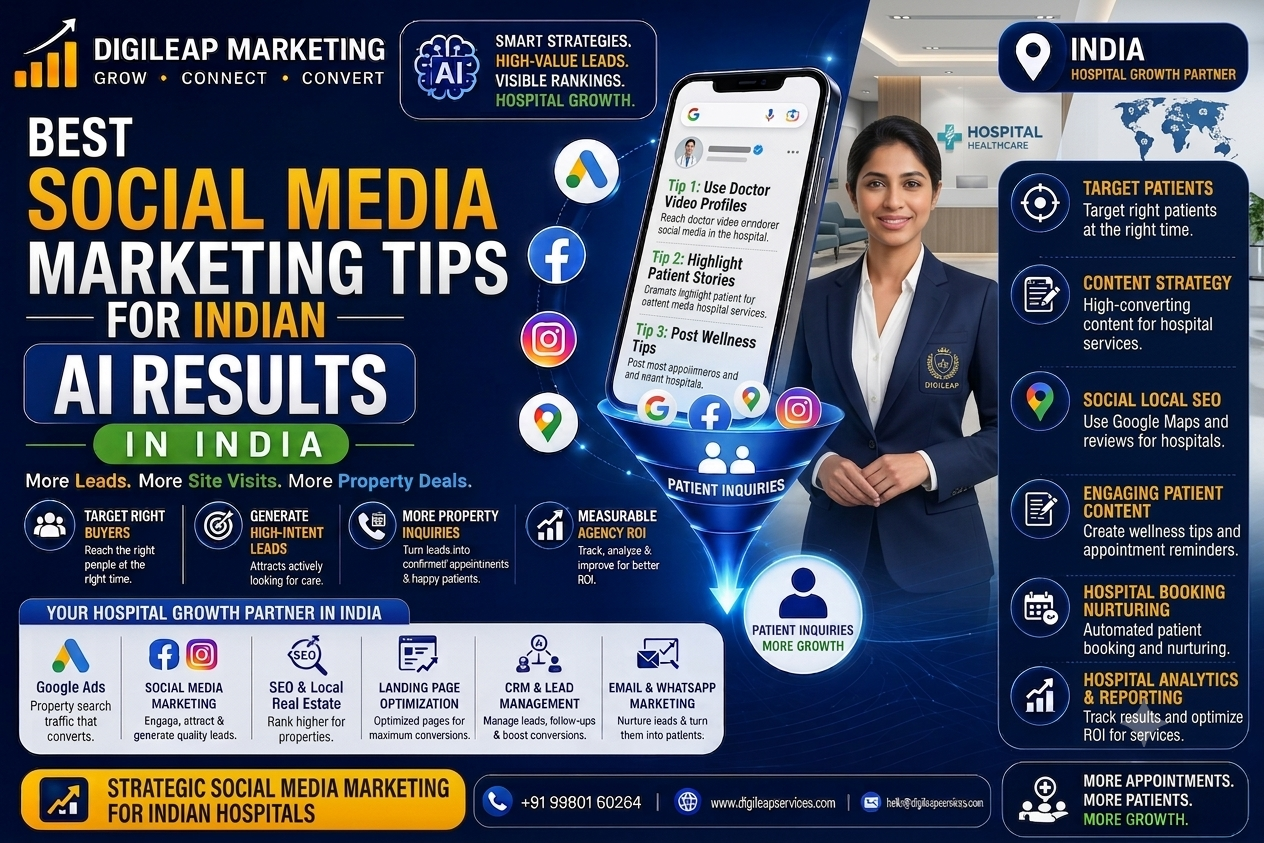
Best Social Media Marketing Tips for Indian Hospitals
In today’s digital-first healthcare environment, patients do more than simply visit a hospital recommended by friends or family. They search online, compare hospitals, read reviews, watch doctor videos, and look for answers to their health questions before making a decision. Therefore, hospitals need a social media strategy that informs, reassures, and builds credibility. Hospital Social Media Marketing India can help healthcare brands connect with patients at different stages of their decision journey while creating a stronger and more trustworthy online presence.
India’s digital audience is already massive. DataReportal reported 491 million social media user identities in India in January 2025, while 806 million people were using the internet. Consequently, hospitals have a significant opportunity to reach patients beyond their physical locations. However, healthcare social media marketing is different from promoting a regular consumer brand. Patients expect accuracy, empathy, privacy, and useful information. So, every post should have a clear purpose and follow responsible healthcare communication practices.
Understand Your Hospital’s Audience
First, hospitals need to understand who they are speaking to. A multispecialty hospital may serve parents, senior citizens, working professionals, young adults, caregivers, and patients with long-term health concerns. Each audience has different questions, concerns, and content preferences. Therefore, creating one generic social media message for everyone may not deliver the best results.
Instead, identify the hospital’s major patient groups and understand what information they commonly seek. For example, parents may want pediatric health advice, while older adults may be interested in cardiac care, joint replacement, diabetes management, or preventive health checks. Similarly, working professionals may respond well to content about stress, sleep, nutrition, and lifestyle conditions. As a result, audience research allows hospitals to create content that feels relevant rather than promotional.
Focus on Patient Education
Education should remain at the centre of Hospital Social Media Marketing India because people often use social platforms to learn about health problems before speaking to a medical professional. Hospitals can use social media to explain symptoms, preventive measures, treatment options, healthy habits, and frequently asked questions in simple language.
For instance, a cardiologist can explain common warning signs of heart disease through a short video. A gynecologist can discuss preventive screenings, while an orthopedic specialist can explain when persistent joint pain requires professional evaluation. However, the content should never replace medical consultation. Instead, it should encourage patients to seek appropriate professional advice.
Educational content also helps hospitals establish authority. When doctors consistently explain complex subjects in an understandable way, audiences are more likely to recognise the hospital as a reliable source of healthcare information.
Use Short-Form Videos to Explain Complex Topics
Video has become one of the most useful formats for healthcare communication. Consequently, hospitals should make short-form videos a regular part of their social media strategy. Instagram Reels, YouTube Shorts, and similar formats allow doctors to explain important subjects without requiring patients to read long articles.
A strong hospital video does not need an elaborate production setup. A doctor speaking directly to the camera can often feel more authentic than an overly polished advertisement. Start with a question that patients commonly ask, provide a simple explanation, and finish by encouraging viewers to consult a qualified healthcare professional when necessary.
For example, a video could begin with, “When should you see a cardiologist for chest discomfort?” The doctor can then explain general warning signs and clarify when urgent medical attention may be appropriate. This approach provides value while avoiding sensational or fear-based messaging.
Introduce Your Doctors and Healthcare Teams
Patients do not connect only with hospital buildings or logos. They connect with people. Therefore, introducing doctors, nurses, technicians, physiotherapists, nutritionists, and other healthcare professionals can make a hospital’s social presence more human.
Share professional introductions that explain a doctor’s speciality, experience, areas of interest, and approach to patient care. You can also create short “Meet the Doctor” videos where specialists answer common patient questions. Moreover, behind-the-scenes content can show the teamwork involved in delivering healthcare.
This strategy can reduce the emotional distance between patients and healthcare professionals. Instead of seeing the hospital as a large institution, audiences begin to understand the people behind the care.
Showcase Hospital Facilities Responsibly
Hospital infrastructure can also become useful social media content. However, simply posting pictures of expensive equipment may not communicate meaningful value. Instead, explain how specific facilities support patient care.
For example, a hospital can introduce a diagnostic department, explain how a particular imaging technology works, or provide a virtual tour of a newly opened facility. Similarly, hospitals can explain how emergency departments, intensive care units, laboratories, or rehabilitation centres support patients.
The key is to focus on patient benefits rather than making exaggerated claims. Clear explanations help audiences understand what the hospital offers while maintaining credibility.
Share Patient Stories With Proper Consent
Patient stories can create powerful emotional connections, but hospitals must handle them carefully. Hospital Social Media Marketing India should always respect patient privacy and informed consent when using testimonials, photographs, treatment journeys, or recovery stories.
A patient story should focus on the experience rather than making unrealistic promises. For example, instead of saying that a particular procedure guarantees a specific outcome, the hospital can share how a patient navigated their treatment journey and recovered with support from the medical team.
Before publishing any patient-related content, hospitals should establish clear consent and privacy procedures. This protects patients while also protecting the hospital’s reputation.
Create Content Around Health Awareness Days
Health awareness days provide hospitals with natural opportunities to educate their audiences. However, hospitals should avoid posting generic “Happy World Health Day” messages without adding meaningful information.
Instead, connect awareness days with practical advice. During World Diabetes Day, for example, a hospital could publish content explaining risk factors, preventive habits, or the importance of regular screening. During World Heart Day, specialists could discuss cardiovascular risk and lifestyle changes.
This approach makes awareness content more useful. Moreover, it gives hospitals opportunities to highlight relevant departments and expertise without turning every awareness day into a sales message.
Build a Strong Local Social Media Strategy
Hospitals operate within specific communities, so local relevance matters. A hospital in Mumbai should create content that speaks to Mumbai audiences, while a hospital in Pune, Bengaluru, Delhi, or Chennai can address the needs and interests of its own local community.
Local content can include doctor introductions, community health camps, hospital events, local awareness initiatives, emergency service information, and department updates. Furthermore, location-specific captions and relevant hashtags can improve discoverability.
Local social media activity can also support broader digital marketing efforts. Patients who discover a hospital on Instagram may later search its name on Google, check reviews, visit the website, and eventually make an appointment. Therefore, social media should work alongside SEO, Google Business Profile optimisation, paid advertising, and reputation management rather than operating as an isolated channel.
Make Instagram a Visual Education Channel
Instagram can be particularly valuable for hospitals because it combines images, Reels, Stories, carousels, and Live content. DataReportal reported that Instagram had 414 million users in India in early 2025, highlighting the platform’s substantial potential reach.
Hospitals can use carousels to explain medical topics step by step. Reels can feature doctors answering common questions. Stories can share hospital updates, polls, quizzes, reminders, and event announcements. Meanwhile, Live sessions can allow specialists to discuss broad health topics and answer general questions.
Nevertheless, the goal should not simply be to accumulate followers. A smaller audience that actively trusts and engages with a hospital’s content can be more valuable than a large audience with little connection to the healthcare brand.
Use YouTube for In-Depth Healthcare Content
While short videos are excellent for awareness, YouTube can help hospitals create deeper educational resources. Hospitals can publish specialist interviews, procedure explainers, department introductions, health webinars, frequently asked questions, and patient education videos.
YouTube can also extend the life of healthcare content. A useful video published today may continue attracting searches months or years later. Therefore, hospitals should create evergreen videos around common patient questions instead of focusing only on temporary trends.
The platform can also strengthen a doctor’s personal authority. A specialist who regularly explains relevant healthcare topics can gradually become a familiar and trusted voice for the audience.
Encourage Meaningful Engagement
Social media is not simply a publishing platform. It is also a communication channel. Therefore, hospitals should monitor comments, direct messages, questions, and mentions regularly.
When someone asks a general question, provide a helpful response without attempting to diagnose the person publicly. If the issue requires personal medical advice, guide the individual toward an appropriate consultation or official hospital channel. Similarly, never ask patients to publicly share sensitive medical information.
Fast and respectful responses can improve the overall patient experience. Furthermore, they show that the hospital values communication even before a patient enters the facility.
Use Reviews and Reputation Carefully
Online reputation plays an important role in healthcare decisions. Patients often compare hospitals by looking at reviews, ratings, testimonials, and conversations across digital platforms. Therefore, social media and reputation management should work together.
Hospitals should encourage genuine feedback and respond professionally to both positive and negative reviews. A negative comment should not automatically become an argument. Instead, acknowledge the concern, avoid discussing private medical details publicly, and move the conversation to an appropriate private channel when necessary.
This approach demonstrates professionalism. Over time, consistent communication can strengthen confidence in the hospital’s brand.
Invest in Targeted Social Media Advertising
Organic social media can build awareness, but paid campaigns can help hospitals reach specific audiences more efficiently. Facebook and Instagram advertising can promote health awareness campaigns, educational webinars, specialist services, hospital events, or relevant landing pages.
However, healthcare advertising requires additional care. Hospitals should avoid misleading claims, unrealistic guarantees, fear-based messaging, or inappropriate targeting. The advertisement should provide clear information and direct users toward a relevant next step.
A good campaign should also have a measurable objective. For example, the goal may be awareness, website traffic, webinar registrations, or appointment enquiries. Tracking these outcomes makes it easier to understand whether advertising expenditure is producing meaningful results.
Measure What Actually Matters
Likes and follower counts may look impressive, but they do not always represent meaningful business or patient outcomes. Therefore, hospitals should measure metrics that connect social media activity with real objectives.
Track reach, engagement, video completion, website visits, enquiries, campaign conversions, and audience growth. Also, identify which topics consistently generate useful engagement. If videos featuring cardiologists receive stronger responses than generic hospital posts, the content strategy can shift accordingly.
Analytics can also reveal audience behaviour. Over time, hospitals can understand which platforms perform best, what subjects attract attention, and which content formats encourage people to take action.
Keep Healthcare Content Ethical and Accurate
Accuracy should always come before virality. Healthcare content can influence real decisions, so hospitals cannot treat social media like ordinary entertainment marketing.
Every medical claim should be reviewed appropriately before publication. Content should avoid exaggeration, guarantee-based language, misleading comparisons, and unsupported statistics. Likewise, hospitals should protect patient confidentiality and obtain appropriate consent for patient-focused content.
This is especially important because misinformation can spread quickly online. A hospital that consistently publishes responsible, evidence-based information can differentiate itself by becoming a dependable digital source.
Maintain a Consistent Content Strategy
Consistency matters more than occasional bursts of activity. A hospital does not need to publish dozens of posts every week. Instead, it needs a sustainable strategy that balances education, doctors, hospital updates, community initiatives, awareness campaigns, and patient-focused information.
For example, the content strategy can rotate between specialist videos, health education, department information, awareness topics, patient stories, and community activities. This creates variety without losing the hospital’s core identity.
Furthermore, every platform should have a purpose. Instagram may focus heavily on short educational videos, YouTube can support long-form education, Facebook can strengthen community engagement, and LinkedIn can highlight hospital leadership, medical innovations, partnerships, and professional achievements.
Connect Social Media With Your Overall Digital Strategy
Social media works best when it forms part of a larger digital ecosystem. A patient may first discover a hospital through Instagram, search for the hospital on Google, read reviews, visit the website, and then contact the hospital. Therefore, hospitals should connect social media with SEO, content marketing, paid advertising, website optimisation, and online reputation management.
For hospitals looking to strengthen their broader digital presence, Digileap’s digital marketing services include social media marketing, SEO, paid advertising, content marketing, and online reputation management. A coordinated strategy can help healthcare brands maintain consistent messaging across multiple patient touchpoints.
Use Data to Improve Hospital Social Media Marketing
The strongest Hospital Social Media Marketing India strategies evolve based on performance data. What works for one hospital may not work for another because audiences, locations, specialties, competition, and patient behaviour can differ significantly.
Therefore, review performance regularly and identify patterns. If educational Reels consistently generate strong engagement, create more of them. If certain topics receive little attention, change the format or angle instead of repeatedly publishing similar posts. Similarly, if social campaigns generate website visits but few enquiries, review the landing page and conversion journey.
The goal is not to chase every trend. Instead, hospitals should use data to make smarter decisions while keeping patient needs at the centre.
Build Trust Before Asking for Appointments
One of the biggest mistakes hospitals can make on social media is focusing too heavily on appointment promotions. Healthcare decisions involve trust, and trust rarely develops from repeated “Book Now” messages alone.
Instead, educate first. Introduce doctors. Explain treatments. Answer common questions. Show the people behind the hospital. Share community initiatives. Provide useful health information. Then, when patients need care, the hospital is more likely to be remembered.
This patient-first approach makes Hospital Social Media Marketing India more sustainable because it creates value before asking audiences to take action.
Conclusion
Social media gives Indian hospitals a powerful way to educate patients, humanise healthcare professionals, build local awareness, and strengthen digital trust. However, success depends on more than posting regularly. Hospitals need accurate information, useful videos, responsible patient stories, local relevance, consistent engagement, ethical advertising, and performance tracking.
When these elements work together, social media becomes more than a promotional channel. It becomes an extension of the hospital’s patient communication strategy and a valuable part of its overall digital presence.
TL;DR
- Focus on education, trust, and meaningful patient engagement rather than constant promotion.
- Create educational videos, introduce doctors, showcase facilities responsibly, share consent-based patient stories, use local content, respond to questions, and measure performance metrics.
- With 491 million social media user identities in India in January 2025, the opportunity to reach and connect with patients is significant.
- Combine useful content, ethical communication, consistent publishing, and data-driven optimisation to build a stronger digital reputation.