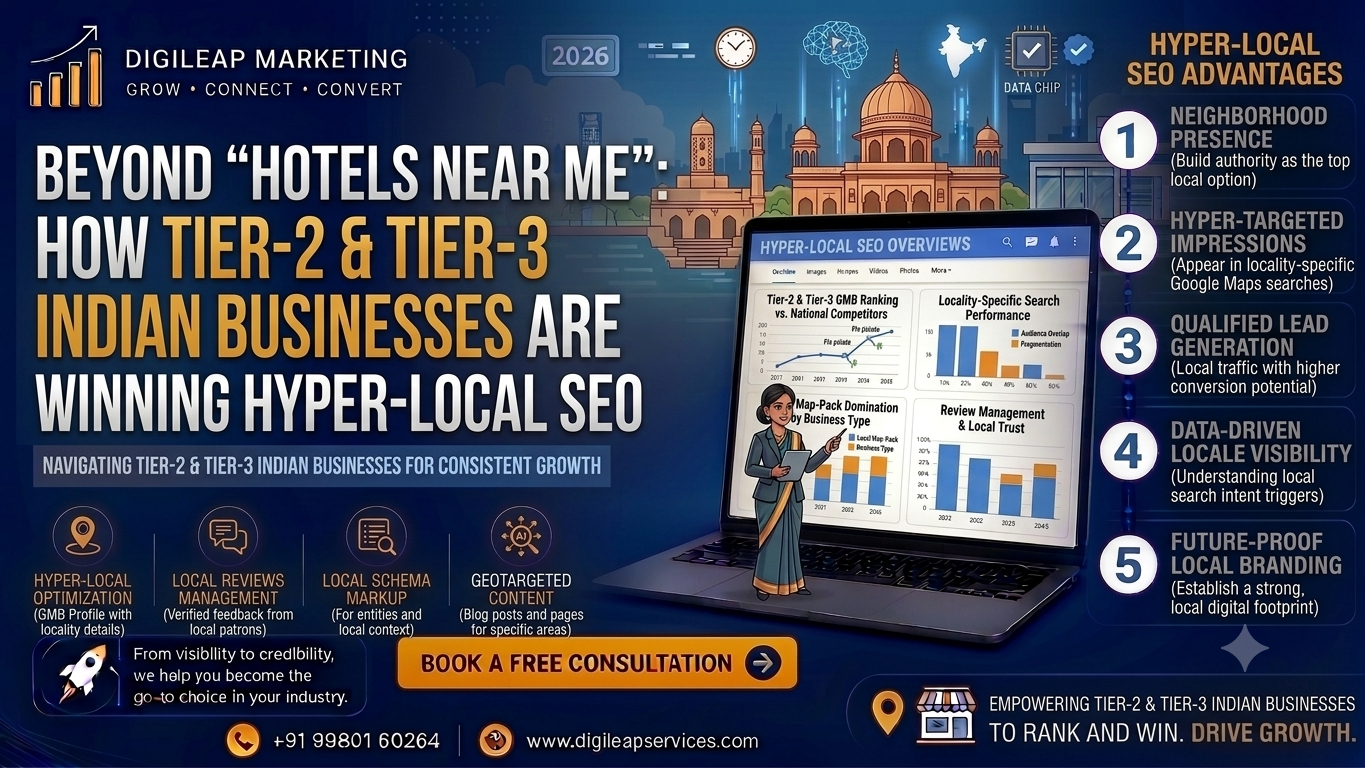
Beyond “Hotels Near Me”: How Tier-2 & Tier-3 Indian Businesses Are Winning Hyper-Local SEO
Searching for a hotel “near me” is no longer just a habit reserved for travellers. Today, people search for dentists near their homes, salons around their neighbourhoods, cafés close to their offices, coaching centres in their locality, repair services nearby, and even niche products available within a few kilometres. This shift has created a powerful opportunity for smaller Indian businesses. hyperlocal seo for businesses helps them compete for customers who are not simply looking for a product or service but want one that is accessible, nearby, trustworthy, and convenient.
The opportunity is particularly strong in Tier-2 and Tier-3 cities. India’s internet audience has expanded far beyond major metros, giving local businesses a much larger digital customer base. According to India’s Ministry of Communications, the country had 969.10 million internet subscribers in March 2025, including 407.69 million rural subscribers. As connectivity continues to spread, local search is becoming an important bridge between digital discovery and physical purchases.
Why Local Search Is Changing Indian Business
For years, businesses in smaller cities depended heavily on word of mouth, roadside visibility, newspaper advertising, local directories, and repeat customers. These channels still matter. However, consumer behaviour has changed. Before visiting a new shop or service provider, customers increasingly check Google Search, Google Maps, reviews, photographs, operating hours, prices, and directions.
Consequently, a business does not need a massive national advertising budget to attract attention. It needs to become highly relevant to the people around it. That is where hyperlocal seo for businesses becomes valuable. Instead of attempting to rank for broad terms such as “best restaurant” or “dentist,” a business can target searches connected to specific neighbourhoods, landmarks, services, and customer needs.
Google itself explains that local results primarily depend on relevance, distance, and prominence. It also recommends keeping Business Profile information complete and accurate, responding to reviews, and adding photos and videos. Therefore, local visibility is not simply about inserting a city name into a website. It involves creating a strong collection of signals that tells both Google and customers exactly what a business offers and where it serves.
Tier-2 and Tier-3 Cities Have a Digital Advantage
The traditional assumption that digital marketing belongs mainly to Mumbai, Delhi, Bengaluru, Hyderabad, or other major metropolitan areas is becoming outdated. Smaller cities now have increasingly connected consumers who use smartphones to discover businesses, compare options, and make purchasing decisions.
A 2025 report cited by PwC research found that Tier-2 and beyond cities represented approximately 46% of India’s consumer internet market in FY2025, with that share projected to reach about 51% by FY2030. This represents a significant shift in where online consumer activity is happening.
For local businesses, this creates an interesting advantage. Competition can be intense in a major metropolitan market, where hundreds of businesses may target the same broad keywords. Meanwhile, a business in a smaller city can build strong visibility by becoming highly relevant within a particular locality.
For example, a bakery in Indore does not necessarily need to compete nationally for “best bakery.” It can focus on searches related to cakes in Vijay Nagar, birthday cakes near a specific landmark, eggless cakes in a particular neighbourhood, or same-day cake delivery within selected areas. Similarly, a physiotherapy clinic in Coimbatore can create content and Business Profile signals around the neighbourhoods and communities it actually serves.
This is the practical strength of hyperlocal seo for businesses. It narrows the competition while improving the chances of reaching customers with immediate purchase intent.
Google Maps Has Become the New Local Storefront
A local business website is important, but Google Maps often becomes the first digital interaction between a customer and a physical business. When someone searches for “salon near me” or “AC repair near me,” Google can display a map pack containing nearby businesses before traditional organic results.
That placement can influence whether the customer calls, visits, requests directions, or chooses another provider. Therefore, businesses should treat their Google Business Profile as an active marketing channel rather than a one-time registration.
The first step involves making sure the business name, address, phone number, category, website, working hours, services, and other information remain accurate. Businesses should also upload genuine photographs that show their premises, products, team, facilities, or completed work.
Reviews matter as well. Instead of simply collecting ratings, businesses should encourage genuine customers to share specific experiences and respond professionally to both positive and negative feedback. Google notes that reviews and positive ratings can contribute to local prominence.
In addition, businesses should monitor whether their profile information matches the details shown across other online platforms. Consistency builds trust and reduces confusion for both customers and search engines.
Neighbourhood Keywords Beat Generic Keywords
One of the biggest mistakes smaller businesses make is targeting keywords that are too broad. A local jewellery store may try to rank for “jewellery shop India,” while its actual customers may search for “jewellery shop in Baner” or “gold jewellery near me.”
Likewise, a restaurant in Jaipur may gain more commercial value from appearing for “family restaurant near Vaishali Nagar” than from chasing a highly competitive national phrase such as “best Indian restaurant.”
This is why hyperlocal seo for businesses should begin with customer language rather than keyword volume alone. Businesses need to understand how people describe their location. Customers might use a neighbourhood name, a nearby railway station, a famous market, a residential complex, a road, a school, or a landmark when searching.
For instance, a clinic may serve customers within five kilometres, but those customers may identify themselves through several nearby localities. Building relevant landing pages and website content around legitimate service areas can help the business capture these variations without creating thin or repetitive pages.
The goal should not be to stuff every neighbourhood name into a page. Instead, businesses should create useful content that naturally answers questions from people in those areas.
Vernacular Search Creates Another Opportunity
India’s local search landscape is also becoming more multilingual. Customers in smaller cities may search in English, Hindi, regional languages, or a combination of languages. Voice search makes this behaviour even more natural because people often speak complete questions rather than typing short keywords.
For a local business, this means understanding how its customers actually communicate. A coaching centre in Lucknow, for example, may need to understand searches that combine English terms with Hindi expressions. A restaurant in Maharashtra may benefit from understanding Marathi search behaviour. A service provider in Tamil Nadu should consider how customers describe its service in Tamil as well as English.
Businesses can respond by creating clear, natural website content, frequently asked questions, service descriptions, and Google Business Profile information that reflect real customer language. They should avoid awkward keyword translations. Instead, they should focus on clarity and usefulness.
This approach makes hyperlocal seo for businesses more customer-focused. The objective is not simply to rank for a phrase. It is to help the right person understand that the business can solve their problem nearby.
Reviews Turn Local Trust Into Visibility
Imagine two restaurants appear next to each other on Google Maps. One has 4.6 stars from hundreds of customers, while the other has only a handful of reviews. Even if both restaurants offer similar food, many customers will naturally feel more comfortable choosing the business with stronger social proof.
Reviews therefore play two roles. First, they influence customer confidence. Second, they can contribute to the prominence signals Google considers when determining local rankings.
However, businesses should avoid buying reviews or using artificial tactics. Genuine customer experiences create stronger long-term value. A restaurant can ask customers for feedback after a meal. A clinic can invite patients to review their experience. A home-service company can request feedback after completing a project.
Businesses should also reply to reviews consistently. A thoughtful response can demonstrate professionalism to future customers who are researching the business for the first time.
Local Content Can Create a Competitive Moat
Many businesses publish generic blogs that attract little local traffic. A better approach involves creating content based on real questions from local customers.
A dental clinic, for example, could publish information about choosing a dentist in its service area, emergency dental care nearby, or what patients should know before booking a consultation. A real estate company could create neighbourhood guides. A restaurant could publish content about local dining occasions. A fitness centre could discuss fitness options for people living or working nearby.
This type of content gives Google more context while giving customers a reason to trust the business. Over time, it can also create opportunities to earn local links from community websites, associations, publications, schools, events, and other relevant organisations.
For businesses looking for a structured approach, Digileap India’s digital marketing and SEO services can support broader search visibility through keyword research, on-page optimisation, content creation, technical SEO, and link-building strategies.
Hyperlocal SEO Is About More Than “Near Me”
The phrase “near me” gets a lot of attention, but customers do not always include those words in their searches. Google can understand location signals even when a user searches for a generic service.
For example, someone standing in Surat may search for “coffee shop” instead of “coffee shop near me.” Google can still use the person’s location to provide relevant nearby results. Therefore, businesses should not obsess over adding “near me” to every webpage or title.
Instead, they should build a strong local presence across their website, Google Business Profile, reviews, citations, local content, and other relevant platforms.
This broader strategy makes hyperlocal seo for businesses more sustainable. Rather than chasing one search phrase, businesses build an ecosystem of local relevance that can help them appear across different types of searches.
Small Businesses Can Compete Without Big Budgets
One of the most attractive aspects of local SEO is that a small business does not necessarily need the advertising budget of a large corporation to become visible within its immediate market.
A local clothing store can outperform a national retailer for a neighbourhood-specific search. A family-run restaurant can become more relevant than a famous chain for customers searching within a small radius. An independent repair company can build stronger local visibility than a national platform for urgent service searches.
However, this does not happen automatically. Businesses must maintain their profiles, publish useful information, collect authentic reviews, monitor rankings, improve their websites, and understand changing customer behaviour.
They also need patience. Local SEO is not a shortcut that guarantees first-page rankings overnight. Instead, it creates cumulative value. Every accurate business detail, genuine review, relevant page, useful piece of content, and legitimate local mention can strengthen the overall presence.
Mobile Search Makes Speed and Convenience Essential
Local search often happens when customers are ready to act. Someone searching for a plumber may need help immediately. Someone searching for a restaurant may want to visit within an hour. Someone looking for a salon may want to call and book an appointment.
Therefore, the customer journey should be simple. A mobile visitor should quickly understand what the business offers, where it is located, when it opens, and how to contact it.
The website should load quickly, display clearly on smartphones, and make important actions easy. Click-to-call buttons, directions, booking options, WhatsApp contact, service details, and clear location information can reduce friction.
Consequently, hyperlocal seo for businesses should connect search visibility with conversion optimisation. Ranking is only the beginning. The real objective is to turn local searches into calls, visits, enquiries, bookings, and sales.
Measure the Right Local SEO Signals
Businesses should not judge local SEO only by website traffic. A local business can succeed with relatively modest traffic if that traffic produces qualified enquiries and customers.
Instead, businesses should monitor Google Business Profile interactions, calls, direction requests, website visits, enquiries, bookings, review growth, local keyword rankings, and conversions. They should also examine which locations and services generate the strongest demand.
For example, a clinic might discover that searches related to a particular neighbourhood produce fewer visits but significantly more appointment requests. That insight can influence its content strategy and advertising budget.
Similarly, a restaurant might discover that customers searching for specific cuisine terms convert better than people searching for generic restaurant phrases. Data can then guide future content and optimisation decisions.
This measurement-led approach makes hyperlocal seo for businesses more accountable. Businesses can connect visibility with actual commercial outcomes instead of celebrating rankings that do not generate customers.
The Future Belongs to Local Relevance
Tier-2 and Tier-3 Indian cities are not simply following the digital growth of metropolitan markets. They are becoming important digital markets in their own right. Rising connectivity, smartphone adoption, online discovery, and growing consumer expectations are giving local businesses new ways to compete.
At the same time, local search is becoming more sophisticated. Customers expect accurate information, authentic reviews, convenient contact options, useful content, and fast answers. Businesses that provide these experiences can earn attention without trying to become everything to everyone.
The strongest local brands will therefore focus on relevance. They will understand their neighbourhoods, speak their customers’ language, maintain trustworthy digital profiles, and create useful experiences around genuine local needs.
Conclusion
The future of local discovery in India goes far beyond typing “hotels near me.” Customers now search for businesses that understand their location, needs, urgency, and preferences. For Tier-2 and Tier-3 businesses, that creates an opportunity to compete on relevance rather than simply competing on budget.
By combining accurate Google Business Profiles, neighbourhood-focused content, authentic reviews, mobile-friendly experiences, local authority, and meaningful measurement, smaller businesses can build strong digital visibility. hyperlocal seo for businesses is ultimately about connecting nearby customers with the right business at the right moment.
TL;DR
Tier-2 and Tier-3 Indian businesses can win local search by focusing on the specific neighbourhoods and communities they serve instead of competing for broad national keywords. Strong Google Business Profiles, accurate location information, authentic reviews, localised content, vernacular search optimisation, mobile-friendly websites, and conversion-focused experiences can turn local searches into real customers. As India’s internet audience continues to expand beyond major metros, businesses that build genuine local relevance today can create a strong competitive advantage for tomorrow.