What Makes a High-Converting Google Ads Campaign in India
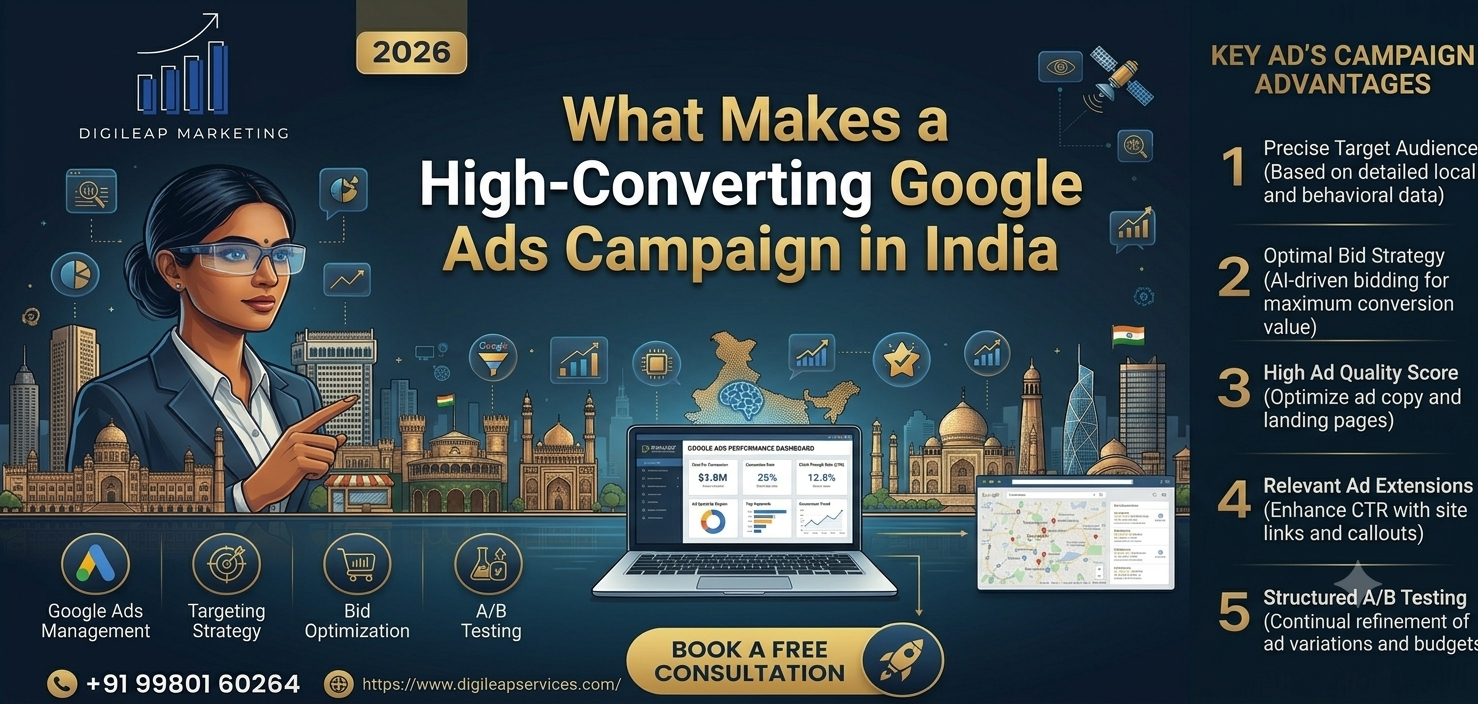
In today’s competitive digital market, businesses need more than clicks to generate revenue. They need the right audience, compelling advertisements, and landing pages that encourage customers to take action. A High-Converting Google Ads India strategy combines these elements to turn advertising spend into qualified leads, sales, and measurable business growth. Whether you run an e-commerce store, a local service business, or a B2B company, the right campaign structure can help you reach potential customers when they are actively searching for your products or services.
However, running Google Ads without a clear strategy can quickly drain your budget. Therefore, businesses must understand customer intent, select relevant keywords, create persuasive ad copy, and measure meaningful results. By focusing on these fundamentals, you can improve campaign performance and build a more profitable advertising strategy.
1. Start with Clear Campaign Goals
Every successful advertising campaign begins with a specific objective. Before launching a High-Converting Google Ads India campaign, decide what you want to achieve. For example, an online store may prioritise purchases, while a dental clinic may want appointment bookings. Similarly, a B2B company may focus on generating enquiries from decision-makers.
Once you define your goal, choose the right campaign type and conversion actions. Search campaigns can connect your business with people actively looking for solutions, while Display, YouTube, and Performance Max campaigns can support broader reach and customer discovery.
Furthermore, set realistic performance targets based on your profit margins, average order value, and customer acquisition costs. Instead of chasing clicks alone, focus on actions that contribute to revenue. This approach gives your campaign a clear direction and helps you make better decisions when allocating your budget.
2. Choose Keywords Based on Search Intent
Keywords determine when your advertisements can appear in search results. Therefore, choosing terms that match customer intent is essential for attracting qualified traffic. For instance, someone searching for “what is digital marketing” may only want information, whereas a person searching for “digital marketing agency in Mumbai” may be ready to contact a provider.
To build a High-Converting Google Ads India campaign, research the phrases your ideal customers use when comparing products, exploring solutions, or preparing to buy. Consider commercial and transactional keywords alongside relevant location-based terms when targeting specific Indian markets.
Additionally, organise keywords into tightly themed ad groups so that your advertisements remain relevant to each search. Use negative keywords to exclude irrelevant queries that waste advertising spend. For example, a premium service provider may exclude terms such as “free course” or “DIY guide” if those searches do not match its offer.
Regularly review your search terms report as well. This allows you to identify valuable queries, remove unwanted traffic, and refine your targeting as customer behaviour changes.
3. Write Compelling and Relevant Ad Copy
Even when your advertisement appears for a relevant search, customers will not necessarily click it. Your message must communicate value quickly and give people a clear reason to choose your business.
Effective ad copy highlights the benefits customers care about most. Depending on your offering, these benefits may include transparent pricing, expert support, fast delivery, flexible packages, or proven experience. Moreover, include your primary keyword naturally in the headline or description when appropriate.
A High-Converting Google Ads India campaign should also use a specific call to action. Phrases such as “Book Your Consultation,” “Get a Free Quote,” or “Shop the Collection” tell customers what to do next.
However, avoid exaggerated claims and vague promises. Instead, explain what makes your business different and ensure every claim reflects the actual service you provide. Use multiple relevant headlines and descriptions, then review their performance over time. Consequently, you can discover which messages attract the most valuable customers rather than simply generating more clicks.
4. Create Landing Pages That Encourage Action
Getting visitors to your website is only the first step. Your landing page must persuade them to complete the next action. If your advertisement promotes a particular service but sends visitors to a generic homepage, customers may struggle to find the information they need.
For a High-Converting Google Ads India campaign, create landing pages that closely match the keywords, advertisements, and offers you promote. Use a clear headline, explain the benefits, display relevant pricing or service information, and provide a prominent call to action.
Furthermore, make your website mobile-friendly because customers across India may discover and contact businesses using smartphones. Ensure that pages load quickly, forms work properly, and important information remains easy to access on smaller screens.
Trust also plays an important role. Therefore, include genuine customer testimonials, relevant case studies, business contact details, and other credible proof where appropriate. At the same time, remove unnecessary form fields and distractions that could prevent visitors from completing their enquiries.
A well-designed landing page creates a smooth journey from the initial search to the final conversion.
5. Use Conversion Tracking and Data Effectively
Without accurate measurement, you cannot determine whether your advertising investment produces meaningful results. Conversion tracking helps you understand which campaigns, keywords, and advertisements generate valuable customer actions.
According to Google Ads Help, conversion rate measures the number of conversions relative to eligible ad interactions. For example, if 1,000 eligible interactions generate 50 conversions, the conversion rate is 5%.
Therefore, set up tracking for relevant actions, such as completed purchases, submitted enquiry forms, booked appointments, or qualified phone calls. Where possible, connect your advertising data with your CRM to understand which enquiries become paying customers.
Google’s official conversion tracking guide explains how measurement tools help advertisers evaluate the impact of their campaigns.
Additionally, monitor cost per lead, cost per acquisition, conversion rate, and return on ad spend. These metrics reveal more about campaign profitability than impressions or clicks alone. For lead-generation businesses, tracking qualified leads and completed sales can provide a clearer picture of actual performance.
6. Optimise Your Budget and Bidding Strategy
A large advertising budget does not automatically produce better results. Instead, businesses should allocate their spending according to campaign objectives, customer demand, and conversion performance.
When building a High-Converting Google Ads India campaign, begin with a budget your business can sustain while collecting enough data to evaluate results. Divide spending according to your priorities, and avoid spreading a limited budget across too many unrelated campaigns.
Google Ads offers bidding strategies designed for different goals. For example, Maximise Conversions can help generate conversions within your budget, while Target CPA aims to achieve conversions around a specified acquisition cost. For e-commerce businesses, Target ROAS can help optimise towards conversion value when sufficient reliable data is available.
Nevertheless, automated bidding works best when conversion tracking is accurate and campaign goals are clearly defined. Review performance regularly, but avoid making frequent, unnecessary changes that disrupt the learning process.
Instead, use your results to identify where additional investment could produce profitable growth. If one campaign generates better-quality leads at a sustainable cost, consider allocating more budget to it after reviewing the supporting data.
7. Improve Performance Through Continuous Testing
A successful campaign requires regular improvement rather than a one-time setup. Customer preferences, competitor offers, search behaviour, and advertising costs can change over time. Consequently, businesses should test different approaches and learn from the results.
For example, compare alternative headlines, calls to action, landing page layouts, and offers. You could test whether highlighting affordability generates more enquiries than emphasising expertise. Similarly, comparing different landing page forms may reveal which version encourages more qualified prospects to submit their details.
However, measure each experiment against a clear objective and allow enough time and data to evaluate its impact. Avoid judging a test solely by click-through rate if your real goal is generating sales.
Also, review device performance, geographic targeting, search terms, and lead quality. If certain locations produce irrelevant enquiries, refine your targeting. If mobile visitors abandon a lengthy form, simplify the process.
For businesses that need expert support, Digileap India can be explored for digital marketing services that support online visibility and business growth. A structured strategy, combined with ongoing measurement, can help businesses make more informed advertising decisions.
8. Understand the Indian Customer Journey
Indian customers often research several options before making a purchase. Therefore, your advertising strategy should support customers at different stages, from discovering a solution to comparing providers and making a final decision.
According to Google India, 80% of Gen Z relies on Google Search for shopping, discovery, research, and decisions. The same report states that 87% of Indian consumers surveyed had discovered a new brand, product, or retailer on Google and YouTube.
These statistics highlight the importance of reaching customers with relevant messages throughout their decision-making process. For example, a business can use Search ads to capture high-intent queries and remarketing campaigns to reconnect with previous website visitors where appropriate.
Moreover, consider regional preferences, language, location, pricing, and payment expectations when creating campaigns for different Indian audiences. A campaign targeting customers in Bengaluru may require different messaging from one targeting customers in a smaller city. By understanding these differences, businesses can create more relevant advertising experiences and improve the likelihood of meaningful conversions.
Conclusion
A successful Google Ads campaign depends on the right combination of audience targeting, relevant keywords, persuasive ad copy, effective landing pages, and accurate conversion tracking. Furthermore, continuous testing helps businesses identify opportunities to improve results without wasting their advertising budgets.
Ultimately, businesses should measure success through qualified leads, completed sales, and profitable customer acquisition rather than clicks alone. With a clear strategy and consistent optimisation, Google Ads can become a valuable channel for sustainable business growth in India.
TL;DR
A high-converting campaign starts with clear business goals and relevant keywords. Create compelling advertisements, direct users to focused landing pages, and track meaningful conversions. Additionally, optimise bidding strategies, test different approaches, and evaluate lead quality regularly. By aligning every campaign decision with customer intent and business outcomes, Indian businesses can improve advertising efficiency and generate better returns on their investment.