
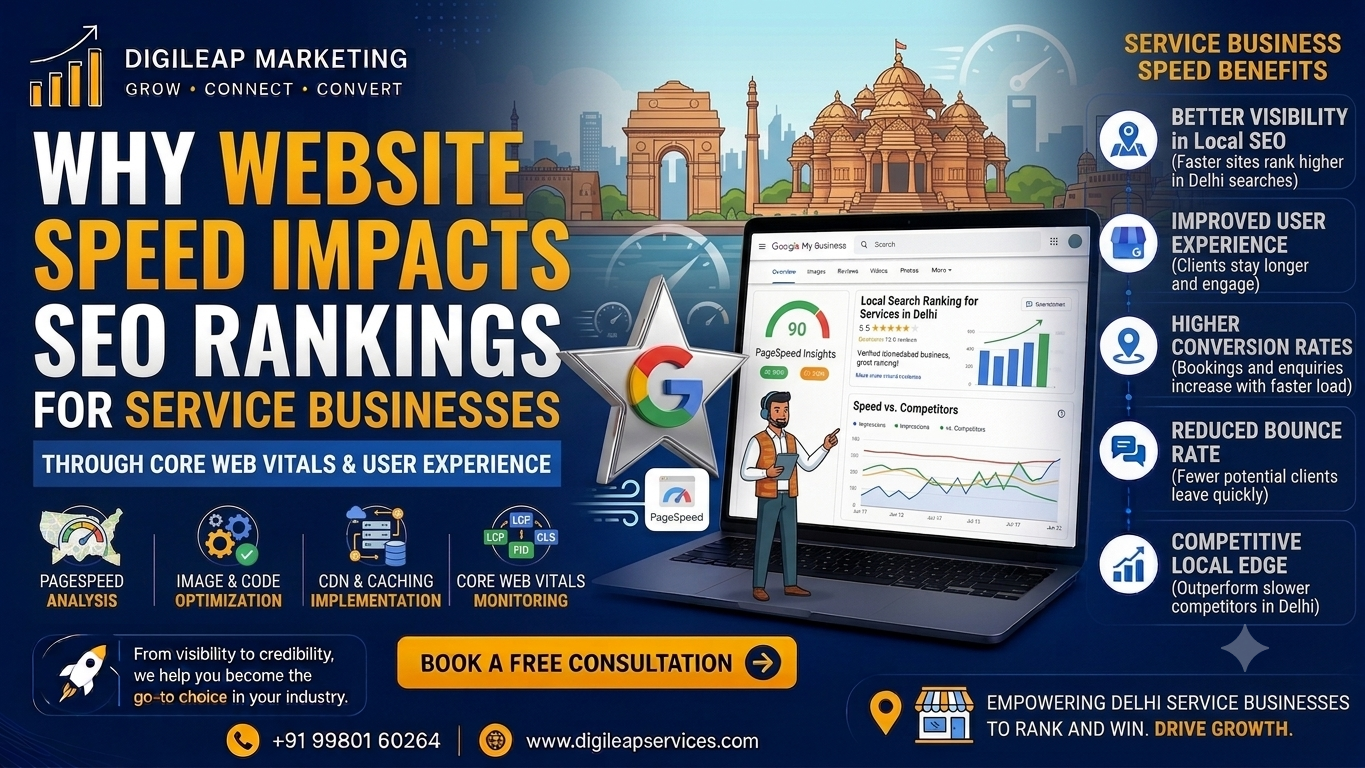
Why Website Speed Impacts SEO Rankings for Service Businesses
Website speed can influence how people discover, use, and trust a service business online. When someone searches for a plumber, clinic, lawyer, consultant, agency, or home service provider, they usually expect the website to load quickly and provide the information they need without delay. Therefore, Website Speed SEO India has become an important part of building a strong search presence. A fast website can improve user experience, support better engagement, and make it easier for search engines to crawl and understand a site. For service businesses competing in crowded Indian markets, even small improvements in speed can contribute to a better overall digital experience.
Speed matters because customers often make decisions quickly. If a website takes too long to load, visitors may leave before they see the company’s services, pricing, contact details, or reviews. Consequently, businesses can lose potential leads even when their SEO content and services are strong. Website performance should therefore be treated as both an SEO consideration and a business growth factor.
Why Website Speed Matters for SEO
Search engines aim to provide users with useful results that also offer a good experience. Website performance is one part of that experience. Google introduced Core Web Vitals to measure important aspects of page experience, including loading performance, responsiveness, and visual stability. These measurements help website owners understand how users experience their pages.
For service businesses, this becomes especially important because the website often acts as the first point of contact. A visitor may discover a business through Google Search, click the result, and expect the page to load almost immediately. If the page feels slow or unstable, the visitor may return to the search results and choose another company instead.
Therefore, Website Speed SEO India should not be viewed as a technical task that only developers need to understand. Marketing teams, business owners, and SEO professionals should also pay attention to speed because it can affect how effectively organic traffic turns into enquiries.
Slow Websites Can Hurt User Experience
Imagine someone searching for an emergency electrician on a mobile phone. They click a promising result, but the website takes several seconds to load. Meanwhile, the customer is waiting for a phone number or service information. Instead of waiting, they may simply return to Google and contact another provider.
This situation can happen across almost every service industry. A patient looking for a clinic, a homeowner searching for a contractor, or a company looking for a consultant may all expect quick access to information.
A fast website removes unnecessary friction. Visitors can quickly understand what the business offers, find contact information, read important details, and take action. As a result, better speed can support a smoother customer journey.
Speed also influences how professional a business appears. A website that loads quickly and responds smoothly can create a stronger first impression. Conversely, a slow website can make even an excellent service provider appear outdated or unreliable.
Mobile Speed Is Especially Important in India
Indian consumers increasingly access websites through smartphones. According to DataReportal’s Digital 2026 India report, India had approximately 1.03 billion internet users at the end of 2025. The report also noted that internet penetration had reached around 70% of the country’s population
This makes mobile performance particularly important for Indian service businesses. Customers may discover a company while travelling, commuting, shopping, or simply using their phones at home. They may not always have a fast or stable connection.
Consequently, businesses should not optimise websites only for desktop users. Pages should load efficiently on smartphones and remain easy to navigate on smaller screens. Images, scripts, fonts, videos, and other elements should not unnecessarily slow down the mobile experience.
A strong Website Speed SEO India strategy therefore considers real-world mobile conditions rather than relying only on performance from a high-speed office connection.
Core Web Vitals and Search Performance
Core Web Vitals provide three key measurements that website owners should understand. Largest Contentful Paint, or LCP, measures loading performance. Interaction to Next Paint, or INP, measures responsiveness. Cumulative Layout Shift, or CLS, measures visual stability. Google uses these metrics as part of its broader page experience signals.
These measurements are useful because they focus on what visitors actually experience. A page may technically appear to load quickly while still feeling frustrating if buttons do not respond or content keeps moving around.
For service businesses, these problems can directly affect conversions. If a visitor tries to tap a call button but the page is still processing scripts, the customer may become frustrated. Similarly, if a form moves while the user is trying to complete it, the experience becomes unnecessarily difficult.
Improving Core Web Vitals can therefore contribute to a better user experience while supporting broader technical SEO improvements.
Faster Pages Can Support Better Engagement
Website speed can influence what visitors do after landing on a page. When pages load quickly, people can move between service pages, read FAQs, view testimonials, and explore contact options without unnecessary delays.
However, speed alone does not guarantee engagement. The content still needs to answer customer questions and provide a clear next step. A fast website with poor content will not automatically generate leads.
That is why speed should work alongside good SEO copy, intuitive navigation, strong calls to action, and useful service information. When these elements work together, visitors have fewer reasons to leave.
For example, a local dental clinic could have a fast treatment page with clear information, patient FAQs, appointment options, and location details. A visitor can quickly find what they need and contact the clinic. In contrast, a slow page can interrupt that journey before the customer even reads the content.
Speed Can Affect Conversion Opportunities
Service businesses usually depend on enquiries, bookings, calls, consultations, or quote requests. Therefore, website performance can have a direct relationship with revenue opportunities.
Suppose a company receives 10,000 monthly organic visitors. If a portion of those visitors leave because the website is slow, the business loses opportunities before visitors even interact with its services.
Improving Website Speed SEO India can help reduce unnecessary friction throughout the conversion journey. Faster pages allow visitors to reach important information sooner, while a responsive website makes it easier to complete forms, click buttons, and contact the business.
This does not mean that every speed improvement will automatically increase sales. Instead, speed removes one potential obstacle. When combined with strong content and a clear conversion path, that improvement can support better performance.
Large Images Often Slow Down Websites
Images are essential for service businesses because they can demonstrate work, facilities, products, teams, projects, or locations. However, large unoptimised images can significantly increase page weight.
For example, a company may upload a high-resolution photograph directly from a camera without resizing or compressing it. The image may look excellent, but loading the original file can consume unnecessary bandwidth.
Businesses should therefore resize images to appropriate dimensions, compress them without damaging quality, and use modern formats where suitable. They should also avoid loading large images that visitors never need to see.
Image optimisation can provide a relatively straightforward starting point for improving page performance. Furthermore, descriptive image filenames and alt text can support accessibility and image understanding without adding unnecessary keyword repetition.
Too Many Scripts Can Create Delays
Websites often use third-party tools for analytics, chat widgets, advertising pixels, appointment systems, social feeds, heatmaps, and other functions. While these tools can be useful, adding too many scripts can increase the amount of work a browser must perform.
As a result, businesses should regularly review their third-party integrations. If a tool no longer serves a meaningful purpose, removing it may improve performance. Developers can also use techniques such as script deferral and asynchronous loading where appropriate.
The goal is not to eliminate every website feature. Instead, businesses should maintain a balance between functionality and performance. Every additional feature should provide enough value to justify its impact on the user experience.
Hosting and Server Response Also Matter
A website can have well-optimised content and images but still feel slow if the server takes too long to respond. Hosting quality, server location, traffic levels, configuration, and caching can all influence response times.
Service businesses should therefore choose hosting that can handle their website’s traffic and technical requirements. They should also use caching and content delivery solutions when appropriate.
For businesses serving customers across India, performance should be evaluated from different locations and devices. A website that performs well for someone sitting next to the server may not provide the same experience for every visitor.
This is another reason why Website Speed SEO India should involve real performance testing rather than relying only on a single desktop speed score.
Use Google’s Performance Tools
Businesses do not need to guess whether their websites are slow. Tools such as Google PageSpeed Insights can provide useful performance information and identify potential opportunities for improvement. (pagespeed.web.dev)
Website owners can use these tools to check important pages, including the homepage, main service pages, contact pages, and landing pages that receive organic traffic.
However, businesses should avoid obsessing over a perfect numerical score. A speed tool provides diagnostic information, but real users and business outcomes matter too. A website should be fast, stable, accessible, and easy to use rather than simply optimised to achieve an arbitrary score.
SEO teams should combine performance data with Search Console information, analytics, conversion data, and customer feedback. This broader view helps identify which improvements are most valuable.
Speed Should Be Part of Technical SEO
Technical SEO covers many elements that help search engines access, understand, and evaluate a website. Website speed fits naturally into this wider process.
A technically healthy website should have a logical structure, crawlable pages, clean internal links, mobile-friendly layouts, secure connections, useful metadata, and strong performance. When these elements work together, search engines can process the site more efficiently while users receive a better experience.
Therefore, businesses should not treat speed as a one-time project. Website updates can introduce new scripts, plugins, images, animations, and tracking tools that gradually reduce performance.
Regular monitoring can identify these problems before they become significant. This ongoing approach is especially valuable for service businesses that depend heavily on organic traffic.
Local Service Businesses Need Every Advantage
Service businesses often compete against companies with larger advertising budgets and stronger brand recognition. SEO can help smaller businesses attract customers without relying entirely on paid advertising.
However, ranking is only part of the challenge. Once a customer clicks on a search result, the website needs to deliver a good experience. A slow page can weaken the value of the SEO work that brought the visitor there in the first place.
That is why Website Speed SEO India should be considered alongside local SEO, content strategy, Google Business Profile optimisation, technical SEO, and conversion optimisation.
For example, a local physiotherapy clinic may rank well for treatment-related searches. If its website loads quickly, provides useful information, displays reviews, and offers a simple appointment process, organic visitors have a clearer path toward becoming patients.
How Digileap India Can Support Website SEO
Improving website speed is only one part of building a successful search strategy. Businesses also need strong keyword research, useful content, technical optimisation, local SEO, conversion-focused landing pages, and regular performance monitoring.
Businesses looking to strengthen their digital presence can explore Digileap SEO and digital marketing services to develop a strategy that connects technical performance with broader marketing goals.
A well-optimised website should not simply attract visitors. It should help those visitors find answers, understand the service, trust the business, and take action.
Why Speed Improvements Should Be Ongoing
Website performance can change over time. A site may be fast after development but become slower as businesses add new pages, plugins, tracking tools, images, videos, and other features.
Therefore, website speed should become part of routine SEO maintenance. Businesses can periodically review Core Web Vitals, test important pages, compress new images, remove unnecessary scripts, and check whether new functionality affects performance.
This ongoing process can make a meaningful difference because small technical problems are easier to fix before they become major issues.
Furthermore, search behaviour continues to change. As more customers use mobile devices and expect instant access to information, businesses need to keep improving their digital experiences. A website that performed well two years ago may need optimisation today.
The Business Value of a Fast Website
Ultimately, website speed is not simply about pleasing search engines. It is about making it easier for customers to interact with a business.
A fast website can help visitors reach important information quickly. It can make navigation smoother, reduce frustration, support conversions, and create a more professional impression. At the same time, strong technical performance can complement broader SEO efforts.
For Indian service businesses, this combination is increasingly important. Customers have plenty of options online, and switching between competitors takes only a few seconds. Consequently, businesses should remove as many unnecessary barriers as possible.
A strong Website Speed SEO India strategy focuses on real users first. By improving loading performance, mobile usability, responsiveness, image optimisation, hosting, and technical efficiency, businesses can create websites that are easier to use and better prepared for organic search.
Conclusion
Website speed plays an important role in the SEO and customer experience of service businesses. While speed alone will not guarantee higher rankings, poor performance can create friction that affects users and weakens the overall effectiveness of a website.
Businesses should therefore monitor Core Web Vitals, optimise images, reduce unnecessary scripts, improve hosting performance, test mobile experiences, and review website performance regularly. Most importantly, they should connect these technical improvements with useful content and clear conversion paths.
When Website Speed SEO India becomes part of a broader SEO strategy, service businesses can create faster, more useful websites that give visitors a better reason to stay, explore, and enquire.
TL;DR
Website Speed SEO India matters because customers expect service websites to load quickly and work smoothly, especially on mobile devices. Faster websites can improve user experience, support conversions, and complement technical SEO. Businesses should optimise images, reduce unnecessary scripts, improve server performance, monitor Core Web Vitals, and test important pages regularly. Most importantly, speed should work alongside high-quality content, local SEO, strong calls to action, and a user-friendly website.